New Outer Bounds on the Capacity Region of Gaussian Interference Channels
Recent outer bounds on the capacity region of Gaussian interference channels are generalized to $m$-user channels with $m>2$ and asymmetric powers and crosstalk coefficients. The bounds are again shown to give the sum-rate capacity for Gaussian inter…
Authors: Xiaohu Shang, Gerhard Kramer, Biao Chen
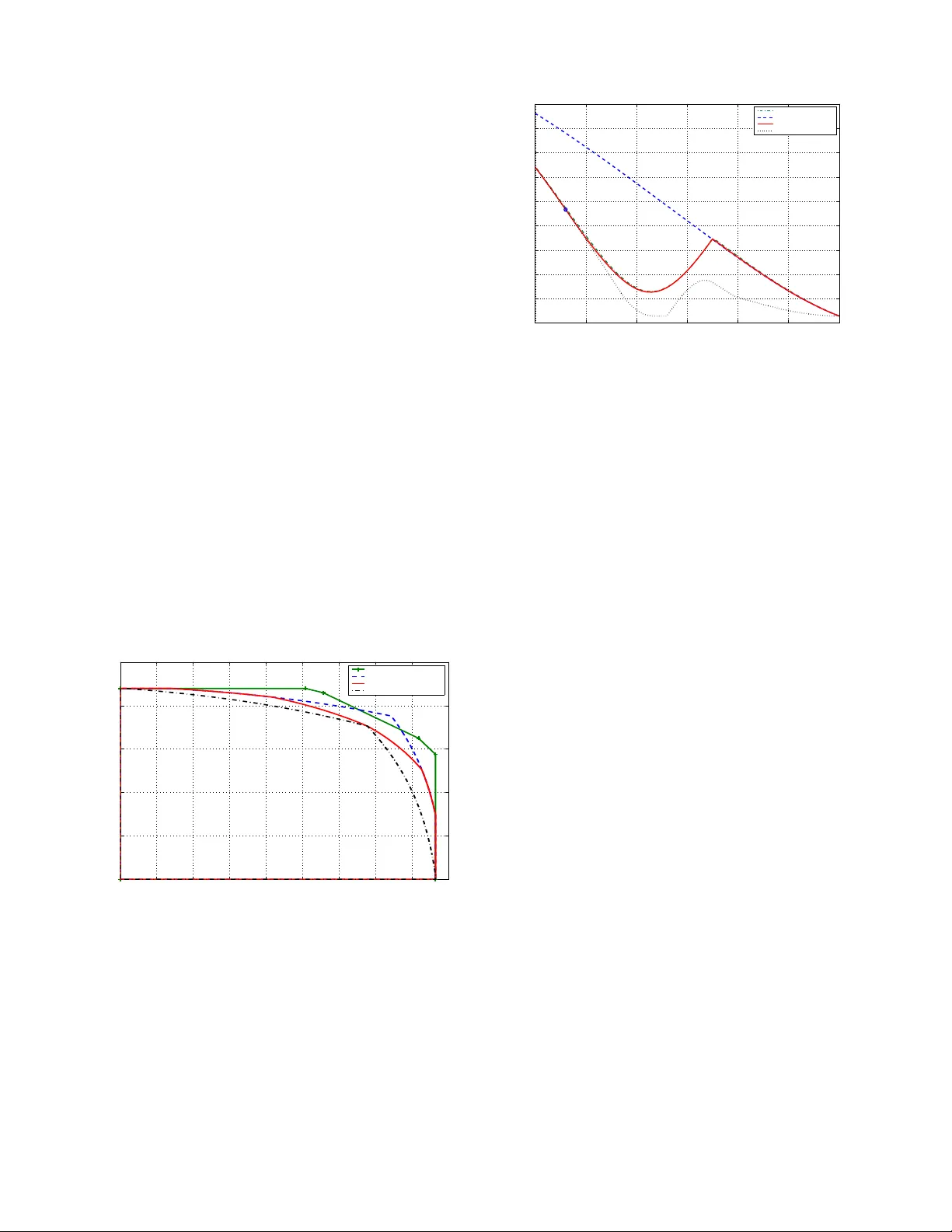
Ne w Outer Bounds on the Ca pacity Re g ion of Gaussian Interf erence Channels Xiaohu Shang Syracuse University Departmen t of EECS Email: xshang @syr .edu Gerhard Kramer Bell Lab s Alcatel-Lucen t Email: gk r@research.b ell-labs.com Biao Chen Syracuse University Departmen t of EECS Email: bichen@ecs.syr .edu Abstract — Recent outer bounds on the capacity r egion of Ga us- sian interference channels are genera lized to m -user channels with m > 2 and asymmetric p owers and cro sstalk coefficients. The bounds are aga in shown to giv e the sum-rate capacity for Gaussian interference chann els wi th low powers and crossta lk coefficients. The ca pacity is achie ved by using single-user detec- tion at each r eceiv er , i.e., treating the interfere nce as noise incurs no loss in perf ormance. Index terms — capacity , Gaussian noise, interference. I . I N T R O D U C T I O N This paper extends the results of [1] to asymmetric Gaussian ICs. The p aper fur ther has a new Theo rem (Th eorem 4) that is not in [2] or in other recent works (see Section V and Motahari and Khand ani [3], and Annap ureddy and V eera valli [4 ]). The interfer ence channel (IC) models com munication sys- tems where transmitters communicate with their respec ti ve receivers while causing interfer ence to all o ther recei vers. For a two-user Gaussian IC, the channel ou tput can be written in the standa rd form [5] Y 1 = X 1 + √ aX 2 + Z 1 , Y 2 = √ bX 1 + X 2 + Z 2 , where √ a an d √ b are chann el coefficients, X i and Y i are the tr ansmit and receiv e signals. The user/channel input se- quence X i 1 , X i 2 , · · · , X in is sub ject to the power constraint P n j =1 E ( X 2 ij ) ≤ nP i , i = 1 , 2 . The transmitted signals X 1 and X 2 are statistically inde penden t. The chann el noises Z 1 and Z 2 are possibly correlated unit variance Gaussian random variables, and ( Z 1 , Z 2 ) is statistically ind ependen t of ( X 1 , X 2 ) . I n the following, we denote th is Gau ssian IC as IC ( a, b, P 1 , P 2 ) . The capacity region o f an IC is define d as the clo sure of the set o f rate pair s ( R 1 , R 2 ) for which both receiv ers can decode their own messages with arbitra rily small positi ve error probab ility . T he capacity r egion of a Gaussian IC is kn own only for three cases: (1 ) a = 0 , b = 0 . (2) a ≥ 1 , b ≥ 1 : see [6]–[8 ]. (3 ) a = 0 , b ≥ 1 ; o r a ≥ 1 , b = 0 : see [9 ]. For the second case both rec eiv ers can decode the messages of both transmitters. Thus this I C acts as two m ultiple access channels (MA Cs), and th e capac ity region for the IC is th e intersectio n of the capacity r egion of the two MA Cs. Ho we ver , when the interferen ce is weak o r moder ate, the capacity region is still unknown. The best inn er boun d is obta ined in [8] b y using superpo sition codin g and join t decoding . A simplified form of the H an-K obayash i region w as gi ven b y Chong-Motani- Garg-El Gamal [ 10], [11 ]. V arious ou ter boun ds have b een developed in [12] –[16] . Kramer in [14] pre sented two o uter bound s. The first is ob tained by p roviding each receiver with just en ough inf ormation to decode b oth messages. The second is obtained by redu cing th e IC to a degraded broadcast channel. Both bounds dominate the bound s by Sato [1 2] and Carleial [13]. Th e recen t outer b ound s by Etkin , Tse, and W an g in [15] are also based on genie- aided method s, and they show that Han an d K obay ashi’ s inner bou nd is within one bit o r a factor of two of the c apacity region. T his result can also be established by the method s of T elatar and Tse [16 ]. W e r emark that neither of the bound s of [1 4] and [15] imp lies each other . Numerical results show that the bou nds of [14] are better at low SNR while those of [15] are better at high SNR. The bound s of [1 6] are not a menable to numerical evaluation since the optimal distributions of the auxiliar y r andom variables ar e unknown. In th is paper , we present new outer bo unds on the capacity region of Gaussian ICs that g eneralize results of [1] . The new bound is ba sed o n a gen ie-aided approach and an e xtremal inequality propo sed by Liu and V iswanath [17]. Based o n this outer bound , we ob tain new sum-r ate capacity results for ICs satisfying some channel coefficient and power co nstraint con- ditions. W e show that the sum-r ate ca pacity can be ach iev ed by treatin g the interfer ence as no ise when b oth th e ch annel gain and th e p ower constra int a re weak. W e say that such channels have noisy interfer en ce . For this class of in terference , the simple single-user tran smission and d etection strategy is sum-rate optimal. This p aper is organized as follows. In Sectio n I I, we pr esent an outer b ound and the resulting sum-rate capa city f or certain 2 -user Gaussian ICs. An extension of th e sum -rate capacity under n oisy in terference to m -user ICs is provid ed in Sectio n III. Nume rical examples are giv en in Section I V , and Sectio n V conclu des the paper . I I . A G E N I E - A I D E D O U T E R B O U N D A. General outer boun d The following is a new outer boun d o n the cap acity region of Gaussian ICs. Note that in contrast to [1] these bo unds permit P 1 6 = P 2 and a 6 = b . R 1 + µR 2 ≤ min ρ i ∈ [0 , 1] ( σ 2 1 ,σ 2 2 ) ∈ Σ 1 2 log 1 + P ∗ 1 σ 2 1 − 1 2 log aP ∗ 2 + 1 − ρ 2 1 + 1 2 log 1 + P 1 + aP 2 − ( P 1 + ρ 1 σ 1 ) 2 P 1 + σ 2 1 + µ 2 log 1 + P ∗ 2 σ 2 2 − µ 2 log bP ∗ 1 + 1 − ρ 2 2 + µ 2 log 1 + P 2 + bP 1 − ( P 2 + ρ 2 σ 2 ) 2 P 2 + σ 2 2 (1) R 1 + η 1 R 2 ≤ 1 2 log 1 + bη 1 − 1 b − b η 1 − η 1 2 log 1 + bη 1 − 1 1 − η 1 + η 1 2 log (1 + bP 1 + P 2 ) (2) R 1 + η 2 R 2 ≤ 1 2 log (1 + P 1 + aP 2 ) − 1 2 log 1 + a − η 2 η 2 − 1 + η 2 2 log 1 + a − η 2 aη 2 − a . (3) Theor em 1: If the rates ( R 1 , R 2 ) are achiev able for IC ( a, b, P 1 , P 2 ) with 0 < a < 1 , 0 < b < 1 , they must satis fy the follo wing co nstraints (1)-(3) for µ > 0 , 1+ bP 1 b + bP 1 ≤ η 1 ≤ 1 b and a ≤ η 2 ≤ a + aP 2 1+ aP 2 , where Σ = n σ 2 1 , σ 2 2 | σ 2 1 > 0 , 0 < σ 2 2 ≤ 1 − ρ 2 1 a o , if µ ≥ 1 , n σ 2 1 , σ 2 2 | 0 < σ 2 1 ≤ 1 − ρ 2 2 b , σ 2 2 > 0 o , if µ < 1 , (4) and if µ ≥ 1 we d efine P ∗ 1 = P 1 , σ 2 1 ≤ h (1 − µ ) P 1 µ + 1 − ρ 2 2 bµ i + , 1 − ρ 2 2 − bµσ 2 1 bµ − b , h (1 − µ ) P 1 µ + 1 − ρ 2 2 bµ i + < σ 2 1 ≤ 1 − ρ 2 2 bµ , 0 , σ 2 1 > 1 − ρ 2 2 bµ , (5) P ∗ 2 = P 2 , σ 2 2 ≤ 1 − ρ 2 1 a , (6) where ( x ) + , max { x, 0 } , and if 0 < µ < 1 we define P ∗ 1 = P 1 , σ 2 1 ≤ 1 − ρ 2 2 b , (7) P ∗ 2 = P 2 , σ 2 2 ≤ ( µ − 1) P 2 + µ ( 1 − ρ 2 1 ) a + , µ ( 1 − ρ 2 1 ) − aσ 2 2 a − aµ , ( µ − 1) P 2 + µ ( 1 − ρ 2 1 ) a + < σ 2 2 ≤ µ ( 1 − ρ 2 1 ) a , 0 , σ 2 2 > µ ( 1 − ρ 2 1 ) a . (8) Pr oo f: W e gi ve a sketch of the pr oof. A genie provide s the two receiv ers with side informa tion X 1 + N 1 and X 2 + N 2 respectively , wh ere N i is Gaussian distributed with variance σ 2 i and E ( N i Z i ) = ρ i σ i , i = 1 , 2 . Startin g from Fano’ s ineq uality , we have n ( R 1 + µR 2 ) − nǫ ≤ I ( X n 1 ; Y n 1 ) + µI ( X n 2 ; Y n 2 ) ≤ I ( X n 1 ; Y n 1 , X n 1 + N n 1 ) + µI ( X n 2 ; Y n 2 , X n 2 + N n 2 ) = h h ( X n 1 + N n 1 ) − µh √ bX n 1 + Z n 2 | N n 2 i − h ( N n 1 ) + µh ( X n 2 + N n 2 ) − h √ aX n 2 + Z n 1 | N n 1 − µh ( N n 2 ) + h ( Y n 1 | X n 1 + N n 1 ) + µh ( Y n 2 | X n 2 + N n 2 ) , (9) where ǫ → 0 as n → ∞ . For h ( Y n 1 | X n 1 + N n 1 ) , zero-m ean Gaussian X n 1 and X n 2 with co variance m atrices P 1 I an d P 2 I are optimal, an d we have h ( Y n 1 | X n 1 + N n 1 ) ≤ n 2 log " 2 π e 1 + a P 2 + P 1 − ( P 1 + ρ 1 σ 1 ) 2 P 1 + σ 2 1 !# . (10) From th e extremal ineq uality in troduced in [17 , Th eorem 1, Corollary 4], we ha ve h ( X n 1 + N n 1 ) − µh √ bX n 1 + Z n 2 | N n 2 (11) ≤ n 2 log 2 π e P ∗ 1 + σ 2 1 − nµ 2 log 2 π e bP ∗ 1 + 1 − ρ 2 2 , and µh ( X n 2 + N n 2 ) − h √ aX n 2 + Z n 1 | N n 1 (12) ≤ nµ 2 log 2 π e P ∗ 2 + σ 2 2 − µ 2 log 2 π e aP ∗ 2 + 1 − ρ 2 1 , where eq ualities h old whe n X n 1 and X n 2 are both Gaussian with covariance matrices P ∗ 1 I and P ∗ 2 I respectively . Fr om (9)- (12) we ob tain the outer bo und (1). The outer bound in (2) (resp. ( 3)) is obtained by letting the genie provide si de informatio n X 2 to receiver one (resp. X 1 to receiver two), an d applying the extremely ineq uality , i.e., n ( R 1 + η 1 R 2 ) − nǫ ≤ I ( X n 1 ; Y n 1 , X n 2 ) + η 1 I ( X n 2 ; Y n 2 ) = h ( X n 1 + Z n 1 ) − η 1 h √ bX n 1 + Z n 2 − h ( Z n 1 ) + η 1 h ( Y n 2 ) ≤ n 2 log ˜ P 1 + 1 − nη 1 2 log b ˜ P 1 + 1 + nη 1 2 log (1 + bP 1 + P 2 ) , (13) where ˜ P 1 = bη 1 − 1 b − bη 1 for 1+ bP 1 b + bP 1 ≤ η 1 ≤ 1 b . This is the bound in (2). Similarly , we obtain b ound (3). Remark 1: The bou nds (1)-(3) ar e ob tained by providing different g enie-aided signals to the r eceivers. Th ere is overlap of the range of µ , η 1 , and η 2 , and none of the boun ds u niform ly dominates the o ther two bound s. Remark 2: Equation s (2) and (3) are outer b ounds for the capacity region of a Z-IC, and a Z-IC is equiv alent to a degraded IC [9]. For such channels, it can b e sh own that (2) and (3) a re the same as the oute r b ound s in [18]. For η 1 = 1+ bP 1 b + bP 1 and η 2 = a + aP 2 1+ aP 2 , the boun ds in (2) and (3) are tight for a Z-IC (or degraded IC) because ˜ P 1 = P 1 , ˜ P 2 = P 2 in (13), an d ther e is no po wer sharing between the tran smitters. Consequently , 1+ bP 1 b + bP 1 and a + aP 2 1+ aP 2 are the negative slopes of the tangent lines for th e capac ity region at the corner points. Remark 3: The boun ds in (2)-(3) tu rn out to be the same as the bound s in [14 , Theorem 2]. T his can be sho wn by re writing the boun ds in [14, Theor em 2] in the form of a weighted sum rate. Remark 4: The bou nds in [14, Theorem 2] are obtained by getting rid of one of the interf erence link s to reduce the IC into a Z-IC. In addition, the proo f in [1 4] allowed th e transmitters to share their p ower , which furthe r redu ces the Z-IC into a degraded broadcast channel. Then the cap acity region of this degraded broad cast channel is an ou ter boun d for the cap acity re gion of the original IC. T he bounds in (2) a nd (3) are also ob tained b y red ucing the IC to a Z-IC. Although we d o no t explicitly allow the transmitters to share their power , it is interesting that these bo unds are equi valent to the bounds in [ 14, Th eorem 2] with power sharin g. In fact, a c areful examinatio n of our deri vation reveals that p ower sharing is implicitly assumed. For example, for the term h ( X n 1 + Z n 1 ) − η 1 h √ bX n 1 + Z n 2 of (13), user 1 uses p ower ˜ P 1 = bη 1 − 1 b − bη 1 ≤ P 1 , while fo r th e te rm η 1 h ( Y n 2 ) user 1 uses all the po wer P 1 . This is eq uiv alent to letting user 1 use the power ˜ P 1 for b oth terms, and letting u ser 2 use a power that exceeds P 2 . Remark 5: Theorem 1 improves [15, Theorem 3]. Specifi- cally , the bo und in (2) is tighter than the first sum -rate b ound of [ 15, Theo rem 3]. Similarly , the bou nd in (3) is tig hter than the second sum-r ate bound of [15, Theor em 3]. The third sum- rate bo und in [15, Theor em 3] is a special case of (1). Remark 6 : Our outer boun d is n ot always tigh ter than that of [15] for all rate points. The reason is that in [15 , last tw o equations of (39)], dif ferent g enie-aided signals a re provided to the sam e r eceiv er . Our ou ter bou nd can also be im proved in a similar and more gene ral way b y providing different genie- aided sign als to the r eceiv ers. Sp ecifically the starting poin t of the bo und can be mod ified to be n ( R 1 + µR 2 ) ≤ k X i =1 λ i I ( X n 1 ; Y n 1 , U i ) + m X j =1 µ i I ( X n 2 ; Y n 2 , W j ) + nǫ, (14) where P k i =1 λ i = 1 , P m j =1 µ j = µ, λ i > 0 , µ j > 0 . B. Sum-rate capacity for noisy interfer ence The o uter boun d in Theorem 1 is in the fo rm of a n optimization problem. F our parameters ρ 1 , ρ 2 , σ 2 1 , σ 2 2 need to be optimized for different choices of the weights µ, η 1 , η 2 . When µ = 1 , the boun d (1) of Theor em 1 leads directly to the fo llowing sum-rate capa city result. Theor em 2: For the IC ( a, b, P 1 , P 2 ) satisfying √ a ( bP 1 + 1) + √ b ( aP 2 + 1) ≤ 1 , (15) the sum-rate cap acity is C = 1 2 log 1 + P 1 1 + a P 2 + 1 2 log 1 + P 2 1 + b P 1 . (16) Pr oo f: By choo sing σ 2 1 = 1 2 b b ( aP 2 + 1) 2 − a ( bP 1 + 1) 2 + 1 ± q [ b ( aP 2 + 1) 2 − a ( bP 1 + 1) 2 + 1] 2 − 4 b ( aP 2 + 1) 2 σ 2 2 = 1 2 a a ( bP 1 + 1) 2 − b ( aP 2 + 1) 2 + 1 ± q [ a ( bP 1 + 1) 2 − b ( aP 2 + 1) 2 + 1] 2 − 4 a ( bP 1 + 1) 2 ρ 1 = q 1 − a σ 2 2 (17) ρ 2 = q 1 − b σ 2 1 , (18) the boun d (1) with µ = 1 is R 1 + R 2 ≤ 1 2 log 1 + P 1 1 + a P 2 + 1 2 log 1 + P 2 1 + b P 1 . (19) But one can achiev e equality in (19) by treating th e interfer- ence as no ise at bo th receivers. In orde r that the choices of σ 2 i and ρ 2 i are feasible, (15) must be satisfied. Remark 7 : Consider the bound (1) with µ = 1 , we further let 1 − ρ 2 1 ≥ aσ 2 2 , 1 − ρ 2 2 ≥ bσ 2 1 . (20) From (5) an d (6) we have P ∗ 1 = P 1 , P ∗ 2 = P 2 . Thus, R 1 ≤ 1 2 log 1 + P 1 σ 2 1 − 1 2 log( aP 2 + 1 − ρ 2 1 ) + 1 2 log 1 + a P 2 + P 1 − ( P 1 + ρ 1 σ 1 ) 2 P 1 + σ 2 1 = 1 2 log " P 1 (1 + aP 2 ) 1 + a P 2 − ρ 2 1 1 σ 1 − ρ 1 1 + a P 2 2 + 1 + P 1 1 + a P 2 # , f ( ρ 1 , σ 1 ) . (21) Therefo re, fo r any gi ven ρ 1 , when ρ 1 σ 1 = 1 + aP 2 , (22) then f ( ρ 1 , σ 1 ) achieves its minimu m which is user 1 ’ s single- user d etection rate. Similarly , we have ρ 2 σ 2 = 1 + bP 1 . Since the constraint in (2 0) must be satis fied, we ha ve 1 + a P 2 ρ 1 ≤ r 1 − ρ 2 2 b , 1 + b P 1 ρ 2 ≤ r 1 − ρ 2 1 a . (23) As long as ther e exists a ρ i ∈ (0 , 1 ) such that (23) is satisfied, we ca n choose σ i to satisfy (22) and hence th e b ound in (1) is tight. By ca ncelling ρ 1 , ρ 2 , we obtain ( 15). Remark 8 : The mo st special choices of ρ 1 , ρ 2 are in (17) and (18), since (11) and (12) with µ = 1 becom e h ( X n 1 + N n 1 ) − h √ bX n 1 + Z n 2 | N n 2 = − n log √ b h ( X n 2 + N n 2 ) − h √ aX n 2 + Z n 1 | N n 1 = − n log √ a. Therefo re, we do not need the extrem al inequality [17] to prove T heorem 2. Remark 9 : T he sum -rate cap acity for a Z-IC with a = 0 , 0 < b < 1 is a special case of Theorem 2 since (15) is satisfied. The sum-rate ca pacity is theref ore gi ven by (16). Remark 10: Theor em 2 f ollows directly from Theor em 1 with µ = 1 . It is remarkable that a ge nie-aided b ound is tigh t if (1 5) is satisfied since the genie provides extra signals to th e receivers without in creasing the rates. This situation is remin iscent of the re cent capacity results f or vector Gaussian b roadcast chann els (see [ 19]). Furtherm ore, the sum- rate cap acity (16) is achieved by treating th e interf erence as noise. W e therefo re refer to ch annels satisfyin g (15) as ICs with noisy interference . Remark 11: For a symmetric IC where a = b , P 1 = P 2 = P , the con straint (15) implies that a ≤ 1 4 , P ≤ √ a − 2 a 2 a 2 . (24) Noisy interfer ence is therefore weaker than weak interfer en ce as defined in [ 9] and [2 0], namely a ≤ √ 1+2 P − 1 2 P or a ≤ 1 2 , P ≤ 1 − 2 a 2 a 2 . (25) Recall that [20 ] showed that for “wea k interfer ence” satisfying (25), treating interfe rence as noise ach iev es larger sum rate than time - or frequency-division multiplexing (TDM/FDM), and [9] claimed that in “weak in terference” the largest known achiev able sum rate is ach iev ed by tr eating the interference as noise. C. Capacity r e gion corner point The b ounds (2) an d (3) of Theor em 1 lead to the f ollowing sum-rate capa city result. Theor em 3: For an IC ( a, b, P 1 , P 2 ) with a > 1 , 0 < b < 1 , the sum- rate capacity is C = 1 2 log (1 + P 1 ) + 1 2 log 1 + P 2 1 + b P 1 (26) when the following condition hold s (1 − ab ) P 1 ≤ a − 1 . (27) A similar result f ollows by swapping a an d b , and P 1 and P 2 . This sum-rate capacity is achieved by a simple scheme : user 1 transmits at th e maximum rate and user 2 tran smits at the rate that both r eceivers can d ecode its message with sin gle- user detection. Su ch a r ate co nstraint was considere d in [9, Theorem 1] which established a co rner p oint of the capacity region. Ho wev er it was pointed out in [20] that the p roof in [9] was flawed. Theor em 3 shows th at the rate pair of [ 20] is in fact a corner point of the capacity region when a > 1 , 0 < b < 1 and ( 27) is satis fied, an d this r ate pair achie ves th e sum-rate capa city . The sum-r ate cap acity of the degrad ed IC ( ab = 1 , 0 < b < 1) is a special case of Theorem 3. Besides this example, there are tw o other kin ds o f ICs to which Th eorem 3 applies. The first case is a b > 1 . In this case, P 1 can be any positive value. The second c ase is ab < 1 and P 1 ≤ a − 1 1 − ab . For b oth cases, the sign als from user 2 can be decoded fir st at both re ceiv ers. I I I . S U M - R A T E C A PAC I T Y F O R m - U S E R I C W I T H N O I S Y I N T E R F E R E N C E For an m - user IC, the receive signal at user i is d efined as Y i = X i + m X j =1 ,j 6 = i √ c j i X j + Z i , i = 1 , 2 , . . . , m, (28) where c j i is the channel gain fro m j th transmitter to i th receiver , Z i is un it-variance G aussian noise, and th e tr ansmit signals h av e th e block power con straints P n l =1 E ( X 2 il ) ≤ nP i . W e have the following sum-rate capacity result. Theor em 4: For an m -u ser IC defined in (28), if there exist ρ i ∈ (0 , 1) , i = 1 , . . . , m , such that the following conditions are satisfied m X j =1 ,j 6 = i c j i (1 + Q j ) 2 ρ 2 j ≤ 1 − ρ 2 i (29) m X j =1 ,j 6 = i c ij 1 + Q j − ρ 2 j ≤ 1 P i + (1 + Q i ) 2 /ρ 2 i , (30) where Q i is the inter ference power at receiv er i , defined as Q i = m X j =1 ,j 6 = i c j i P j , (31) the sum-rate cap acity is C = 1 2 m X i =1 log 1 + P i 1 + Q i (32) Therefo re, if th ere exist ρ 1 , . . . , ρ m , such that (2 9) an d (3 0) are satisfied f or all i = 1 , . . . , m , the sum- rate capacity of a n m -user IC can be achie ved by treating interf erence a s noise. The proo f is om itted due to the space lim itation. It can be shown that Theorem 2 is a special c ase of Theorem 4. Consider a u niformly symmetric m -user IC wh ere c j i = c , for all i, j = 1 , . . . , m, i 6 = j , and P i = P . The bounds (29) and (30) with ρ i = ρ f or all i reduce to c ≤ 1 4( m − 1 ) , P ≤ p ( m − 1) c − 2 ( m − 1 ) c 2( m − 1 ) 2 c 2 . (33) I V . N U M E R I C A L E X A M P L E S A comparison of th e outer bounds fo r a Gaussian IC is giv en in Fig. 1. Some part of the outer b ound from T heorem 1 overlaps with Kramer’ s outer bo und due to ( 2) and (3). Since this IC has noisy interfer ence, the propo sed outer bo und coincides with the inner b ound at the su m rate po int. The lower and upper b ounds for the sum-rate capacity of the symme tric IC are shown in Fig 2 fo r high power level. The upper b ound is tight u p to point A . The bound in [1 5, Theorem 3 ] app roaches the bound in Theor em 1 whe n the power is large, but there is still a gap. Fig. 2 also provides a definitive an swer to a qu estion f rom [20, Fig. 2 ]: whether the sum-rate cap acity of symmetr ic Gaussian IC is a d ecreasing function of a , or th ere e xists a bump lik e the lo we r b ound when a varies fr om 0 to 1 . In Fig . 2 , our prop osed uppe r bou nd an d Sason’ s inner b ound explicitly show that the sum capacity is not a monoton e function of a (this re sult also follows by the bound s o f [15]) . V . C O N C L U S I O N S , E X T E N S I O N S A N D PA R A L L E L W O R K W e de riv ed an ou ter bound for the capacity region of 2 - user Gaussian ICs by a genie-aided m ethod. From this outer bound , th e sum -rate cap acities fo r ICs that satisfy ( 15) o r ( 27) are obtained . The sum-rate capacity f or m -user Gaussian I Cs that satisfy (29) and (30) are also ob tained. Finally , we wish to acknowledge parallel work . After sub- mitting our 2 -user bound s and cap acity results on the arXi v .org e-Print a rchive [2] , two other team s o f researc hers - Motahar i and Khandan i from the Uni versity of W aterlo o, Annapured dy and V eerav alli from the University of Illinois at Ur bana- Champaign - let us know that they derived the same 2 -user sum-rate capa city results (Theor em 2) . Acknowledgement The work of X. Shang and B. Chen was suppo rted in p art by the NSF under Grants 054649 1 and 05015 34, and by the AFOSR un der Grant F A9550 -06-1 -0051 , and by the AFRL under Agreem ent F A87 50-05 -2-01 21. G. Kramer gratefully acknowledges the supp ort of the Board of T rustees of th e University of Illinois Subaward no. 04-2 17 under NSF Grant CCR-0325673 and the Arm y Research Office under AR O Grant W911 NF-06-1- 0182 . 0 0.2 0.4 0.6 0.8 1 1.2 1.4 1.6 1.8 0 0.5 1 1.5 2 2.5 R 1 in bit per channel use R 2 in bit per channel use ETW outer bound Kramer outer bound Proposed outer bound HK inner bound Fig. 1. Inner and outer bounds for the ca pacit y region of Gaussian ICs wit h a = 0 . 04 , b = 0 . 09 , P 1 = 10 , P 2 = 20 . The ETW bound is by E tkin, Tse and W ang in [15, T heorem 3]; the Kramer bound is from [14, Theorem 2]; the HK inner bound is based on [8] by Han and Kobaya shi. R E F E R E N C E S [1] X. Shang, G. Kramer , and B. Chen, “Outer bound and noisy-int erferenc e sum-rate capa city for symmetric Gaussian interferenc e chann els, ” s ub- mitted to CISS 2008. [2] X. Shang, G. Kramer , and B. Chen, “A ne w outer bound and the noisy-interf erence sum-rat e capacity for Gaussian interfer- ence channels, ” submitte d to the IE EE T rans. Inform. Theory . http:// arxiv .org/abs/071 2.1987 , 2007. −30 −25 −20 −15 −10 −5 0 6.5 7 7.5 8 8.5 9 9.5 10 10.5 11 a in dB Sum rate in bit per channel use ETW upper bound Kramer upper bound Upper bound in Theorem 1 Sason lower bound A Fig. 2. Lower and upper bounds for the sum-rate capacity of symmetric Gaussian ICs with a = b, P 1 = P 2 = 5000 . The channel gain at point A is a = − 26 . 99 dB. Sason’ s bound is an inner bound obtained from Han and Ko bayashi’ s bound by a specia l time sharing s cheme [20, T able I]. [3] A. S. Motahari and A. K. Khandani, “Capacity boun ds for th e Gaussian interfe rence channel , ” to be submitted to IEEE T rans. Inform. Theory . [4] V . S. Annapuredd y and V . V eera va lli, “Su m capa city of the Gaussia n interfe rence channel in the low interferen ce re gime, ” submitted to IT A 2008. [5] A.B. Carleia l, “Interf erence Channels, ” IEE E T rans. Inform. Theory , vol. 24, pp. 60–70, J an. 1978. [6] A.B. Carle ial, “A case where inte rference does not reduce capacit y, ” IEEE T ran s. Inform. Theory , vol. 21, pp. 569–570, Sep. 1975. [7] H. Sato, “The capacit y of the Gaussian interferenc e channel under strong interfe rence, ” IE EE T rans. Inform. Theory , vol. 27, pp. 786–788, Nov . 1981. [8] T .S. Han and K. Kobaya shi, “A ne w achie vable rate region for th e interfe rence channel , ” IEEE T rans. Inform. Theory , vol . 27, pp. 49–60, Jan. 1981. [9] M.H.M. Costa, “On the Gaussian interference channel , ” IEEE Tr ans. Inform. Theory , vol. 31, pp. 607–615, Sept. 1985. [10] H.F . Chong, M. Motani, H.K. Gar g, and H.E. Gamal, “On t he Han- Ko bayashi Reg ion for the interferenc e channel , ” submitted to the IEEE T rans. Inform. Theory , 2006. [11] G. Kramer , “Re view of rate regions for interfer ence channels, ” in Internati onal Zurich Seminar , Zurich, Feb.22 -24 2006, pp. 162–165. [12] H. Sato, “T wo-user communica tion channels, ” IEEE T rans. Inform. Theory , vol. 23, pp. 295–304, May 1977. [13] A.B. Carle ial, “Outer bounds on the capacity of int erferen ce channel s, ” IEEE T ran s. Inform. Theory , vol. 29, pp. 602–606, July 1983. [14] G. Krame r , “ Outer boun ds on th e capa city of Gaussia n interfere nce channe ls, ” IEEE T rans. on Inform. Theory , vol. 50, pp. 581–586, Mar . 2004. [15] R. H. Etkin, D. N. C. Tse, and H. W ang, “Gaussi an interfere nce ch annel capac ity to within one bit, ” submitted to the IEEE T rans. Inform. Theory , 2007. [16] E. T elat ar and D. Tse, “Boun ds on the capacity region of a class of inte rference channel s, ” in P r oc. IEEE Internationa l Sy mposium on Informatio n Theory 2007 , Nice, France, Jun. 2007. [17] T . Liu and P . V iswanath, “ An extre mal ineq uality motiv ated by multite rminal information -theoret ic problems, ” IEEE T rans. Inform. Theory , vol. 53, no. 5, pp. 1839–1851, May 2006. [18] H. Sato, “On degraded Gaussian two-user channels, ” IE EE T rans. Inform. Theory , vol. 24, pp. 634–640, Sept. 1978. [19] H. W einga rten, Y . Ste inber g, and S. Shamai (Shit z), “The capac ity region of the Gaussian multiple -input multiple-ou tput broadcast channel, ” IE EE T rans. Inform. Theory , vol. 52, no. 9, pp. 3936–3964, Sep. 2006. [20] I. Sason, “On achi e v able rate regi ons for the Gaussian interfere nce channe ls, ” IE EE T rans. Inform. Theory , v ol. 50, pp. 1345–13 56, June 2004.
Original Paper
Loading high-quality paper...
Comments & Academic Discussion
Loading comments...
Leave a Comment