Fermi, Pasta, Ulam and a mysterious lady
It is reported that the numerical simulations of the Fermi-Pasta-Ulam problem were performed by a young lady, Mary Tsingou. After 50 years of omission, it is time for a proper recognition of her decisive contribution to the first ever numerical exper…
Authors: Thierry Dauxois (Phys-ENS)
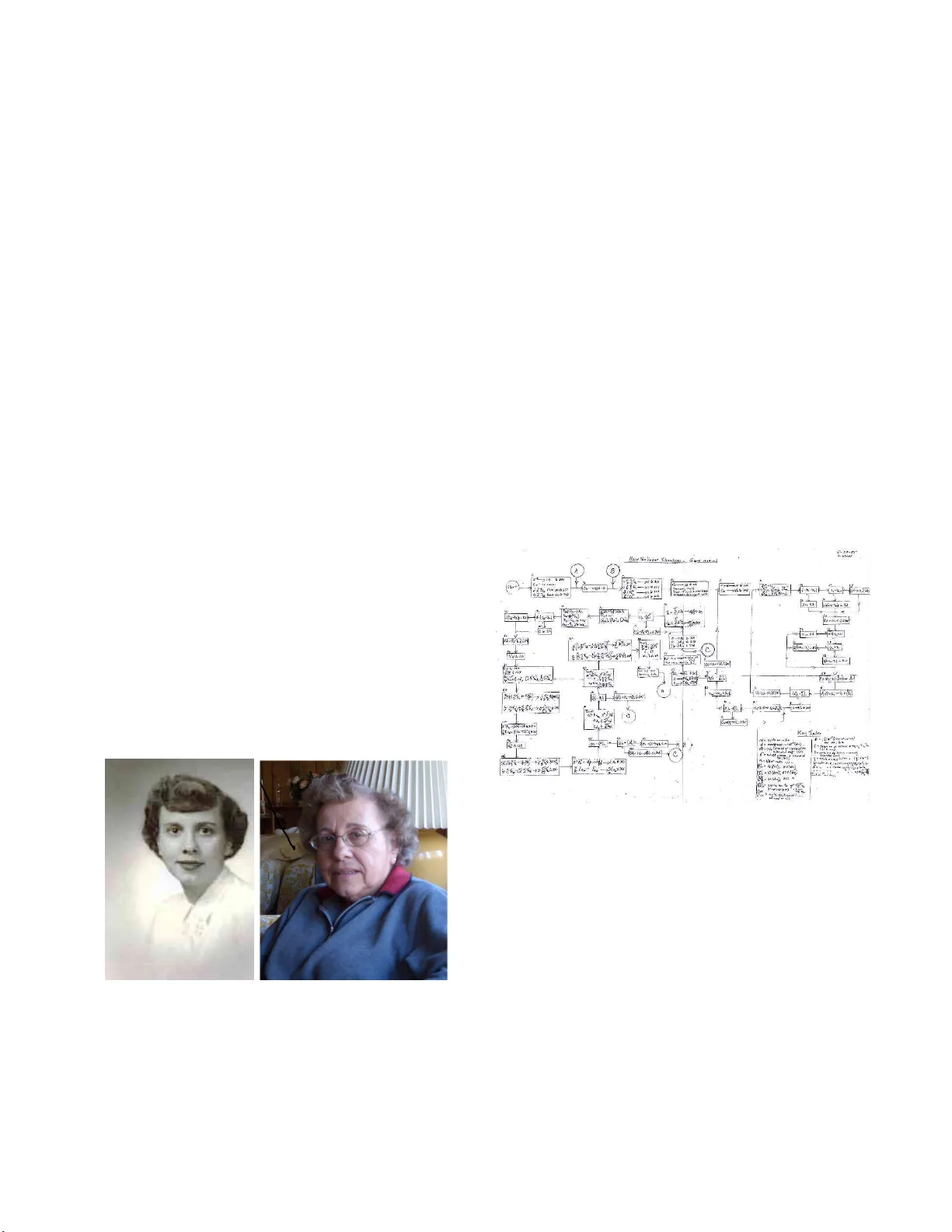
F ermi, P asta, Ulam and a mysterious lady Thierry D A UX OIS Universit ´ e de Lyon, CNRS, L ab or atoir e de Physique, ´ Ec ole Normale Sup ´ erieur e de Lyon, 46 Al l´ ee d’Italie, 69364 Lyon c´ edex 07, F r anc e Thierry.Dauxois@ens- lyon.fr It is rep orted that the numerical sim ulations of the F ermi-P asta-Ulam problem were performed by a young lady , Mary Tsingou. After 50 years of omissio n, it i s time for a p roper recognition of her decisive contribution to the first ever numerical ex periment, central in t h e solitons and chaos theories, but also one of t he v ery first out-of-equilibrium statistical mechanics study . Let us quote from no w on the F ermi-P asta-Ulam- Tsingou problem. The F ermi-Pasta-Ulam problem [1] was named a fter the three scien tists who prop osed to study how a cr ys- tal ev o lv es to wards therma l equilibrium. The idea was to simulate a chain of par ticles, linked by a linear in- teraction but adding also a weak nonline ar one. FPU thought that, due to this additional term, the energy in- tro duced in to a sing le F ourier mo de should slowly dr ift to the other m o des, un til the equipartition of energy pre- dicted b y statistical ph ysics is reac hed. The beginning of the c a lculation indeed suggested that this would b e the case, but to their gr e a t surprise, after a lo nger time, almost all the energy was back to the lo west fre q uency mo de a nd the initial state seems to b e almost p erfectly recov ered after this recurr ence perio d. Th us , contrary to the exp ectations o f the authors, the drift o f the energy do es not o ccur. This highly remark able result, known a s the FPU pa r adox, sho ws that nonlinea r it y is no t enough to guara n tee the equipar tition o f energy . Pursuing the solution of the FPU pa radox, Zabusky and Krus k a l emphasized ten years later the link b e tw een the problem in the so - called contin uum limit and the Korteweg-de V ries equatio n [2], known to hav e spatially lo calized solutions. Lo oking to the problem in rea l space rather than in F o urier space, they sho wed how to solv e the par a do x in terms of the dynamics o f these lo calized excitations. It was the birth of the ter m solitons , fo r these lo calised (or solit ary) wa ves with proper ties of par- ticles (explaining the suffix on as for electro n, b oson,...). Consequently , the n umerous physical applications [3] of solitons or ig inates from this FPU pap er. Another line of thought w a s dev elop ed in parallel. Peo- ple focused on the F ourier mode dynamics, lo oking for non-resona nce conditions that could explain the ineffi- cient energy transfer. No convincing expla nation was found befor e the discov e ry o f the KAM theorem, whic h states that most or bits o f sligh tly per turbed integrable Hamiltonian systems rema in quas i-perio dic. If the per - turbation is s o strong that nonlinear resona nces ’supe r - po se’, the FPU recurrence is destroyed a nd one obtains a fast co n vergence to thermal equilibrium. [4 ] The FP U problem is thus of central impor tance in the Solitons and Chaos theories [5]. This is the reason why , in 200 5 , several conferences, ar ticles and s e mina rs ha ve celebrated the 5 0th anniversary of the May 1955 publica - tion o f the Lo s Alamos rep ort. This pap er ma rk ed indeed a true change in mo dern science, b oth making the birth of a new field, Nonline ar Scienc e , and entering in the age of co mputational science: the problem is indeed the first landmark in the developmen t of physics computer simu lations. There w as how ever very few mentions of an intriguing po in t. On the first page of the FP U Los Alamos repo rt published in 1 955, it is written, ”R ep ort written by F ermi, Pasta and Ulam. Work done by F ermi, Pasta, Ulam an d Tsingo u ”. This r emark, that Mary Ts ing ou who too k part in the n umerical study is not an author of the re port, was al- wa ys puzzling for scientists who have rea d this pap er: indeed, it is clear that co ding the first ever numerical ex- per imen t on the first co mputer was not a dir ect and im- mediate tas k. Consequently , wh y her co ntribution has it been recog nized only by tw o lines of ackno wledgements? Moreov er, why ha s it b een impos sible until today to pick up her tra c k? People more deeply in volved in the FPU literature ha ve usually also read the 1972 pap er by T uc k a nd Menzel [6]. A ca reful reading o f the intro duction clear ly empha s izes that o ne of the author of this pap er, M. T. Menzel, was co ding the original pro blem: how can we solve this para- dox? The o b vio us solution is that in the name M. T. Menzel, M is for Mary and T for Tsing ou. There is no paradox, this is the same p erson, after her wedding! How ever, once again, it has b een imp ossible for decades to pick up her trail. W e recently discov ered how ever, that she is still alive and present in Los Alamos, a co uple of miles from the place wher e this pro blem, so imp ortant in the pa st and pr esen t of nonlinear physics [3], was devis e d. It is time for a prop er recognition of her work. Born in Octob er 1 4th 192 8 at Milwauk ee, Wisco ns in, in a Greek na tive family , Mar y Tsingou Menzel sp ent her childhoo d in the US. As the grea t depression was tak- ing pla ce in the US, her family mov ed to Europ e in 193 6 , where her father had a prop erty in Bulgaria . How ever, in June 19 40 the American embassy a dvised them to come back to US for safety . They pick up the very la s t Ameri- can ship that left Ita ly . Almost within a week after they landed in New Y ork, Italy declared war. 2 She gained a B ac helor of Science in 19 51 at the Univer- sit y of Wisconsin, and a Master in mathematics in 1 955 at Universit y o f Mic higan. In 195 2 , following a sug ges- tion b y her mathematics professor , a woman, she a pplied for a p osition at Los Alamo s Na tio na l La bor a tory . At that time, women were no t encoura ged to do mathemat- ics, but b ecause o f the Korean war, there w as a shortage of American young men a nd staff positio ns were also pro- po sed to young women. She w as th us hired with a whole group o f young p eople right out of colleg e, for doing hand calculations. She w as initially as signed to the T1 division (T for The- oretical) at Los Alamos Na tio nal L a bor a tory , led during the w ar by Rudolph Peierls and to which the famous spy , Klaus F uchs, b elonged. But she quic kly mov ed to T7 led b y N. Metrop o lis for working o n the first ever computer, the Mania c I, that no one c ould progra m. T ogether with Mary Hunt , she was therefore the firs t progr ammer to start explor atory w ork on it. She r e member s it as prett y easy b e c a use of the very limited p ossibilities of the com- puter: 1000 words. They were working primarily on weapo ns but, in par al- lel, they studied o ther pro blems like programming chess or studying fundamental physics’ problems. Mary Tsin- gou mostly in teracted with J. R. Pasta. They were the first ones to do a c tua lly gr aphics on the computer, when they considered a pro blem with an explosion and visua l- ized it o n a n o scilloscop e. In addition to Pasta, she interacted also with Stan Ulam, but very little with E. F ermi, at that time pr o- fessor in Chicago. He was visiting Los Alamos only for short p eriods , mostly during the summer. How ever, she knew Nella, F ermi’s daug h ter, m uch b etter b ecause Nella didn’t wan t to stay with her par en ts during their v is its to Los Alamos. Both early t wen ties girls w ere sleeping in the same do r mitory , while Enrico and Laura F ermi were hosted by their go o d friends, Stan and F ran¸ coise Ulam. FIG. 1: Mary Tsingou in 1955 and in 2007. It was F ermi who had the genius to prop ose that, in- stead of simply p erforming standard calculus, co mputers could be used to test a physical idea, inv enting the co n- cept of numerical exp eriments. He prop osed to chec k the prediction of statistical ph ysics o n the thermalization of solids. As anticipated, preliminary r esults c o nfirmed that energy initially introduced in a single F our ier mo de drift to o ther ones. How ever, one day , the ov ersight to stop the computer allows one to discover so me unexp ected r e- currences which were initially hidden b y the slowness of the computer. It was the start o f an ongo ing fruitful research. [5] The algor ithm used by Ma r y Tsing ou in 1 955 to sim- ulate the r elaxation of energy in a mo del crystal on the Maniac is repro duced in Fig. 2. Its complexity has to be co mpa red with the 15 lines Matlab c co de, sufficient to da y to repro duce the or iginal FPU r ecurrences [7]. A t the time, progr a mming was a tas k requiring grea t insight and or iginalit y , and through the 1960s and even later, it was common to list programmer s as co-a uthors. It app ears that the o nly reas o n for the menti on “W ork done by FPU+Ts ingou, and rep ort wr itten by FPU” is that she was no t inv olved in the writing. How ever, F ermi was not either since, as noticed in S. Ulam bio g raphical bo ok [8], the FPU rep ort was never published b ecause F ermi died b efore the writing o f the pap er. Cons e quen tly , Tsingou was not given credit simply b ecause the r eport was never forma lly presented in a jour nal and its state- men t o f credit, differentiating b et ween the writing a nd the work done, was presumably misrea d by la ter p eople. FIG. 2: Repro duction of the algorithm used by Mary Tsingou to code th e first numerical ex periment. Note the date (5-20- 55) at the top right of the figure. In 1958 , Mary Tsing ou marr ied Joseph Menzel w ho was also working at Los Ala mo s for the Protective F orce of the At omic E nergy Commission. She stay ed her whole life in this small city but her colleag ues changed since Metrop olis left Lo s Alamos for Chica go, Pasta went to W ashington, and later Ulam wen t to Co lo rado Universit y . She work ed successively on different pro blems, alw ays with computers. Sh e b ecame one of the ea rly exp erts in F ortran (F O Rm ula TRANslator ) in ven ted by IBM in 1955, and was assigned to help researchers in the la bora - tory . After her se mina l pr o gramming w ork on the Mania c, in the b eginning of the sixties she came back to the 3 FPU problem with J im T uck loo king for recurrences [6]. But she also consider ed n umerica l solution of Sch r¨ odinger equations, the mixing problem of tw o fluids of different densities with J. V on Neumann, and other pr oblems. Fi- nally , in the eig hties during Ronald Reagan’s presidency , she was deeply inv o lved in the Star W ars pro ject calcu- lations. Retired in 1991 , Mar y T. Menzel is still living with her h usband at Los Alamos , very close to the place where the FPU problem was desig ned and discovered: it is time for a prop er reco gnition of her contribution: let us quote from now o n the F ermi-Pasta-Ulam- Tsingou problem. Ac knowledgemen ts : I would lik e to thank T. J. Gammel and J. Barr´ e for helps. [1] Fermi E., P ast a J., Ulam S., “Studies of nonlinear prob- lems. I.”, L os Alamos r ep ort LA- 194 0 (1955), pu blished later in Col l e cte d Pap ers of Enric o F ermi , E. Segr´ e (Ed.) (Universit y of Chicago Press, Chicago 1965); also in Non- line ar Wave Motion , N ew ell A. C. Ed., Lecture in App lied Mathematics 15 (A MS, Providence, Rho de Island, 1974); also in The Many-Bo dy Pr oblem , Mattis C. C. Ed. (W orld Scienti fic, S ingapore, 1993). [2] Zabusky N. J., Kruskal M . D. , Phys. R ev. L ett. 15 , 2403 (1965). [3] Da uxois T., Peyrard M., Physics of Solitons , Cam- bridge Un iv ersity Press (2006). [4] Izrailev F. M., Chiriko v B. V. Sov. Phys. D okl. 11 30 (1966). [5] Chaos 15 , F o cus issue: The “F ermi-Pa sta-Ulam” problem- the first 50 years (2005). [6] Tuck J. L., Me nzel M. T., The sup erp erio d of the non- line ar weighte d string (FPU) pr oblem , Adv ances in Math- ematics 9 , 399-407 (1972). [7] Da uxois T., P eyrard M., R uffo S. , The F ermi-Pasta- Ulam “numeric al exp eriment”: hi stor y and p e dago gic al p ersp e ctives , Europ ean Journal of Physics 26, S3 (2005). [8] Ulam S. M., A dventur es of a Mathematician , Charles Scribner’s Son, New Y ork, ( 1976).
Original Paper
Loading high-quality paper...
Comments & Academic Discussion
Loading comments...
Leave a Comment