Distributed Power Allocation Strategies for Parallel Relay Networks
We consider a source-destination pair assisted by parallel regenerative decode-and-forward relays operating in orthogonal channels. We investigate distributed power allocation strategies for this system with limited channel state information at the s…
Authors: Min Chen, Semih Serbetli, Aylin Yener
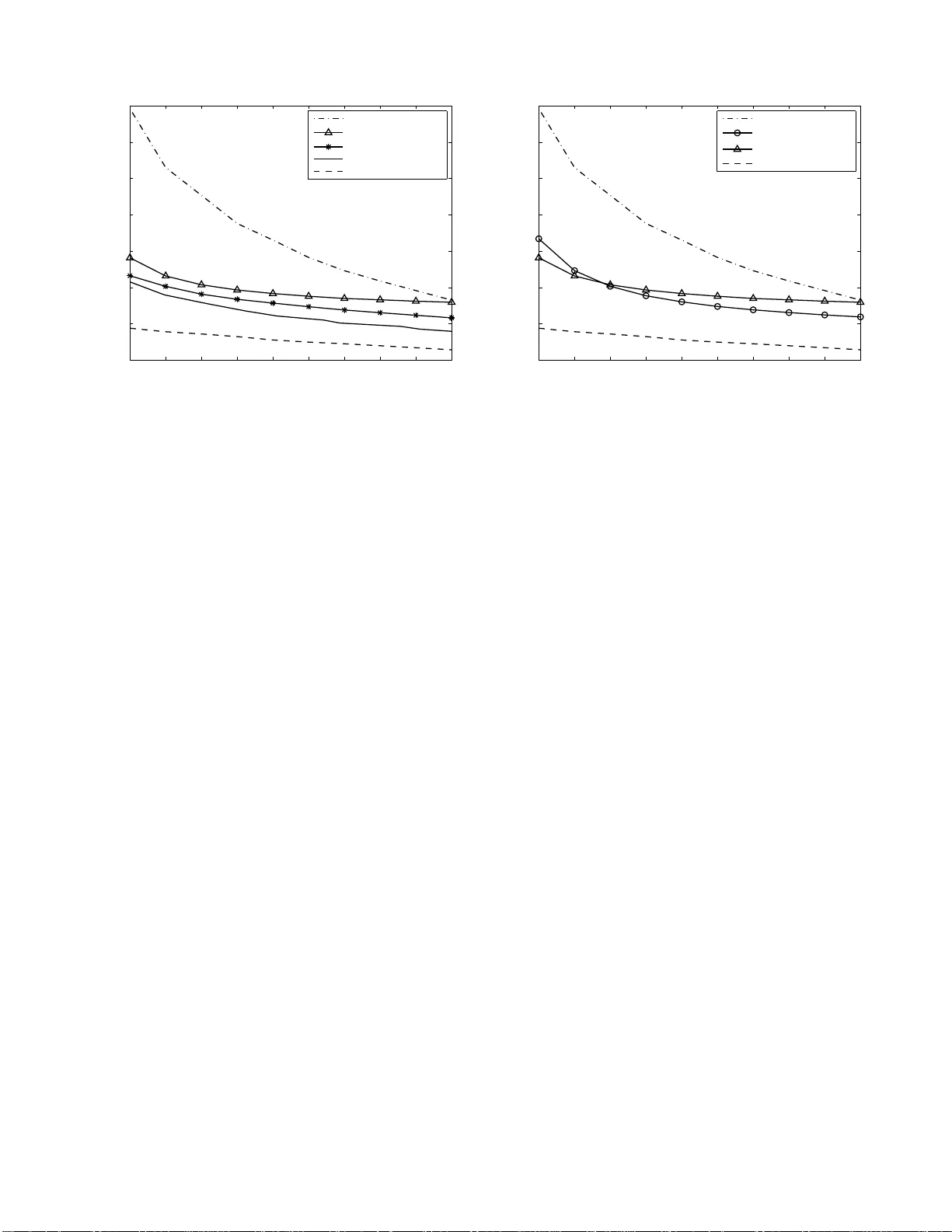
IEEE TRANSACTIONS ON WIRELESS COMMUNICA TIONS, A CCEPTED FOR PUBLICA TION 1 Distrib ute d Po wer Allocation St rate gies for Para llel Relay Net works Min Chen, Semih Serbetli, Membe r , IEEE, and A ylin Y ener , Me mber , IEEE Abstract —W e consider a source-destination pair assisted by parallel regenera tive decode-and-fo rward rela ys operating in orthogonal channels. W e inv estigate distributed power allocation strategies fo r this system with limited channel state information at the source and the relay nodes. W e first propose a d i stributed de- cision m echanism f or each r elay to ind ividually make its decision on whether to forwa rd the source data. The decision mechanism calls for each relay that is able to decode the information from the source to compare its relay-to-destination channel gain with a gi ven thr eshold. W e identify th e optimum di st ri buted power allocation stra tegy that minimizes th e total transmit power whi le prov iding a target signal-to-noise ratio at the destination with a target outage p robability . The strategy dictates the op t i mum choices f or th e source po wer as well as the threshold v alue at th e relays. Next, we consider two simpler d istributed po wer allocation strategies, n amely the passive source model where the source power and the relay th reshold are fixed, and the single relay model where only one relay is allowed t o fo rward the source data. These models are motiv ated by limitations on the a vailable channel state information as well as ease of implementation as compared to t h e opt i mum distributed strategy . Simulation results are presented to demonstrate the performa nce of th e proposed distributed power allocation schemes. Sp ecifically , we observ e significant po wer sa vings with proposed methods as compared to random relay selection. Index T erms —Relay selection, distributed power allocation, decode-and-forwar d, orthogonal parallel relays. I . I N T RO D U C T I O N Relay-assisted transmission sche mes for wireless networks are co ntinuing to flourish du e to their pote ntial of providing the benefits of space diversity without th e ne ed fo r p hysical antenna arrays [1]. Amo ng the earliest work on coope ra- ti ve network s are referen ces [2]– [4]. A coop erativ e div ersity model is pro posed in [2 ] an d [3], in which two users act as p artners and cooperatively co mmunicate with a co mmon destination, each tra nsmitting its own bit in the first time interval and th e estimated bit o f its partn er in the second time interval. I n [4] , several low-complexity cooper ati ve pr otocols are prop osed and studied, includ ing fixed relaying, selection Manuscript recei v ed December 7, 2005; revise d February 19, 2007; ac- cepte d October 25, 2007. T he editor coordina ting the re vie w of this paper and appro ving i t for publicati on was Kin K. L eung. This work wa s supported in part by NSF grants CCF 02-37727, CNS 05-08114, CNS 06-26905 and D ARP A ITMANET Program grant W 911NF-07-1-002 8. This work was presente d in part in Glo becom 2005, St. Loui s, MO, No vember 2005. Min Chen and A ylin Y ener are with the Wirel ess Communicat ions and Networ king Laboratory , Depa rtment of Electrical E ngineer ing, Pennsylva- nia State Univ ersity , Uni ver sity Pa rk, P A 16802. emai l: mchen@psu.edu, yener@e e.psu.edu. Semih Serbetli was with the Wi reless Communicati ons and Networki ng Laboratory at the Pennsylv ania State Uni versit y . He is no w with Philips Researc h L abs, Eindho ve n, Netherla nds. email: semih .serbetli@p hilips.com. relaying and increme ntal relay ing, in which the relay node can eith er amp lify-and- forward (AF) or decode-and- forward (DF) th e signal it receiv es. In [5], networks consisting of more than two users th at em ploy the space-time coding to achieve the co operative diversity are considered. Cod ed co operation schemes are discussed in [6 ] and [7], wh ere a user transmits part of its partner’ s codeword as well. References [8 ] an d [9] in vestigate the capacity of relay networks of arbitrary size. References so far have shown that, re lay nodes can pr ovide perfor mance impr ovement in terms of ou tage behavior [4], [5], achiev able rate region [ 2], [ 3], [8], [9], and er ror prob ability [6], [7 ], [ 10], [1 1]. Power efficiency is a critical design con sideration for wire- less n etworks such as a d-hoc and sen sor n etworks, due to the limited transmission p ower o f th e (rela y and th e sour ce) nodes. T o that en d, choosing the appr opriate relays to forward the sou rce data, as well as th e transm it power levels of all the nodes becom e impo rtant design iss ues. Op timum power allocation strategies for relay networks are studied up-to- date f or several structu res and relay tran smission schem es. Three-n ode models are discussed in [12 ] an d [13] , while multi-hop relay networks are studied in [14]–[ 16]. Relay forwarding stra tegies f or both AF and DF parallel relay channels in wideb and regime are propo sed in [17]. Recent works also discuss relay selectio n algorithm s for network s with mu ltiple relays. Optimu m relay selection strategies f or se veral models are identified in [10], [17] , [ 18]. Recently propo sed practical relay selection strategies in clude p re-select one relay [19] , best-select relay [19] , blind-selection-algo rithm [20], infor med-selection -algorithm [20] , and coop erativ e r elay selection [21 ]. All of th ese pro posed methods result in power efficient transmission strategies. Howe ver , th e c ommon th eme is that, the implemen tations of these alg orithms requir e either the d estination or the source to have substantial infor mation about the network, such as the channel state in formation (CSI) of all commu nication channels, re ceiv ed signal-to-no ise ratio (SNR) at every no de, the topolog y of the network, etc. Such centralized po wer allocation/relay selection schem es may be infeasible to imp lement du e to th e sub stantial feedbac k requirem ents, overhead a nd d elay th ey may introd uce. T o ov ercome the obstacles of a ce ntralized arch itecture, se veral heur istic approach es h av e been propo sed in [22] , f or multi-user ne tworks with coded coop eration. In this work, users select co operation partners based on a pr iority list in a distributed mann er . Altho ugh the p roposed algorithm s ar e advantageous due to their ease of implem entation, their perfor- mance depen ds o n the fading condition s, and th e rando mness in the ch annel may prevent the pr otocols from pr oviding fu ll IEEE TRANSACTIONS ON WIREL ESS C OMMUNICA TIONS, ACCEPTED FOR PUBLICA TION 2 div ersity . I n [2 3], an SNR th reshold me thod is propo sed for the relay no de to make a decision on wheth er to forward the source data in a three-node model. Since ther e is only one relay node in th e co nsidered system, relay selection is no t an issue. Reference [24] p rovides a r elay selection algor ithm b ased on instantaneou s channel measur ements do ne by e ach relay no de locally . For the purp ose of reducing the commu nication amo ng relays, a flag packet is b roadcasted b y the selected relay to notify th e other relays o f th e result. In this paper, we in vestigate optimum distrib uted power allocation strategies for decode- and-fo rward parallel relay networks, in which o nly partial CSI is accessible at the so urce and the re lay no des. W e first pro pose a d istributed de cision mechanism for each relay node to individually make a decision on whether to forward the sou rce data. In contrast to the SNR based decision proto col presented in [2 3], in o ur pro posed decision mechan ism, the re lay m akes its decision not only b y considerin g its received SNR, but also by comparing its relay- to-destination channe l gain with a given threshold , and no feedback from the destination is needed . Th e overall overhead is furth er reduced as compar ed to the method pr oposed in [24] sinc e the distributed decision mech anism does n ot re quire commun ication among relays. Secon dly , given such a relay decision scheme, an d co nsidering a n ou tage occu rs when ev er the SNR a t the destination is lower than the req uired value (target), we formulate the distributed power allocatio n problem that aims to minimize the expected value of the total transmit power while pr oviding th e target SNR at the destination with an outag e proba bility constrain t. W e id entify the solution of this prob lem, that consists o f the op timum value o f the source power , and the correspo nding rela y decision th reshold based on the partial CSI av ailable at the sou rce. The extra power the distributed power alloc ation mechanism needs as com pared to the optimu m cen tralized power allocation mech anism, i.e ., the additio n al power expenditur e , is examined to observe the tradeoff between the o utage probability an d the add itional power expenditure. W e next co nsider tw o special cases with simpler implemen- tation, nam ely the p a ssive source model wher e the sour ce does not contr ibute to the relay selection pr ocess, and the single r elay model where one relay n ode is selected to for ward the source d ata based on limited CSI. For each case, we op timize the respective relevant parameters. Our resu lts d emonstrate that considerable p ower sa vings can be obtain ed by our pro- posed distributed relay selection and power allocation schemes with respect to ran dom r elay selection . The organization of the paper is as follo ws. In Section II, the system mo del is described . The distributed power allocation problem is for mulated and the optimum solution is given in Section III. In Sectio n IV, we inv estigate the passive source model an d the single relay model. Numerical re sults supportin g the theoretica l an alysis are presented in Section V, and Section V I conclud es the pa per . I I . S Y S T E M M O D E L A N D B A C K G RO U N D W e consider a relay network consisting o f a so urce- destination pair and N relay nodes employing d ecode- and-fo rward. W e assume that the relay nodes op erate in Source Destination Relay 1 Relay i Relay N ⊕ ⊕ ⊕ ⊕ ⊕ ⊕ ⊕ 1 r z i r z N r z 1 d z i d z N d z 0 d z 1 g i g N g 1 f i f N f h ⋮ ⋮ A subset of relays Tx , each in one time slot Source Tx & All relays Rx First time slot Subsequent time slots Source Destination Relay 1 Relay i Relay N ⊕ ⊕ ⊕ ⊕ ⊕ ⊕ ⊕ 1 r z i r z N r z 1 d z i d z N d z 0 d z 1 g i g N g 1 f i f N f h ⋮ ⋮ A subset of relays Tx , each in one time slot Source Tx & All relays Rx First time slot Subsequent time slots Fig. 1. Relay net work system model . pre-assigned o rthogo nal ch annels, e.g . in non-overlapp ing time/frequ ency slots, or using o rthogo nal signatures. The source is assumed to tran smit in a time slot prior to (and non-overlapp ing with) the relay s. Let f i and g i denote th e fad- ing coefficients of the source -to-relay an d relay-to-d estination channels for the i th relay nod e, for i = 1 , ..., N . T he fading coefficient of the source-to- destination link is denoted by h . W e assume that each chan nel is flat f ading, and f i , g i and h are all indepen dent realizatio ns of zer o mean complex Gaussian rando m variables with variances σ 2 f i , σ 2 g i and σ 2 h per dimension, respectively . W ithout loss of gener ality , we will assume th at we have a time slotted system in the seq uel. The sy stem mode l is shown in Figure 1 . In th e first time slot, th e sourc e broadca sts X o with power P s . The destination o bserves y d 0 : y d 0 = p P s hX o + z d 0 (1) and the i th relay ob serves y r i : y r i = p P s f i X o + z r i for i = 1 , ..., N (2) where z d 0 and { z r i } N i =1 are Ad ditiv e White Ga ussian Noise (A WGN) terms at the destination an d the relay s, respectively . Assume witho ut loss of g enerality th at they ar e of variance 1 / 2 per dimen sion. The i th relay node is said to be reliable and can cor rectly decode X o when its receiv ed SNR, S N R r i , satisfies S N R r i = P s | f i | 2 ≥ S N R tar g et (3) where S N R tar g et is the given decod ability constra int. In the subsequen t time slots following the first one, the relays that belong to the set of r eliable relays, A R , can deco de and forward the sou rce data to the destination, each in its assigned time slot. Throug hout this paper, we assume that the reliable relays simp ly regene rate the source data X o [4], [13], [15]. The sign al r eceiv ed at the destinatio n fro m the reliable relay i is y d i = p P i g i X o + z d i , i ∈ A R (4) IEEE TRANSACTIONS ON WIREL ESS C OMMUNICA TIONS, ACCEPTED FOR PUBLICA TION 3 where P i is th e transmit power of the i th relay node, and z d i is the A WGN term at the i th relay-to- destination ch annel. The destination combines signals received from the reliable relay nodes an d the direct link with a ma ximum ratio combin er (MRC), and the r esulting SNR at the d estination is S N R d = P s | h | 2 + X i ∈ A R P i | g i | 2 (5) W e consider that the destination can corr ectly recei ve the source data wh enever S N R d ≥ S N R tar g et . Giv en this system model, the p ower allocation prob lem for regenerative DF r elay networks with parallel re lays can be posed as min P s, { P i } P s + P i ∈ A R P i (6) s. t. P s | h | 2 + P i ∈ A R P i | g i | 2 ≥ S N R tar g et (7) P s | f i | 2 ≥ S N R targ et for each i ∈ A R (8) W e note tha t th e resulting power allocatio n strategy may prevent som e reliab le relay s from participating simply by assigning zero power to those r elays. The o ptimum p ower allocatio n strategy fo r DF relay net- works using different code bo oks at the r elays is iden tified in [17]. This strategy , re-stated below for the be nefit of the read er , is easily seen to be the op timum centralized power allo cation strategy fo r regene rativ e DF relay networks as well. P ∗ s = S N R targ et | f k ∗ | 2 (9) P ∗ i = ( S N R target −| h | 2 S N R target / | f k ∗ | 2 | g k ∗ | 2 + , i = k ∗ 0 , otherwise (10) k ∗ = arg min { k ∈ A E } " 1 | f k | 2 + 1 | g k | 2 − | h | 2 | f k | 2 | g k | 2 # (11) where ( · ) + = ma x(0 , · ) . In (11), the set A E denotes the set of efficient relay s such that the tra nsmission throu gh the relay is m ore p ower efficient than the direct tr ansmission, i.e., A E = { i | ( | f i | 2 ≥ | h | 2 ) ∩ ( | g i | 2 ≥ | h | 2 ) , i = 1 ..N } (12) Observe that when the source po wer is assigned as in (9), the relay no de k ∗ , ch osen accor ding to ( 11), is the only relay no de with received SNR equ al to S N R targ et . Thus, each relay no de can decide whethe r it is the intended relay no de by simply checking its received SNR. When the SNR contribution of th e relay node, S N R targ et − | h | 2 S N R targ et / | f k ∗ | 2 , is indicated explicitly by th e source, the in tended relay node can calculate its req uired transmit power as in (10) and f orward X o to the destination. Alternativ ely , the source can broad cast the selected relay and the op timum power lev el in a side chann el. A moment’ s thought reveals th at to imp lement the strategy giv en by (9)-(11), the full CSI, i.e., { f i , g i } N i =1 and h , at the source node , and the individual CSI, i.e., { f i , g i } , at relay node i are needed. Although (9)-(11) provid es the most power efficient DF relay transmission strategy , its cen tralized nature , i.e., th e fact th at it requ ires the chann el estimate of each link and the fe edback of this information to the source, ma y ren der its impleme ntation im practical. As such, distributed strategies are needed . In the fo llowing, we d evise efficient distributed power allocation strategies. I I I . D IS T R I B U T E D P OW E R A L L O C AT I O N Our aim in this p aper is to fin d p ower allocatio n schemes that do not r equir e a centralized mechan ism , an d u tilize the limited av ailable CSI at each node. I n practice, it is feasible that the chann els are estimated by trainin g bef ore the actual data transmission, when each no de o perates in TDMA mode. When the sourc e transmits the training b its, all r elay nodes can simultane ously estimate their sour ce-to-relay fading coefficients { f i } N i =1 due to the b roadcast nature of the wireless medium. Similarly , when the relay no de i transmits the trainin g bits, the source -to-relay coefficient f i can b e estimated at the source. Ho wever , for { g i } N i =1 to be av ailable at the sou rce, the feedback from th e d estination f or each rea lization is required, which may be imp ractical. Thus, we in vestigate d istributed power allocation schemes when the source h as th e realiza tions { f i } N i =1 and h , an d only the statistics of { g i } . T he relay no des are assum ed to have their in dividual CSI, i.e., f i and g i for relay i , i = 1 , ..., N . A. Distributed Decision Mechanism W e first derive a d istributed decision mechanism with the model assumptions gi ven ab ove. Since the source has only the statistical description instead of the re alizations { g i } N i =1 , the optimu m centralized po wer allocation ind icated by (9)- (11) canno t be imple mented by the source. Also, while it is clea r that f or a fixed source power , the best strategy is transmitting through the reliable relay node that has the highest relay-to- destination channel gain , this m echanism requires a com parison of a ll { g i } N i =1 . Th e distributed nature of the strategy r equires that each relay sho uld make its d ecision relying only o n its ind i vidual CSI. Since each relay can ea sily determine whether it is a reliable relay by using its SNR value, i.e., its ind i vidua l CSI, we prop ose that the i th reliable re lay decides it will be a fo rwarding n ode wh en its chann el g ain to the d estination satisfies | g i | 2 ≥ γ (13) where γ is a given thresho ld value. Relay i then for wards the decoded sign al w ith sufficient power . That is, we have P ∗ i = S N R ′ tar g et / | g i | 2 (14) where S N R ′ tar g et = ( S N R tar g et − P s | h | 2 ) + denotes the SNR contribution from the relay . 1 W e note that such a distrib uted decision mechanism includ es the pro bability th at mo re than one relay will transmit. Simi- larly , we no te that with any γ > 0 , the scheme results in a n onzero probability that none of the r elay no des satisfies (13), an d hen ce a nonzero outa ge proba bility Prob ( S N R d < S N R tar g et ) . As such, the sou rce sho uld d etermine the op- timum source power and the corresp onding threshold γ by considerin g the realization s o f { f i } and the random ness in 1 γ and S N R ′ tar g et v alues are assumed to be broadcasted by the source on a side channel . IEEE TRANSACTIONS ON WIREL ESS C OMMUNICA TIONS, ACCEPTED FOR PUBLICA TION 4 { g i } , to meet a system given specification , i.e., an ou tage probab ility r equiremen t. B. S our ce P o wer Allo cation an d Thr eshold Decision Giv en th e ab ove described strategy , we n ow in vestigate how the source shou ld decide the value o f its tr ansmit power P s and the relay decision th reshold γ , to satisfy the target SNR, S N R targ et at th e destination with a target outage pr obability , ρ targ et . From the source’ s point of view , the relay transm it powers are r andom variables with kn own statistics b ecause the real- izations { g i } N i =1 are no t av ailable at the sour ce. W e h av e the pdf of X i = | g i | 2 as p X i ( x i ) = 1 2 σ 2 g i exp − x i 2 σ 2 g i , for i ∈ [1 , ..., N ] (15) where g i is a z ero mean com plex Gau ssian ran dom variable with variance σ 2 g i per d imension. W e con sider the expected value of the transmit power of r elay i E [ P i ] = Z ∞ γ S N R ′ targ et x i p X i ( x i ) dx i (16) = Z ∞ γ S N R ′ targ et 2 σ 2 g i x i exp( − x i 2 σ 2 g i ) dx i (17) The distrib uted po wer allo cation problem can then be ex- pressed as min γ ,P s P s + P i ∈ A R ( P s ) E [ P i ] (18) s. t. Prob ( S N R d ≤ S N R targ et ) ≤ ρ tar g et (19) P s | f i | 2 ≥ S N R targ et for each i ∈ A R (20) where we explicitly state the depend ency of the set of reliable relay A R on P s . Observe that the determ inistic quality- of-service guarante e in (7) is r eplaced by the prob abilistic constraint ( 19). The fo llowing theo rem provid es the o ptimum solution: Theorem 1: T he optimum sourc e p ower , P ∗∗ s , can only be one of th e ( M + 1 ) discrete values in the set { S N R targ et | f 1 | 2 , ..., S N R targ et | f M | 2 , S N R tar g et | h | 2 } (21) where we r eorder the in dices o f the relay nodes such that | f 1 | 2 > | f 2 | 2 > ... > | f M | 2 > | h | 2 > | f M +1 | 2 ... > | f N | 2 , i. e., S N R target | f 1 | 2 < S N R target | f 2 | 2 < ... < S N R target | f M | 2 < S N R target | h | 2 < S N R target | f M +1 | 2 < ... < S N R target | f N | 2 . 2 For ea ch possible P ∗∗ s value, there exist a corr espondin g reliable relay set A ∗∗ R , and a un ique optimum threshold value, γ ∗∗ . Pr oof: Assume tha t P s = S N R tar g et / | f i | 2 and there exist a reliab le relay set A † R containing R i relay nod es and a cor respond ing threshold value γ † . Th en, the expected value 2 P s = S N R target | h | 2 is th e la rgest can didate of the source po wer . Wi th th is po wer lev el, source can reach the destination via the direct link and relay transmission is no t needed . of th e total p ower is E [ P total ] = P s + X i ∈ A † R Z ∞ γ † ( S N R tar g et − P s | h | 2 ) + 2 σ 2 g i x i exp( − x i 2 σ 2 g i ) dx i (22) W e consider the set of transmitting r elays as a super relay node whose effecti ve channel gain to the destination is | g ef f | 2 . Thus, the expec ted value of th e total power can b e expressed as E [ P total ] = P s + ( S N R tar g et − P s | h | 2 ) + | g ef f | 2 (23) where | g ef f | 2 = 1 P i ∈ A † R R ∞ γ † 1 2 σ 2 g i x i exp( − x i / 2 σ 2 g i ) dx i (24) The direc t transmission is mo re power ef ficient than the relay-assisted tran smission when th e cha nnel gain of the d irect link, | h | 2 , is gr eater than the effecti ve channel gain of the relay-to- destination links, | g ef f | 2 , i.e., | h | 2 > | g ef f | 2 (25) In this case, the o ptimum sourc e power is P ∗∗ s = S N R tar g et / | h | 2 . On the oth er hand, the relay transmission is preferr ed wh en | h | 2 < | g ef f | 2 (26) W e n ote tha t th e deriv ativ e o f E [ P total ] with resp ect to P s is ∂ E [ P total ] ∂ P s = 1 − | h | 2 | g ef f | 2 (27) and (2 6) implies ∂ E [ P total ] ∂ P s > 0 , which m eans in creasing P s beyond S N R tar g et / | f i | 2 until th e value S N R tar g et / | f i +1 | 2 for i = 1 , . . . , M does not change A † R but increases the expected value of the total power E [ P total ] . Thus, the optimum source po wer P ∗∗ s can be on ly on e of the (M+1) discr ete v alues in the set given by (21). For P s = S N R tar g et / | f i | 2 , one of th e candidates of the optimum source power, and its correspo nding reliable set A † R , when γ increa ses, the expe cted value o f the total power decreases, while th e outage prob ability incr eases. Therefo re, threshold γ † should be chosen as the value that satisfies the outage p robability with eq uality , i.e., Y i ∈ A † R (1 − Z ∞ γ † 1 2 σ 2 g i exp( − x i 2 σ 2 g i ) dx i ) = ρ tar g et (28) It can b e fu rther red uced to Y i ∈ A † R (1 − exp( − γ † 2 σ 2 g i )) = ρ tar g et (29) Let σ 2 g min =min { σ 2 g i , i ∈ A † R } and σ 2 g max =max { σ 2 g i , i ∈ A † R } , IEEE TRANSACTIONS ON WIREL ESS C OMMUNICA TIONS, ACCEPTED FOR PUBLICA TION 5 we have (1 − exp( − γ † 2 σ 2 g max )) | A † R | ≤ Y i ∈ A † R (1 − exp( − γ † 2 σ 2 g i )) ≤ (1 − exp( − γ † 2 σ 2 g min )) | A † R | (30) Therefo re, γ † is boun ded as γ † min ≤ γ † ≤ γ † max (31) where γ † min = − ln(1 − ( ρ targ et ) 1 | A † R | ) · 2 σ 2 g min and γ † max = − ln(1 − ( ρ targ et ) 1 | A † R | ) · 2 σ 2 g max . The value of γ † can be obtained by a sear ch in th e ran ge [ γ † min , γ † max ] nu merically . Note that for P s = S N R targ et / | h | 2 , i. e., when th e sou rce can reach the destination via t he direct link, γ † = ∞ to prevent any red undant relay transmission and power consum ption. The sou rce shou ld simply com pare ( M + 1) possible E [ P total ] v alues and decid e the best ( P ∗∗ s , γ ∗∗ ) pair . Note that when the expected value of the total tr ansmit power is higher than that with direct tr ansmission, the source w ill pr efer to transmit d irectly to the sou rce. 3 The cost of the lack of full CSI at the source , i.e ., the cost of using the distributed rela y d ecision me chanism, is an addi- tional power expenditure. Let P ∗∗ total and P ∗ total denote the total power of the propo sed optimum distributed power allocation scheme, and that of the optimu m centralized allocation scheme which is the sum of the source power P ∗ s and the relay power P ∗ i giv en in (9)-(11), respectively . T he expected value of the additional power expenditur e is: E [ P add ] = E [ P ∗∗ total ] − E [ P ∗ total ] (32) = P ∗∗ s + X i ∈ A ∗∗ R Z ∞ γ ∗∗ S N R ′ targ et 2 σ 2 g i x exp( − x/ 2 σ 2 g i ) dx − E [ P ∗ total ] (33) W e observe that in (2 8), ρ targ et is an incr easing fun ction of γ , while in (33), E [ P add ] is a d ecreasing functio n of γ . Thus, there exists a tr adeoff between the o utage probab ility and the ad ditional power expenditure: redu cing the target outage pr obability will require mo re addition al p ower . While designing the power allo cation strategy , a reasonable target outage p robability sho uld b e cho sen in acco rdance with this tradeoff. I V . S I M P L E R S C H E M E S The o ptimum distributed po wer allocation strategy still requires the realizations of { f i } N i =1 and h , i.e., the CSI of the source-to- relay and the dir ect links, av ailable at the sour ce. I t also req uires the source to update the thresho ld γ ∗∗ and the source power P ∗∗ s at each time when these channel coef ficients change. Due to fu rther limitation s on th e av ailability of this CSI and for implementation complexity , we may opt for even simpler schemes. In this con text, we next consider two special cases, nam ely the passiv e source model an d the single relay model. For both cases, we have the p revious assumptio n that 3 The source w ould communic ate this decision via th e side c hannel. each relay has its individual CSI, i.e., f i and g i for relay i , i = 1 , ..., N . Below are th e b rief d escriptions of the two models. • P assive sour ce mod el: W e assume that the source o nly has the statistics o f all commu nication channels, and does not particip ate in the relay selection pro cess a t all. For this mod el, we fix the sou rce power P s , and the relay decision threshold γ , an d employ the same distributed decision mec hanism as p roposed in II I-A. • Sing le r elay model: W e assume that the source has CSI of th e direct and the sourc e-to-relay link s, i.e., { f i } N i =1 and h , and the statistics of the relay- to-destination links { g i } . W e have the so urce select one assisting relay no de to satisfy the system requ irements on r eceiv ed SNR an d the o utage probab ility . A. P a ssive S our ce Model In practice, we may have situatio ns where the source does not have the r ealizations of any of the chann els, but has access o nly to the statistical d escriptions of them . I t m ay also be th e case that the source may not be a ble to d o computatio nally expensive operation s, e.g. , due to h ardware constraints in sensor or RFID network s. W e term such sour ce nodes, passive . Considering these p ractical issues, in this section, we inv estigate the distributed p ower allocation for the passiv e sou rce mo del. Since eac h relay has its in dividual CSI, we can apply the same distributed decisio n m echanism as pro posed in Section III-A. Howe ver , a passive so urce canno t op timize its power P s or γ based o n channel realizations; th ey should be found off-line based on the statistical d escriptions of the chann el and kept fixed for all realization s. Note that, different from Section III, in this ca se, we may end up h aving n o reliable relay if the fixed sour ce power value is too small. Let us n ow dev elop th e criterion o n h ow to choose the source power P s and the threshold γ by considering the outage probab ility an d the additional power expen diture jointly . Th e outage p robability of th e dir ect link is given by d out = Prob { P s | h | 2 < S N R tar g et } = 1 − ex p − S N R tar g et P s · 2 σ 2 h (34) For clarity of e xposition , let us define a i as the pro bability that the i th relay is a reliable relay , b i as the p robab ility that the i th relay satisfies (13), and c i as th e prob ability that the i th relay is in set A C , which den otes the set of relays tha t satisfy both (3) an d (1 3). W e h av e a i = Prob { i ∈ A R } = Pro b { P s | f i | 2 ≥ S N R tar g et } = exp − S N R tar g et P s · 2 σ 2 f i ! (35) b i = Prob {| g i | 2 ≥ γ } = exp − γ 2 σ 2 g i (36) c i = Prob { i ∈ A C } = a i · b i (37) IEEE TRANSACTIONS ON WIREL ESS C OMMUNICA TIONS, ACCEPTED FOR PUBLICA TION 6 where f i and g i are ze ro mean co mplex Gaussian rando m vari- ables with variances σ 2 f i and σ 2 g i per dimen sion, respectively . The overall o utage probab ility b ecomes ρ outage = Prob { A C = ∅} · d out = N Y i =1 Prob { i 6∈ A C } d out = N Y i =1 [1 − c i ] · d out (38) Observe in (38) that ρ outage is a fu nction of the source transmit power, P s and the threshold γ . T o cho ose the ( P s , γ ) pair th at satisfies (38), w e make two observations. The fir st one is ρ outage ≥ N Y i =1 [1 − a i ] d out (39) where equ ality occurs when γ = 0 , that is when all reliable relays forward the source data. Thus, to achie ve a target outag e probab ility , ρ targ et , there exists a min imum so urce p ower P s , that p rovides the target outage p robability with γ = 0 . Note that when P s is ch osen close to this minimum value, the correspo nding γ factor will be close to 0, r esulting in many relays transmitting. This may result in unnecessarily large extra power expenditure and care must be exercised to choo se the correct pair . Secondly , we observe ρ outage ≥ N Y i =1 [1 − b i ] d out (40) Thus, for a given P s value, γ sho uld be strictly less than some threshold to provide a target o utage pro bability . When we consider a special case where d out ≈ 1 , i.e., th e direct link is not r eliable, and { f i } N i =1 and { g i } N i =1 are i.i.d., we have ρ outage ≈ ( 1 − exp ( − S N R targ et 2 P s σ 2 f − γ 2 σ 2 g )) N (41) and ( P s , γ ) pair that aim s to achieve an outage p robab ility ρ targ et should satisfy S N R targ et 2 P s σ 2 f + γ 2 σ 2 g ≈ − ln (1 − ( ρ tar g et ) 1 / N ) (42) Since the relays employ the distributed de cision mechanism propo sed in I II-A, there exists a no nzero prob ability that additional relay n odes besides the best relay decide to for ward the source data. In this case, additional power is expended . For a realization of | g i | 2 , x i = | g i | 2 ≥ γ , th e probability that relay i makes a forwardin g d ecision even th ough it is not the best relay in set A R , W i ( x i ) , can b e expressed as W i ( x i ) = Prob ( Wrong fo rwarding decision by relay i | x i ≥ γ ) (43) = Prob { ( i ∈ A R ) ∩ ( ∃ j ∈ A R and j 6 = i, such that X j > x i ≥ γ ) } (4 4) = Prob { i ∈ A R } · Prob {∃ j ∈ A R and j 6 = i, such that X j > x i ≥ γ } (45) = Prob { i ∈ A R } · (1 − Prob {∀ j ∈ [1 , ..., N ] and j 6 = i, ( j / ∈ A R ) ∪ (( j ∈ A R ) ∩ ( X j < x i )) } ) (46 ) = Prob { i ∈ A R } · (1 − N Y j =1 ,i 6 = j ( Prob { j / ∈ A R } + Prob { j ∈ A R } · Prob { X j < x i } )) (47) = a i · (1 − N Y j =1 ,i 6 = j ((1 − a j ) + a j · (1 − exp( − x i 2 σ 2 g j )))) (4 8) = exp( − S N R tar g et P s 2 σ 2 f i ) · (1 − N Y j =1 ,i 6 = j (1 − exp( − S N R tar g et P s 2 σ 2 f j ) · exp( − x i 2 σ 2 g j ))) (49) If re lay i makes a w rong fo rwarding decision, it will transmit with power v alue S N R ′ tar g et /x i . In essence, the power o f relay i is wasted, sinc e the relay with the highest relay-to- destination chan nel gain in A R also transmits the source data to the destination reliably but with a lower p ower . W e h av e the expected value of the wasted power of r elay i , E [ P waste i ] as E [ P waste i ] = Z ∞ γ W i ( x i ) S N R ′ tar g et x i p X i ( x i ) dx i (50) The expected value o f the ad ditional power expenditure of all relays is 4 E [ P add Relay ] = N X i =1 E [ P waste i ] (51) Observe that in (38), ρ outage is an increasing functio n of γ when other parameter s are fixed, while in (51), the expected value o f the additional power expen diture is a decreasing function of γ . Ther e exists a tradeo ff between the o utage probab ility and the additional relay power expenditu re. A reasonable pair of the source power and the thre shold γ sho uld be chosen by considerin g bo th th e trad eoff and the p roperties of th e ( P s , γ ) pair in (38), (39) and (40). B. S ingle Relay Model The distributed power allocatio n schemes p roposed up to this po int in gene ral result in m ultiple r elays transmitting to the destina tion, c ausing ad ditional power exp enditure. In this section, we in vestigate the case where only one relay node selected b y the sou rce is allowed to transmit. In contr ast to the centralized solutio n in (9)-(11), howe ver , we consider that the sou rce has limited CSI. In p articular, we re-emp hasize that, o nly the statistical descriptions of the relay-to -destination channels are available at the source. Adop ting the single relay model, we will see that the task of finding the threshold value for the relay fo rwarding decision s can be substantially simplified a s co mpared to the o ptimum d istributed stra tegy . 4 Observe that E [ P waste i ] = 0 if i is an unre liable relay or the best relia ble relay . IEEE TRANSACTIONS ON WIREL ESS C OMMUNICA TIONS, ACCEPTED FOR PUBLICA TION 7 When relay k is selected, the so urce transmits with just enoug h power P s = S N R targ et / | f k | 2 to make relay k a reliable r elay . So, the source-to-relay link does no t have outage. However , since relay k will forward the d ecoded source data only when its channel gain to the d estination satisfies | g k | 2 ≥ τ k , we ma y have an outage on th e relay- to-destination link. Ob serve that, if relay k decides to forward the data it will do so with p ower P k = S N R ′ tar g et / | g k | 2 . Therefo re, to satisfy the outage constrain t ρ tar g et , the relay- to-destination gain thr eshold, τ k should satisfy Z ∞ τ k p X k ( x k ) d ( x k ) = Z ∞ τ k 1 2 σ 2 g k exp − x k 2 σ 2 g k dx k = 1 − ρ targ et (52) Thus, we have τ k = − 2 σ 2 g k ln(1 − ρ tar g et ) (53) The expected value of the tr ansmit power of the relay node is E [ P k ] = Z ∞ τ k S N R ′ targ et x k p X k ( x k ) dx k (54) = R ∞ τ S N R ′ target x k exp( − x k / 2) dx k 2 σ 2 g k (55) = S N R ′ targ et K ( τ ) 2 σ 2 g k (56) where K ( τ ) = Z ∞ τ 1 x k exp( − x k / 2) dx k (57) and τ = − 2 ln(1 − ρ targ et ) . W e ob serve tha t E [ P k ] in versely propo rtional to th e variance of th e fading coefficient, σ 2 g k . The optimum power allocation problem in this case be- comes min P s ,k P s + E [ P k ] (58) s. t. Prob ( S N R d ≤ S N R targ et ) ≤ ρ tar g et (59) P s | f k | 2 ≥ S N R tar g et (60) Theorem 1 is valid for (58)- (60) as well, i.e ., the op - timum source power P ∗∗ s , has to be one of th e ( M + 1) p ossibilities. T he proof f ollows th e sam e steps with the to tal power expression (1 8) rep laced by (58), i. e., P i ∈ A † R R ∞ γ † 1 2 σ 2 g i x i exp( − x i 2 σ 2 g i ) dx i should be rep laced by K ( τ ) 2 σ 2 g k . The optimum so lution can b e expressed as P ∗∗ s = S N R targ et / | f k ∗∗ | 2 (61) k ∗∗ = arg min | h | 2 < 2 σ 2 g k /K ( τ ) 1 | f k | 2 + K ( τ ) 2 σ 2 g k 1 − | h | 2 | f k | 2 + (62) (61)-(62) result in on ly the r elay selected by the source , k ∗∗ , satisfying SNR target. Th us, e ach relay ca n decide wheth er it is th e selected n ode b y examin ing its own received SNR. From (53) and (56), we note the trad eoff between th e outage pro bability and the addition al power e xpend iture in this scheme as well. W e a lso note th at the relay thresh old τ k is a scaled version of σ 2 g k for each relay i . The complexity for −20 0 20 40 60 80 100 120 −50 −40 −30 −20 −10 0 10 20 30 40 50 X Y Destination Relay nodes Source Fig. 2. System set-up for the simulat ion. calculating the relay threshold at the sou rce is thus signifi- cantly less compare d to that of the o ptimum distributed power allocation scheme der iv ed in Section II I, mak ing th e model and the corre sponding strategy given in this section attractive from a pra ctical stand po int. Howe ver , we n ote that, with this scheme, since exactly one relay will b e reliable, add itional power may be needed as compared to the op timum distributed strategy to satisfy the same outage requireme nt. V . N U M E R I CA L R E S U LT S In th is section, we p resent n umerical results re lated to the perfo rmance o f the prop osed d istributed power allocatio n schemes. W e con sider a r elay network consisting of a source and a destination 1 00 m apart, and N = 15 relay nod es th at are d istributed in a 50 × 50 m 2 square are a, as shown in Figure 2. W e consider the fading mode l as in [4], i.e. , the variance of the chann el g ain is p ropor tional to the distance between nodes. Thus, we ha ve σ 2 f i = C /d α S R i , σ 2 g i = C /d α R i D and σ 2 h = C /d α S D , where d AB is the distance between node A a nd B , and S , D an d R i denote the source, th e destination and the i th relay node, respe cti vely . The path-loss exponent is deno ted by α . C is a constant that is expressed as C = G t G r λ 2 / (4 π ) 2 L , whe re G t is the transmitter a ntenna gain, G r is the receiver anten na gain, λ is th e wav elength , and L is the system loss factor not related to pro pagation ( L ≥ 1 ). T he values α = 3 , G t = G r = 1 , λ = 1 / 3 m (carrie r frequen cy f = 9 00 M H z ), L = 1 , ar e used thro ughou t the simulations. The A WGN v ariances on all communicatio n link s are assumed to be 10 − 10 . W e set S N R tar g et = 1 0 as the system SNR r equiremen t. Simulation results are presen ted to demon strate the perfo r- mance of the proposed p ower allocatio n strate gies. Specifi- cally , we plot E [ P total ] , th e expec ted value of the total power expended versus ρ outage , the target o utage pro bability . Note that in th e theo retical analysis, ther e is no o utage in th e optimum cen tralized power allo cation (OCP A) in Sec tion I I, since the sour ce and the relay can always ad just their transm it IEEE TRANSACTIONS ON WIREL ESS C OMMUNICA TIONS, ACCEPTED FOR PUBLICA TION 8 0.05 0.1 0.15 0.2 0.25 0.3 0.35 0.4 0.45 0.5 0 100 200 300 400 500 600 700 ρ outage E(P total ) (mW) RRS PSM with P s =150 mW SRM ODPA OCPA Fig. 3. E [ P total ] vs ρ outag e for dif feren t power allo cation schemes. power to satisfy the SNR requ irement at th e d estination. For a fair comparison , we define that an ou tage occu rs f or OCP A when the total transm it power is high er th an a g i ven power constraint. T his is rea sonable since if there is no maximum power con straint, the expected value of the transmit power goes in finite to achieve a zero outage prob ability on a fading channel. W e first compar e the perf ormance among the prop osed optimum distributed power allocation (ODP A) sch eme, the OCP A sch eme, a nd the random relay selection (RRS) scheme, in which the sou rce randomly selects on e out of all relays with equ al prob ability to forward th e source d ata. W e observe in Figure 3 th at a substantial am ount of power is saved b y employing ODP A, with respect to RR S. Th e power savings is more pron ounced for low outage proba bility values. As ex- pected, an additiona l power expenditur e, which is th e pen alty of lack of fu ll CSI, is intr oduced b y ODP A. W e o bserve that the add itional power exp enditure decre ases as th e ou tage probab ility increases, which is expected from the discussion on the tradeoff between the outage probab ility and the add itional power expenditure in Section III. W e also compare all o f the proposed distrib uted power allocation sche mes in Figure 3. As expected, we o bserve that the best performin g scheme is ODP A. Pass ive sour ce model (PSM) and single relay mod el (SRM) bo th h av e som e perfor mance loss du e to the fact that, for PSM the values of the so urce power P s and the thresh old γ are fixed; for SRM only one relay node is used for f orwarding tra nsmission. Howe ver , the two special cases still outperfo rm RRS by considerin g the limited av ailable CSI f or p ower allocation, and they simplify the optimization pr ocess of ODP A and facilitate the implementation s. Thus, PSM and SRM may be preferr ed when compu tational complexity is at a p remium. When ρ outage = 0 . 05 , appro ximately , 80% , 77% and 67% power is saved by ODP A, SRM and PSM with respect to RRS, respectively . Figure 4 rem arks that th e p erform ance of the system with 0.05 0.1 0.15 0.2 0.25 0.3 0.35 0.4 0.45 0.5 0 100 200 300 400 500 600 700 ρ outage E(P total ) (mW) RRS PSM with P s =100 mW PSM with P s =150 mW OCPA Fig. 4. E [ P total ] vs ρ outag e for the passive sour ce model (PSM). PSM depends strong ly on the v alue of the source po wer (which is fixed). For low outage pr obability values, a h igh source power is fa vorable sin ce it red uces the SNR contribution from the relay nodes, and hence the transmit power of the r elay nodes. On the oth er ha nd, for hig h outage pro bability values, the source power beco mes a lower bound fo r the total p ower . Thus, a low source power is preferre d in this c ase. W e also investigate the effect o f the d irect link on the perfor mance. Figu re 5 and Figure 6 show th e ef fect of the direct link SNR con tribution o n PSM and SRM, respectively . It is observed that a small amount of p ower sa vings is obtained when the d irect link is considered. This amo unt vanishes as th e quality of the dire ct link decreases. W ith this observation, when the direct link has a po or channel quality , the transmittin g relay i can fo rward the sign al with power S N R tar g et / | g i | 2 instead of S N R ′ tar g et / | g i | 2 without a significant performa nce loss. Em ploying su ch a strategy has the advantage that, the direct lin k, h , is no t r equired for calculating S N R ′ tar g et , an d thu s th e amo unt of feedb ack fro m the d estination is re duced. In addition , to show the power efficiency advantage of the relay-assisted tran smission scheme ODP A, we compar e the perfor mances of ODP A and the direct transmission scheme where the signal is transmitted from the source to the desti- nation v ia the d irect link only . T o show that ODP A benefits more gen eral n etworks than the one we co nsidered in Figure 2 where the dir ect link distance is larger than th at of any source-to- relay o r re lay-to-de stination link, we now consider that the d estination’ s position is random ly chosen in the area of X × Y = [20 , 1 00] × [ − 50 , 5 0] for each rea lization, while the source and relay nodes rema in in the same position as in F igure 2. In F igure 7, we plot the e xpected v alue of total power expen- diture, E [ P total ] , versus the target outage pr obability , ρ outage , for ODP A and the direct tran smission scheme. W e observe that in the absen ce of the relay s, d irect transmission scheme requires a relati vely high power expenditu re to achieve the same ou tage proba bility as comp ared to ODP A. It is ob served IEEE TRANSACTIONS ON WIREL ESS C OMMUNICA TIONS, ACCEPTED FOR PUBLICA TION 9 0.05 0.1 0.15 0.2 0.25 0.3 0.35 0.4 0.45 0.5 140 160 180 200 220 240 260 280 300 320 ρ outage E(P total ) (mW) Direct link SNR contribution is not considered Direct link SNR contribution is considered Fig. 5. Effe ct of the direct link SNR contrib ution on the passiv e source model (PSM) ( P s = 150 mW ). 0.05 0.1 0.15 0.2 0.25 0.3 0.35 0.4 0.45 0.5 100 120 140 160 180 200 220 240 ρ outage E(P total ) (mW) Direct link SNR contribution is not considered Direct link SNR contribution is considered Fig. 6. Effec t of the di rect li nk SNR contrib ution on the single relay mode l (SRM). that the pro posed relay- assisted transmission schem e provide s significant perfo rmance gain in terms of power ef ficiency upon the d irect tran smission. T his is in tuitiv ely pleasing since the relay selection and po wer alloc ation algorith ms in the pro posed scheme guar antee that the mor e power ef ficient way is always selected o ut of th e relay -assisted transmission an d the direct transmission for each channel r ealization. V I . C O N C L U S I O N In this paper, we add ressed the distributed power allocation problem for parallel relay networks. Given the partial CSI av ailable at the source and the relay nodes, we pro posed a distributed r elay decision mechanism and developed the optimum distributed p ower allocatio n sche me. By optimizin g the relay selection strategy a nd power allocation, the optimum distributed power allocation strategy performs close to the 0.05 0.1 0.15 0.2 0.25 0.3 0.35 0.4 0.45 0.5 0 100 200 300 400 500 600 ρ outage E(P total ) (mW) Direct transmission ODPA Fig. 7. Comparison of the relay-assisted transmission scheme O DP A and the di rect transmission scheme. optimum centralized scheme. W e have also con sidered tw o simple distributed power allocation strategies, the passi ve source mo del and the single r elay mod el. Both sch emes h a ve significantly less co mputation al com plexity requir ements a t the sour ce with a modest sacrifice in perfo rmance. Our main result is that by using distributed p ower allocation and p artial CSI, we can develop power e fficient transmission schemes, reducing the amou nt of contro l traffic overhead f or re lay- assisted co mmunica tions. R E F E R E N C E S [1] T . M. Cover and A. A. El Gamal. Capaci ty theorems for the relay channe l. IEEE T r ansactio ns on Informati on Theory , IT -25(5):572 – 584, September 1979 . [2] A. Sendonaris, E. Erkip, and B. Aazhang. User cooperati on di versi ty- part I: System descriptio n. IEEE T ransact ions on Communicat ions , 51(11):192 7 – 1938, Nov ember 2003. [3] A. Sendonaris, E. Erkip, and B. Aazhang. User cooperati on di versi ty- part II: Implement ation aspects a nd perf ormance ana lysis. IEE E T ran s- actions on C ommunicati ons , 51(11):193 9 – 1948, Nov ember 2003. [4] J. N. L aneman, D. N. C. Tse, and G. W . W ornell . Cooperati ve dive rsity in wirele ss networks: Effici ent protocols and outage behavior . IEE E T ra nsactions on Information Theory , 50(12):30 62 – 3080, December 2004. [5] J. N. Laneman and G. W . W or nell. Distri buted space -time-code d protocol s for e xploitin g cooperat i ve di ver sity in wirel ess networks. IEE E T ra nsactions on Informatio n Theory , 49(10):24 15 – 2425, Octob er 2003. [6] A. Stefa nov and E. E rkip. Co operati v e coding for wireless networ ks. IEEE Tr ansactio ns on Communicati ons , 52(9):1470 – 14 76, Septe mber 2004. [7] M. Janani, A. Hedayat, T . Hunter , and A. Nosratinia. Coded coopera- tion in wir eless communicat ions: S pace-t ime transmission and iterat i ve decodin g. IEEE Tr ansactio ns on Signal Pr ocessing , 52(2):362 – 371, February 2004. [8] P . Gupta and P . R. Kumar . T owar ds an information theory of large netw orks: an achie v able rate region. IEEE T ransacti ons on In formation Theory , 49(8): 1877 – 1894, Au gust 2003. [9] G. Kramer , M. Gastpar , and P . Gupta. Cooperat i ve strate gies and capac ity theo rems for relay networks. IEEE T ran sactions on Information Theory , 51(9): 3037 – 3063, Se ptember 2005. [10] A. Ribeiro, X. Cai , and G. B. Gia nnakis. Symbol error prob abiliti es for general coope rati ve links. IEEE T ransac tions on W ir ele ss Communica- tions , 4(4): 1264 – 1273, Ma y 2005. [11] P . A. Anghel a nd M. Kave h. Exact symbol error probability of a coop- erati v e network in a Rayle igh-fa ding en vironment. IE E E T ransact ions on W ireless C ommunicati ons , 3(5):1416 – 1 421, September 2004 . IEEE TRANSACTIONS ON WIREL ESS C OMMUNICA TIONS, ACCEPTED FOR PUBLICA TION 10 [12] A. Host-Madsen and J. Zhang. Capacit y bounds and power allocati on for wi reless relay c hannels. IEE E T ransact ions on Info rmation Theory , 51(6):2020 – 2 040, June 2005. [13] D. R. Bro wn III. Resource allocation for cooperati v e transmission in wireless netwo rks. In 38th Asilomar Confer ence on Signals, Systems and Comput ers , Nove mber 2004. [14] A. Reznik, S . R. Kulkarni, and S. V erd ´ u. Degraded Gaussian multirel ay channe l: capac ity and optimal power all ocation. IEEE T ran sactions on Informatio n T heory , 50(12):3037 – 3046, De cember 2004. [15] M. O. Hasna and M. -S. Alouini. Optimal po wer allocation for relayed transmissions over Rayleigh-f ading channels. IEEE T ransacti ons on W i rel ess Communication s , 3(6):1999 – 200 4, Nov ember 2004. [16] M. Dohler , A. Gke lias, and H. Agh va mi. Resource all ocatio n for FDMA- based regenerat i ve multihop links. IEEE T ransac tions on W ire less Communicat ions , 3(6):1989 – 1993, Nov ember 20 04. [17] I. Mari c and R. Y ates. Forwa rding strategie s for Gaussian parallel-r elay netw orks. In Confer ence on Information Sciences and Systems, CISS’04 , March 2004. [18] X. Cai, Y . Y ao, and G. B. Giannaki s. Achiev abl e rates in lo w-po wer relay links over fadin g channels. IEE E T r ansactions on Communicat ions , 53(1):184 – 19 4, January 2005 . [19] J. L uo, R. S. Blum, L. J. Cimini, L . J. Greenstein, and A. M. Haimov ich. Link-fa ilure probabil ities for practic al cooperat iv e relay networks. In IEEE 61st V ehic ular T echnolo gy Confe re nce, VT C’05 Spring , May 2005. [20] Z. Lin and E. E rkip. Relay s earch algorithms for coded cooperati v e systems. In IEEE Global T e lecommunic ations Confer enc e 2005 , Globe- com’05 , No vember 2005. [21] H. Zheng, Y . Zhu, C. Shen, and X. W ang. On the ef fecti v eness of coopera ti ve di versi ty in ad hoc ne tworks: a MA C l ayer study . In IEEE Internati onal Confer ence on Acousti cs, Speech, and Signa l P r ocessing , ICASSP’05 , March 2 005. [22] T . E. Hunter and A. Nosratinia. Distribute d protocol s for user cooper - ation in multi-user wire less netw orks. In IEEE Global T elecommuni ca- tions Confe renc e 2004, Globeco m’04 , D ecember 200 4. [23] P . Herhold, E. Zimmermann, and G. Fettwe is. A s imple cooperat i ve ext ension to wireless rela ying. In 2004 International Zurich Seminar on Communicat ions , pages 36 – 39, 2004. [24] A. Bletsas, A. Khisti , D. P . Reed, and A. L ippman. A simple cooperati ve di versi ty method based on netw ork path selecti on. IEEE Journal on Selec ted Are as o f Communica tions , 24(3):659 – 672, March 2006.
Original Paper
Loading high-quality paper...
Comments & Academic Discussion
Loading comments...
Leave a Comment