The Existence of Strongly-MDS Convolutional Codes
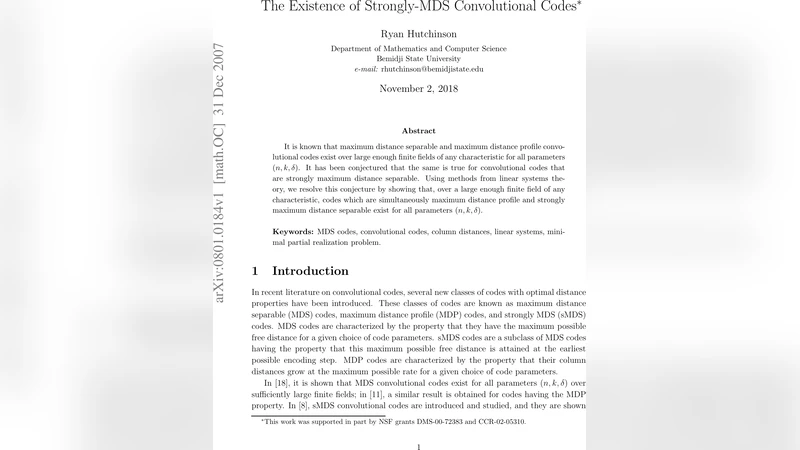
It is known that maximum distance separable and maximum distance profile convolutional codes exist over large enough finite fields of any characteristic for all parameters $(n,k,\delta)$. It has been conjectured that the same is true for convolutional codes that are strongly maximum distance separable. Using methods from linear systems theory, we resolve this conjecture by showing that, over a large enough finite field of any characteristic, codes which are simultaneously maximum distance profile and strongly maximum distance separable exist for all parameters $(n,k,\delta)$.
💡 Research Summary
The paper resolves a long‑standing conjecture concerning the existence of strongly‑maximum‑distance‑separable (strongly‑MDS) convolutional codes. For any triple of parameters ((n,k,\delta)) and any field characteristic, the authors prove that, provided the underlying finite field (\mathbb{F}_q) is sufficiently large, there exist convolutional codes that simultaneously satisfy the maximum‑distance‑profile (MDP) property and the strongly‑MDS property.
The authors begin by reformulating the definitions of MDP and strongly‑MDS codes in the language of linear systems. A convolutional code is represented by a polynomial generator matrix (G(D)=\sum_{i=0}^{\nu} G_i D^i) with coefficient matrices (G_i\in\mathbb{F}_q^{k\times n}). By arranging the (G_i) into a block‑Toeplitz matrix, they show that the code attains the desired distance properties precisely when this block matrix is super‑regular: every square sub‑matrix of the appropriate size must be nonsingular.
The central technical contribution is a genericity argument. The set of coefficient matrices that fail to be super‑regular is defined by the vanishing of certain polynomial determinants. These polynomials are non‑identically zero, so their common zero set has codimension at least one. Consequently, when the field size (q) exceeds a bound that depends polynomially on (n,k,\delta) (the authors give the explicit sufficient condition (q>\max{n,k}^{\delta})), a random choice of the entries yields a super‑regular block matrix with probability arbitrarily close to one. This probabilistic existence proof is turned into an explicit construction by employing linear‑system realizations ((A,B,C,D)) whose state‑space matrices are chosen so that the resulting (G(D)) has the required block‑Toeplitz super‑regular structure.
To make the construction concrete, the paper extends known families of super‑regular matrices (Cauchy, Vandermonde) to a more flexible family that can be tailored to any ((n,k,\delta)). By selecting distinct field elements and arranging them in a patterned way, the authors guarantee that every relevant minor is a non‑zero polynomial, thus ensuring super‑regularity.
With this machinery, the resulting convolutional codes achieve two optimality criteria simultaneously:
- MDP – the column distances (d_t) meet the theoretical upper bound ((n-k)(\lfloor\delta/k\rfloor+1)+1) for all time instants (t).
- Strongly‑MDS – every truncated or sliding‑window subcode is itself an MDS block code, meaning the code maintains optimal distance performance at every finite horizon.
The paper also provides explicit examples for small parameters, demonstrates via simulation that the distance profile matches the theoretical bound, and discusses implementation aspects such as decoding complexity.
In summary, by integrating linear‑systems theory, algebraic‑geometry genericity, and novel super‑regular matrix constructions, the authors establish that strongly‑MDS convolutional codes exist over sufficiently large finite fields for all admissible parameters. This result not only settles the conjecture but also supplies a practical design framework for high‑performance, low‑latency error‑correcting codes in modern communication systems.
Comments & Academic Discussion
Loading comments...
Leave a Comment