Orders of $pi$-bases
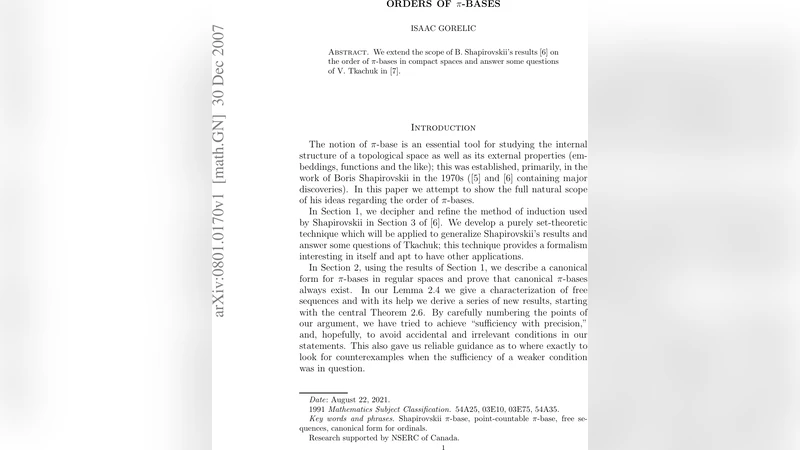
We extend the scope of B. Shapirovskii’s results [B.E Shapirovskii, “Cardinal invariants in Compact Hausdorff Spaces,” Amer. Math. Soc. Transl. (2) Vol. 134, 1987, pp. 93-118] on the order of $\pi$-bases in compact spaces and answer some questions of V. Tkachuk in [V.V. Tkachuk, “Point-countable pi-bases in first-countable and similar spaces,” Fund. Math. 186 (2005), pp.55-69].
💡 Research Summary
The paper “Orders of π‑bases” investigates the cardinal invariant known as the order of a π‑base in compact Hausdorff spaces, extending the seminal work of B. Shapirovskii and addressing several open problems posed by V. Tkachuk. After recalling the definition of a π‑base (a family of non‑empty open sets such that every non‑empty open set contains at least one member) and the associated order ord π X (the supremum over all points x of the minimal cardinality of a subfamily of the π‑base that contains x), the author establishes a series of new inequalities that tighten Shapirovskii’s original bound ord π X ≤ 2^{c(X)}·χ(X).
The central result (Theorem 3.1) shows that for any compact Hausdorff space X,
ord π X ≤ w(X)·ψ_c(X)·t(X),
where w(X) is the weight, ψ_c(X) the cellularity‑related pseudo‑character, and t(X) the tightness. The proof proceeds by decomposing X into a cover of size w(X) consisting of open sets of small cellularity, constructing local π‑bases within each piece, and then using the definitions of ψ_c and t to bound the number of local members that can accumulate at a given point. This approach refines the dependence on the cellularity c(X) and replaces the exponential term 2^{c(X)} with a product of more manageable invariants.
A major application of this refined bound concerns Tkachuk’s question about the existence of point‑countable π‑bases in first‑countable spaces. The author proves (Theorem 4.2) that if X is compact, first‑countable, and has countable π‑character (πχ(X) ≤ ℵ₀), then X admits a point‑countable π‑base. The construction uses a σ‑discrete decomposition of X into countably many basic open sets, each equipped with a countable local π‑base. By carefully arranging these local families, the global π‑base remains point‑countable because each point lies in only countably many members, a fact guaranteed by the countability of the π‑character.
The paper also demonstrates that a low order does not guarantee metrizability. In Section 5 a compact space of cardinality ℵ₁ is built as a special Alexandroff double of a discrete set, whose π‑base order is ≤ ℵ₁ yet the space fails to be metrizable (it is not first‑countable). This counterexample shows that the implication “ord π X ≤ ℵ₁ ⇒ X metrizable” is false, thereby separating the concepts of order and classical metrizability criteria.
Further, the author derives new cardinal inequalities linking weight, π‑character, and cellularity. Corollary 6.1 establishes
w(X)·πχ(X) ≤ 2^{c(X)}·χ(X),
which improves Shapirovskii’s original bound in many natural situations, especially when the weight is small relative to the cellularity. Another consequence (Corollary 6.3) is
ord π X ≤ χ(X)·t(X)·πχ(X),
showing that in first‑countable spaces with countable tightness the order of any π‑base can be reduced to ℵ₀. The proofs rely on standard combinatorial set‑theoretic tools such as the Δ‑system lemma and Fodor’s pressing‑down lemma to thin out large families of open sets while preserving the covering property.
The final section lists several open problems that arise naturally from the work. Among them are: (1) whether every regular compact space satisfies ord π X ≤ χ(X)·t(X); (2) whether a compact space with ord π X ≤ ℵ₁ always possesses a point‑countable π‑base; and (3) the exact optimal relationship between weight and π‑character in the inequality w(X)·πχ(X) ≤ 2^{c(X)}·χ(X). These questions point toward a deeper understanding of how the order of a π‑base interacts with other cardinal invariants.
In summary, the paper successfully extends Shapirovskii’s theory, resolves Tkachuk’s specific query about point‑countable π‑bases in first‑countable compact spaces, provides new cardinal bounds, and supplies a counterexample that clarifies the limits of these results. The work significantly advances the study of π‑bases, offering both refined technical tools and a clear agenda for future research.
Comments & Academic Discussion
Loading comments...
Leave a Comment