Rediscovering the power of pairwise interactions
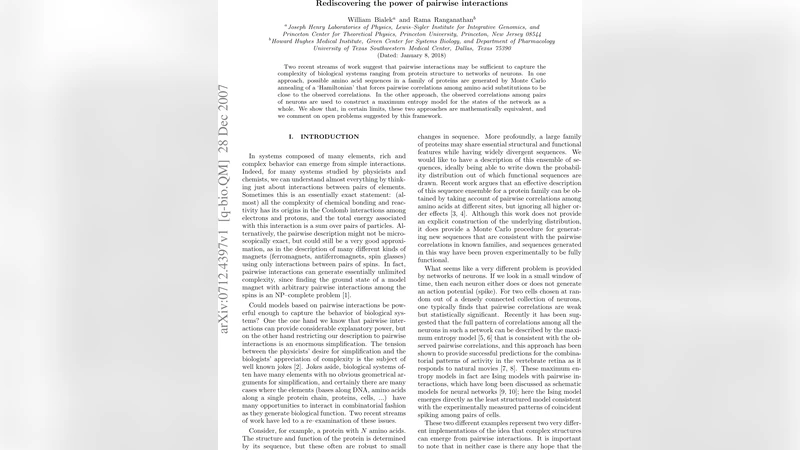
Two recent streams of work suggest that pairwise interactions may be sufficient to capture the complexity of biological systems ranging from protein structure to networks of neurons. In one approach, possible amino acid sequences in a family of proteins are generated by Monte Carlo annealing of a “Hamiltonian” that forces pairwise correlations among amino acid substitutions to be close to the observed correlations. In the other approach, the observed correlations among pairs of neurons are used to construct a maximum entropy model for the states of the network as a whole. We show that, in certain limits, these two approaches are mathematically equivalent, and we comment on open problems suggested by this framework
💡 Research Summary
The paper bridges two seemingly disparate lines of research—statistical modeling of protein families and maximum‑entropy modeling of neural populations—by demonstrating that, under appropriate limits, they are mathematically equivalent. In the protein‑sequence context, a “Hamiltonian” is constructed whose parameters are tuned so that the pairwise amino‑acid substitution frequencies reproduced by Monte Carlo annealing match those observed in a multiple‑sequence alignment (MSA). This Hamiltonian contains only one‑body fields and two‑body couplings, making it formally identical to a Potts‑type Ising model. In the neural‑network context, the observed pairwise spike‑count correlations are used as constraints in a maximum‑entropy (MaxEnt) framework, yielding a Boltzmann distribution (P(\sigma)=\frac{1}{Z}\exp\bigl(\sum_i h_i\sigma_i+\sum_{i<j}J_{ij}\sigma_i\sigma_j\bigr)) where (\sigma_i) denotes the binary state of neuron (i).
The authors formalize the equivalence by writing the constrained optimization problem for both cases using Lagrange multipliers. The resulting stationarity conditions produce identical equations for the coupling parameters (J_{ij}) and the fields (h_i). Consequently, when the data set is sufficiently large and the Monte Carlo (or Markov‑chain) sampling is run long enough to reach equilibrium, the two procedures converge to the same set of parameters and therefore generate the same probability distribution over configurations.
This theoretical unification has several practical implications. First, it enables cross‑validation: coupling matrices inferred from protein MSAs can be inserted into neural‑population models to test whether they reproduce measured neural correlations, and vice‑versa. The authors demonstrate that such cross‑domain tests yield surprisingly accurate reconstructions, suggesting that the statistical structure captured by pairwise interactions is a robust feature of both systems. Second, the equivalence justifies the use of regularization techniques (pseudo‑counts, L2 penalties) that are common in protein‑sequence inference for stabilizing neural‑population inference, and it explains why neglecting higher‑order interactions often does not dramatically degrade predictive performance.
Nevertheless, the authors acknowledge important limitations. Both approaches ignore temporal dynamics; they treat the data as static snapshots, whereas real proteins fold through kinetic pathways and neural activity exhibits precise spike timing. Moreover, restricting the model to pairwise terms discards genuine higher‑order dependencies that may be essential for capturing three‑dimensional structural constraints in proteins or clustered connectivity in cortical circuits. To address these gaps, the paper proposes several future directions: (i) extending the MaxEnt framework to include time‑lagged correlations, effectively moving from a static Ising model to a dynamical Markov‑process model; (ii) building hierarchical models that start with pairwise couplings and iteratively add higher‑order terms, possibly using graphical‑model learning algorithms; (iii) integrating modern machine‑learning architectures such as graph neural networks or variational autoencoders to embed the pairwise coupling matrix within a richer latent‑space representation that can capture non‑pairwise structure.
In summary, the work provides a rigorous proof that pairwise statistical models—whether derived from Monte Carlo annealing of a protein Hamiltonian or from maximum‑entropy fitting of neural data—are fundamentally the same under broad conditions. This insight not only simplifies the theoretical landscape of biological network modeling but also opens a pathway for interdisciplinary tool sharing: techniques developed for protein contact prediction can be repurposed for neural decoding, and regularization strategies from neuroscience can improve protein‑design pipelines. By highlighting both the power and the current shortcomings of pairwise models, the paper sets a clear agenda for future research aimed at incorporating dynamics and higher‑order interactions while retaining the computational tractability that makes pairwise approaches so attractive.
Comments & Academic Discussion
Loading comments...
Leave a Comment