Cell biology: Networks, regulation, pathways
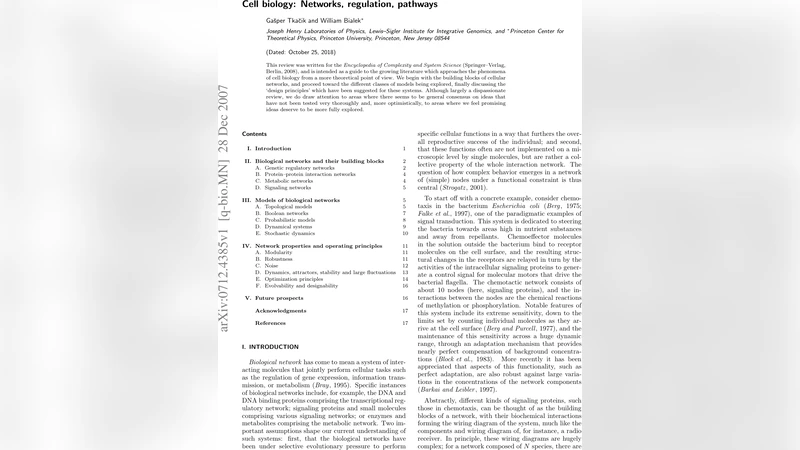
This review was written for the Encyclopedia of Complexity and System Science (Springer-Verlag, Berlin, 2008), and is intended as a guide to the growing literature which approaches the phenomena of cell biology from a more theoretical point of view. We begin with the building blocks of cellular networks, and proceed toward the different classes of models being explored, finally discussing the “design principles” which have been suggested for these systems. Although largely a dispassionate review, we do draw attention to areas where there seems to be general consensus on ideas that have not been tested very thoroughly and, more optimistically, to areas where we feel promising ideas deserve to be more fully explored.
💡 Research Summary
This review, originally written for the Encyclopedia of Complexity and System Science (2008), serves as a comprehensive guide to the growing body of literature that treats cell biology from a theoretical, systems‑level perspective. It begins by defining the fundamental building blocks of cellular networks—proteins, nucleic acids, metabolites, and small signaling molecules—and highlights modern high‑throughput techniques (large‑scale protein‑protein interaction screens, quantitative mass spectrometry, single‑cell RNA‑seq) that provide the quantitative interaction data needed for network reconstruction.
The author then classifies the principal modeling approaches into four categories. First, static graph‑theoretic models describe the topology of networks using metrics such as degree centrality, clustering coefficients, and community‑detection algorithms, allowing identification of hubs and modular structures. Second, Boolean network models reduce each component to an ON/OFF state, enabling rapid simulation of large regulatory systems and the analysis of attractor landscapes that correspond to distinct cellular fates. Third, continuous deterministic models based on ordinary differential equations capture the precise kinetic behavior of metabolic pathways and signal transduction cascades by incorporating reaction rates and concentration changes over time. Fourth, stochastic models (e.g., Gillespie algorithm, stochastic differential equations) account for intrinsic molecular noise that becomes significant when copy numbers are low. The review stresses that each framework has distinct data requirements, computational costs, and interpretive strengths, and that hybrid strategies—combining, for example, Boolean logic for regulatory layers with ODEs for metabolic fluxes—are often the most biologically realistic.
In the “design principles” section, concepts borrowed from complex‑systems theory are mapped onto cellular networks. Robustness is described as the ability of a network to maintain function despite external perturbations or internal mutations; this is achieved through redundant pathways, feedback loops, and distributed control, with concrete examples drawn from MAPK and PI3K/AKT signaling. Modularity is presented as the emergence of semi‑independent functional sub‑networks that can evolve, be rewired, or be repurposed with minimal impact on the rest of the system, thereby supporting both evolutionary conservation and signal specificity. The review also discusses feed‑forward and feedback control motifs, as well as mixed digital‑analog regulation, illustrating how cells integrate binary switches with graded responses to adapt to fluctuating environments.
A critical part of the paper points out that several widely accepted ideas—such as the notion that network hubs are preferential disease genes—remain under‑tested experimentally, despite strong statistical correlations. Conversely, the author identifies promising but underexplored avenues: the relationship between scale‑free topology and dynamic stability, the integration of multi‑omics data for network reconstruction, and systematic validation of proposed design principles using synthetic biology platforms.
Finally, the author calls for standardized data formats (SBML, BioPAX) and shared repositories to bridge theoretical models and experimental datasets. Emerging computational tools, including machine‑learning‑based parameter inference and Bayesian network reconstruction, are highlighted as catalysts for future progress. The review concludes that viewing cell biology through the lens of complexity science not only complements traditional reductionist experiments but also opens pathways toward a predictive, system‑wide understanding of cellular behavior.
Comments & Academic Discussion
Loading comments...
Leave a Comment