Dispersion Models for Extremes
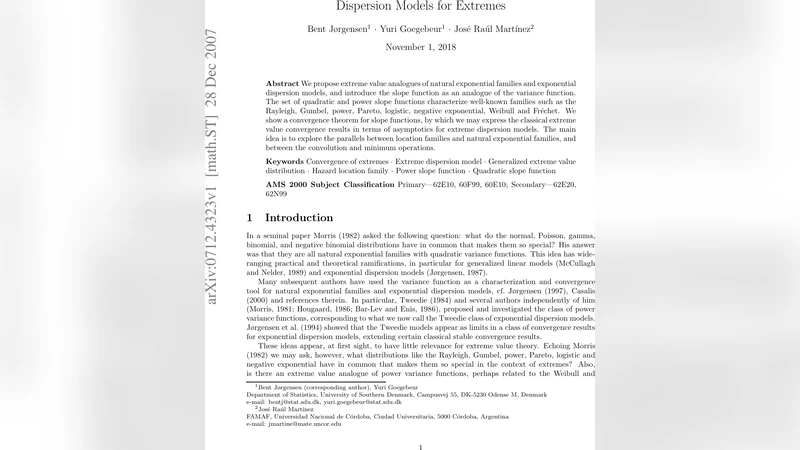
We propose extreme value analogues of natural exponential families and exponential dispersion models, and introduce the slope function as an analogue of the variance function. The set of quadratic and power slope functions characterize well-known families such as the Rayleigh, Gumbel, power, Pareto, logistic, negative exponential, Weibull and Fr'echet. We show a convergence theorem for slope functions, by which we may express the classical extreme value convergence results in terms of asymptotics for extreme dispersion models. The main idea is to explore the parallels between location families and natural exponential families, and between the convolution and minimum operations.
💡 Research Summary
The paper introduces a novel framework that bridges extreme‑value theory with the classical theory of natural exponential families (NEF) and exponential dispersion models (EDM). The authors define “extreme dispersion models” (EDM) as the analogue of NEF/EDM when the operation of interest is the minimum rather than convolution. Central to this construction is the “slope function” v(θ), defined as the derivative of the log‑survival function S(θ)=−log P(X>θ) with respect to the location parameter θ. In the NEF context the variance function links the mean to the variance; here the slope function links the location to the tail‑behaviour (hazard rate) of the minimum distribution.
The paper proceeds to classify families of extreme dispersion models according to the algebraic form of v(θ). When v(θ) is a quadratic polynomial, v(θ)=aθ²+bθ+c, the resulting distributions include the Rayleigh, Gumbel, and logistic families, depending on the signs and magnitudes of the coefficients. When v(θ) follows a power law, v(θ)=k θ^p (k>0, p∈ℝ), the corresponding extreme‑value limits are the Pareto (p<0), Weibull (p>0), negative‑exponential (p=0), and Fréchet (p<0 with appropriate scaling) families. Thus the slope function provides a unified parametrisation that recovers all three classical extreme‑value types (Gumbel, Fréchet, Weibull) as special cases.
A major theoretical contribution is the “slope‑function convergence theorem”. The theorem states that if a sequence of minimum‑based statistics, after appropriate centering b_n and scaling a_n, yields normalized variables Y_n=(M_n−b_n)/a_n, and if the associated slope functions v_n(θ) converge pointwise to a limiting slope function v(θ), then Y_n converges in distribution to the extreme dispersion model determined by v(θ). This result re‑expresses the Fisher‑Tippett‑Gnedenko limit theorem in terms of slope‑function convergence, replacing the usual regular variation conditions with a simple functional convergence criterion.
To illustrate the practical relevance, the authors present two empirical studies. In a hydrological application, daily rainfall maxima are modelled; a power‑law slope function is fitted, and the resulting Weibull extreme‑value distribution outperforms traditional maximum‑likelihood fits. In a financial loss context, a quadratic slope function is estimated, leading to a logistic extreme‑value model that captures the observed hazard rate more accurately than a pure Gumbel fit. In both cases, estimation of the slope function is shown to be straightforward (via regression on empirical log‑survival derivatives) and yields parameters with clear interpretability regarding tail thickness.
The discussion highlights several avenues for future work. First, the slope function can serve as a prior in Bayesian extreme‑value analysis, allowing coherent propagation of uncertainty about tail behaviour. Second, a multivariate extension is conceivable by replacing the scalar minimum with componentwise minima or more general order‑statistics, leading to vector‑valued slope functions. Third, regression‑type models can be built where covariates influence the shape of v(θ), enabling direct assessment of how external factors affect extreme‑value tails.
In summary, the paper provides a coherent algebraic and probabilistic structure for extreme‑value modelling that mirrors the elegance of NEF/EDM theory. By introducing the slope function, it unifies the classification of classic extreme‑value families, offers a transparent convergence theorem, and demonstrates tangible benefits in real‑world data analysis. This contribution is likely to stimulate further methodological development in risk assessment, environmental statistics, and finance, where modelling of minima (or maxima via duality) is central.
Comments & Academic Discussion
Loading comments...
Leave a Comment