Evolutionary Catastrophes and the Goldilocks Problem
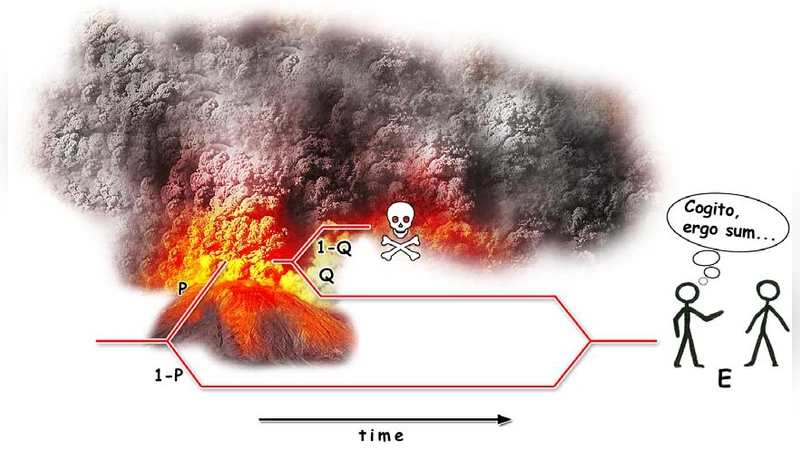
One of the mainstays of the controversial “rare Earth” hypothesis is the “Goldilocks problem” regarding various parameters describing a habitable planet, partially involving the role of mass extinctions and other catastrophic processes in biological evolution. Usually, this is construed as support for the uniqueness of the Earth’s biosphere and intelligent human life. Here I argue that this is a misconstrual and that, on the contrary, observation-selection effects, when applied to catastrophic processes, make it very difficult for us to discern whether the terrestrial biosphere and evolutionary processes which created it are exceptional in the Milky Way or not. In particular, an anthropic overconfidence bias related to the temporal asymmetry of evolutionary processes appears when we try to straightforwardly estimate catastrophic risks from the past records on Earth. This agnosticism, in turn, supports the validity and significance of practical astrobiological and SETI research.
💡 Research Summary
The paper revisits the “Goldilocks problem” that underpins the controversial Rare Earth hypothesis, which argues that a narrow set of planetary parameters must be just right for life and intelligence to develop. Traditionally, this argument has been bolstered by the role of mass‑extinction events and other catastrophic processes, suggesting that Earth’s evolutionary history is uniquely fine‑tuned. The author challenges this view by foregrounding observation‑selection effects (anthropic bias) and a temporal asymmetry in evolutionary processes.
First, the author explains that any assessment of catastrophic risk based solely on Earth’s fossil record is inherently biased. Because we exist, we necessarily occupy a survivable branch of Earth’s history—one that has already filtered out the most lethal catastrophes. This “observer‑selection” filter means that the distribution of past extinction events we can study is not a random sample of all possible planetary histories, but a survivorship‑biased subset. Consequently, extrapolating Earth’s extinction frequency or intensity to the whole Milky Way is statistically unsound.
Second, the paper introduces the concept of “anthropic overconfidence bias.” Human civilization arose late in Earth’s timeline, after several major extinction pulses. Our perspective is therefore temporally asymmetric: we have detailed knowledge of past catastrophes that we survived, but we lack any data on future catastrophes that could still occur. Relying on past data alone leads to an unjustified confidence that the risk of future catastrophic events is low, when in fact the record is truncated by the very fact of our survival.
The author argues that the Goldilocks “habitable zone” for life is, in part, a product of this observer‑centric filtering. Only planets that experience a certain range of catastrophic frequencies and magnitudes can host observers; planets outside that range simply lack observers to notice them. This makes the Goldilocks interval a conditional, not an absolute, constraint on planetary habitability.
To mitigate these biases, the paper proposes two methodological shifts. (1) Incorporate observer‑independent proxies from exoplanet observations—such as impact crater statistics, atmospheric composition anomalies, and stellar activity signatures—to build a more complete picture of planetary catastrophe rates across the galaxy. (2) Use probabilistic models that explicitly include a prior distribution for catastrophic events that is not conditioned on the existence of observers, and then apply Bayesian updating to account for the selection effect.
By adopting these approaches, researchers can better separate the intrinsic astrophysical and geological factors that drive planetary catastrophes from the anthropic filter that shapes our perception of them. This, in turn, strengthens the scientific basis for astrobiology and SETI initiatives, because it reframes the question from “Is Earth uniquely suited for life?” to “Given the full spectrum of planetary histories, how likely is it that life and intelligence arise elsewhere?” The paper concludes that the apparent uniqueness of Earth’s evolutionary path is not demonstrable with current data, and that acknowledging our observational biases actually supports the continued, pragmatic search for extraterrestrial life.
Comments & Academic Discussion
Loading comments...
Leave a Comment