KIF1A kinesins are single-headed motor proteins which move on cylindrical nano-tubes called microtubules (MT). A normal MT consists of 13 protofilaments on which the equispaced motor binding sites form a periodic array. The collective movement of the kinesins on a MT is, therefore, analogous to vehicular traffic on multi-lane highways where each protofilament is the analogue of a single lane. Does lane-changing increase or decrease the motor flux per lane? We address this fundamental question here by appropriately extending a recent model [{\it Phys. Rev. E {\bf 75}, 041905 (2007)}]. By carrying out analytical calculations and computer simulations of this extended model, we predict that the flux per lane can increase or decrease with the increasing rate of lane changing, depending on the concentrations of motors and the rate of hydrolysis of ATP, the ``fuel'' molecules. Our predictions can be tested, in principle, by carrying out {\it in-vitro} experiments with fluorescently labelled KIF1A molecules.
Deep Dive into Traffic of single-headed motor proteins KIF1A: effects of lane changing.
KIF1A kinesins are single-headed motor proteins which move on cylindrical nano-tubes called microtubules (MT). A normal MT consists of 13 protofilaments on which the equispaced motor binding sites form a periodic array. The collective movement of the kinesins on a MT is, therefore, analogous to vehicular traffic on multi-lane highways where each protofilament is the analogue of a single lane. Does lane-changing increase or decrease the motor flux per lane? We address this fundamental question here by appropriately extending a recent model [{\it Phys. Rev. E {\bf 75}, 041905 (2007)}]. By carrying out analytical calculations and computer simulations of this extended model, we predict that the flux per lane can increase or decrease with the increasing rate of lane changing, depending on the concentrations of motors and the rate of hydrolysis of ATP, the ``fuel’’ molecules. Our predictions can be tested, in principle, by carrying out {\it in-vitro} experiments with fluorescently labelled K
Members of the kinesin superfamily of motor proteins move along microtubules (MTs) which are cylindrical nano-tubes [1,2]. A normal MT consists of 13 protofilaments each of which is formed by the head-to-tail sequential lining up of basic subunits. Each subunit of a protofilament is a 8 nm heterodimer of α-β tubulins and provides a specific binding site for a single head of a kinesin motor. Often many kinesins move simultaneously along a given MT; because of close similarities with vehicular traffic [3], the collective movement of the molecular motors on a MT is sometimes referred to as molecular motor traffic [4,5,6,7,8].
The effects of lane changing on the flow properties of vehicular traffic has been investigated extensively using particle-hopping models [3] which are, essentially, appropriate extensions of the totally asymmetric simple exclusion process (TASEP) [9,10,11]. Models of multi-lane TASEP, where the particles can occasionally change lane, have also been investigated analytically [12,13]. Twolane generalizations of generic models of cytoskeletal molecular motor traffic have also been reported [14,15].
Recently a quantitative theoretical model has been developed [16,17] (from now onwards, we shall refer to it as the NOSC model) for the traffic of KIF1A proteins, which are single-headed kinesins [18,19,20], by explicitly capturing the essential features of the mechano-chemical cycle of each individual KIF1A motor, in addition to their steric interactions. In this communication we extend the NOSC model by adding to the master equation all those terms which correspond to lane changing. Solving these equations analytically, we address a fundamental question: does lane changing increase or decrease flux per lane? We show that the answer to this question depends on the parameter regime of our model. We establish the levels of accuracy of our analytical results by comparing with the corresponding numerical data obtained from computer simulations of the model. We interpret the results physically and suggest experiments for testing our theoretical predictions. The equispaced binding sites for KIF1A on a given protofilament of the MT are labelled by the integer index i (i = 1, …, L). We use the integer index j to label the protofilaments; the position of each binding site is denoted completely by the pair (i, j). Because of the tubular geometry of the MT, periodic boundary conditions along the j-direction would be a natural choice. We impose periodic boundary conditions also along the i-direction, as it not only simplifies our analytical calculations but is also adequate to answer the fundamental questions which we address in this communication.
In each mechano-chemical cycle a KIF1A motor hydrolyzes one molecule of adenosine triphosphate (ATP) which supplies the mechanical energy required for its movement. The experimental results on KIF1A motors [18,19,20] indicate that a simplified description of its mechano-chemical cycle in terms of a 2-state model [16] would be sufficient to understand their traffic on a MT. In the two “chemical” states labelled by the symbols S and W the motor is, respectively, strongly and weakly bound to the MT.
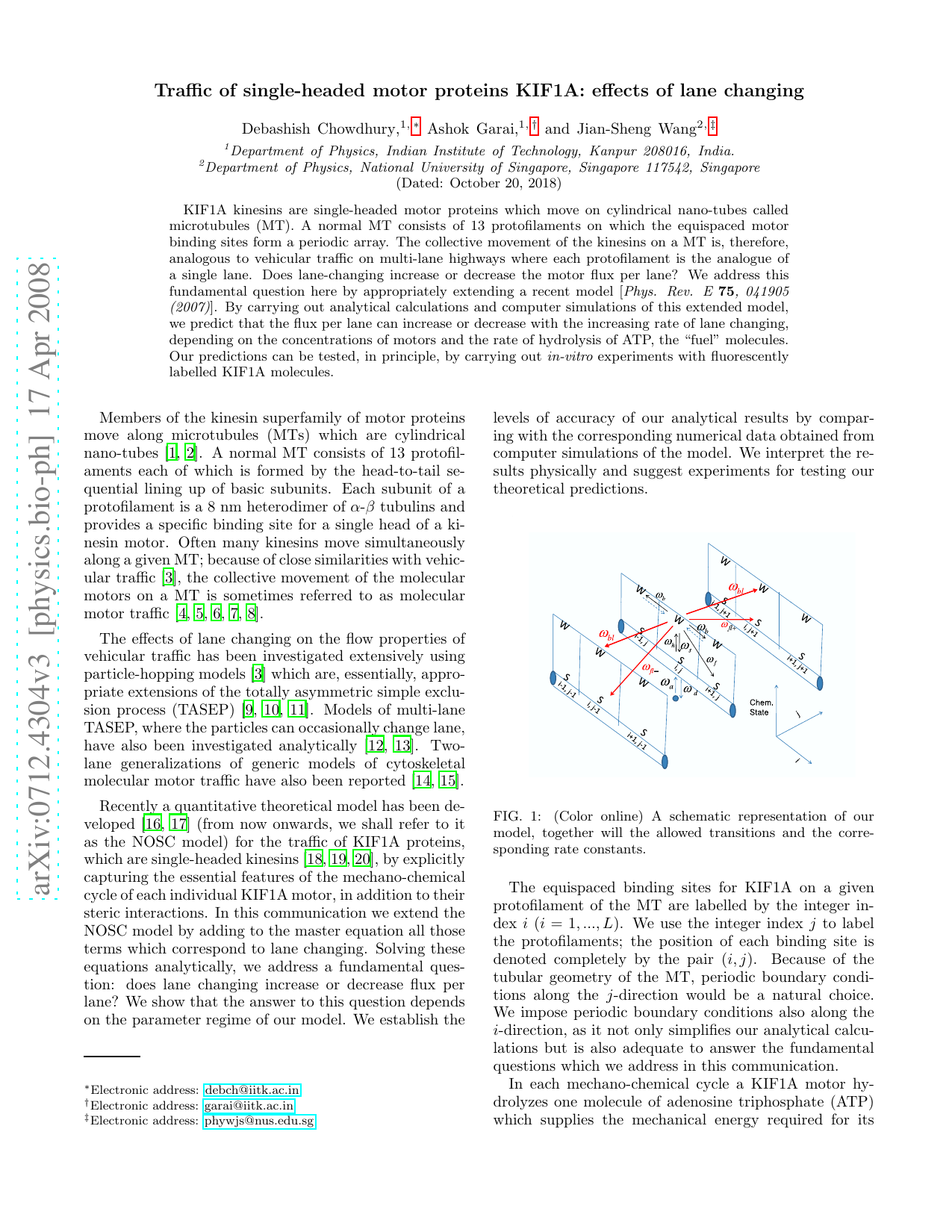
In the NOSC model, a KIF1A molecule is allowed to attach to (and detach from) a site with rates ω a (and ω d ). The rate constant ω b corresponds to the unbiased Brownian motion of the motor in the state W . The rate constant ω h is associated with the process driven by ATP hydrolysis which causes the transition of the motor from the state S to the state W . The rate constants ω f and ω s , together, capture the Brownian ratchet mechanism [21,22] of a KIF1A motor. Moreover, any movement of the motor under these rules is, finally, implemented only if the target site is not already occupied by another motor.
The rules of time evolution in the extended NOSC model proposed here are identical to those in the NOSC model, except for the following additional lane-changing rules (see fig. 1): a motor weakly-bound (i.e., in state W ) to the binding site i on the protofilament j is allowed to move to the positions (i, j + 1) and (i, j -1) (i) without simultaneous change in its chemical state, both the corresponding rates being ω bl ; (ii) with simultaneous transition to the chemical state S, the corresponding rate constants being ω f l+ and ω f l-, respectively.
Let S i (j, t) and W i (j, t) denote the probabilities for a motor to be in the “chemical” states S and W , respectively, at site i on the protofilament j. In the extended NOSC model, under mean-field approximation, the master equations for the probabilities S i (j, t) and W i (j, t) are given by
Rate constant numerical value/range (s In the steady state under periodic boundary conditions, S = S i (j, t) and W = W i (j, t), independent of t and irrespective of i and j; from eqs.( 1) and ( 2), we get
where
The average total density of the motors attached to each filament of the MT in the steady state is given by
U
…(Full text truncated)…
This content is AI-processed based on ArXiv data.