Discrete logarithms in curves over finite fields
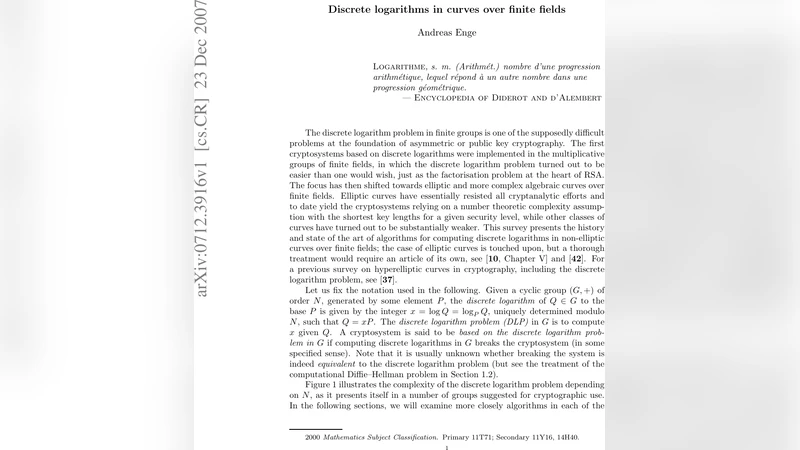
A survey on algorithms for computing discrete logarithms in Jacobians of curves over finite fields.
💡 Research Summary
This survey paper provides a comprehensive overview of the state‑of‑the‑art algorithms for solving the discrete logarithm problem (DLP) in the Jacobians of algebraic curves defined over finite fields. The authors begin by motivating the importance of the DLP in modern public‑key cryptography, noting that curve‑based systems such as elliptic‑curve cryptography (ECC) and hyperelliptic‑curve cryptography (HEC) rely on the presumed hardness of computing logarithms in these groups. After a brief mathematical preliminaries section that defines Jacobians, genus, and group order (≈ q^g for a field of size q and genus g), the paper classifies algorithms into four major families.
-
Generic algorithms – Baby‑step‑giant‑step, Pollard’s ρ, and parallel variants. These methods have a √N time complexity (N ≈ q^g) and are independent of the curve’s structure, but they become impractical for security levels beyond a few hundred bits because they require exponential resources in the genus.
-
Index‑calculus methods – The classic subexponential approach that expresses random divisor classes as linear combinations of a small “factor base” of low‑degree divisors. By collecting enough relations and solving a sparse linear system, one obtains logarithms in time L_q
Comments & Academic Discussion
Loading comments...
Leave a Comment