Hopf modules for autonomous pseudomonoids and the monoidal centre
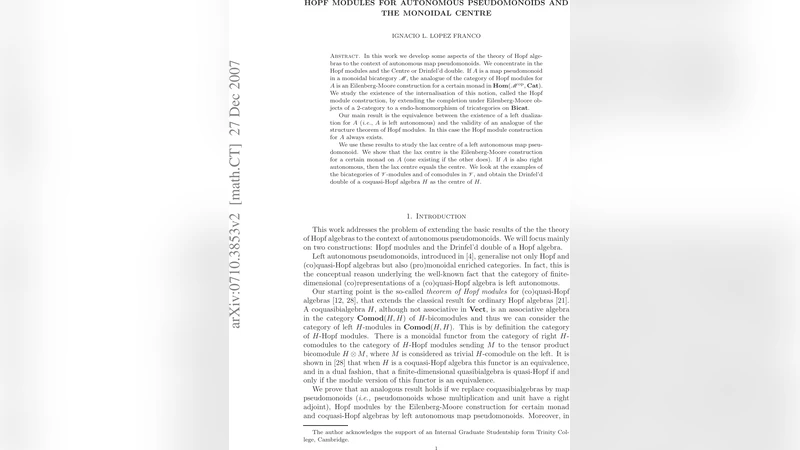
In this work we develop some aspects of the theory of Hopf algebras to the context of autonomous map pseudomonoids. We concentrate in the Hopf modules and the Centre or Drinfel’d double. If $A$ is a map pseudomonoid in a monoidal bicategory \M, the analogue of the category of Hopf modules for $A$ is an Eilenberg-Moore construction for a certain monad in $\mathbf{Hom}(\M^{\mathrm{op}},\mathbf{Cat})$. We study the existence of the internalisation of this notion, called the Hopf module construction, by extending the completion under Eilenberg-Moore objects of a 2-category to a endo-homomorphism of tricategories on $\mathbf{Bicat}$. Our main result is the equivalence between the existence of a left dualization for $A$ ({\em i.e.}, $A$ is left autonomous) and the validity of an analogue of the structure theorem of Hopf modules. In this case the Hopf module construction for $A$ always exists. We use these results to study the lax centre of a left autonomous map pseudomonoid. We show that the lax centre is the Eilenberg-Moore construction for a certain monad on $A$ (one existing if the other does). If $A$ is also right autonomous, then the lax centre equals the centre. We look at the examples of the bicategories of \V-modules and of comodules in \V, and obtain the Drinfel’d double of a coquasi-Hopf algebra $H$ as the centre of $H$.
💡 Research Summary
This paper extends core concepts of Hopf algebra theory to the setting of autonomous map pseudomonoids inside a monoidal bicategory (\mathcal{M}). The authors begin by recalling that a map pseudomonoid (A) in (\mathcal{M}) is a higher‑dimensional analogue of a Hopf algebra, but the usual notions of modules and comodules do not translate directly to the bicategorical context. To overcome this, they construct a specific monad (\mathbb{H}_A) on the 2‑category (\mathbf{Hom}(\mathcal{M}^{\mathrm{op}},\mathbf{Cat})). For any pseudofunctor (F:\mathcal{M}^{\mathrm{op}}\to\mathbf{Cat}), (\mathbb{H}_A(F)) simultaneously incorporates the left and right actions of (A), thereby encoding the compatibility condition that defines a Hopf module.
The Eilenberg–Moore (EM) object of (\mathbb{H}_A) is taken as the “category of Hopf modules” for (A). However, EM objects do not automatically exist in an arbitrary bicategory. The authors therefore develop a completion process that freely adds EM objects to any 2‑category. This construction is lifted to the tricategory (\mathbf{Bicat}) as an endo‑homomorphism (\mathsf{EM}:\mathbf{Bicat}\to\mathbf{Bicat}). Applying (\mathsf{EM}) to (\mathcal{M}) yields a new bicategory in which every monad, in particular (\mathbb{H}_A), has an EM object. The resulting EM object is called the Hopf module construction for (A) and lives internally in the completed bicategory.
The central theorem establishes an exact equivalence between two conditions: (1) (A) is left autonomous, i.e. it possesses a left dual (A^\vee) together with evaluation and coevaluation 2‑cells; (2) the structure theorem for Hopf modules holds, meaning that the EM category of (\mathbb{H}_A) exists and is equivalent to the ordinary category of left (A)‑modules. The proof proceeds in both directions. From left autonomy one can explicitly build the monad (\mathbb{H}_A) and its EM object, using the duality to define the required action‑coaction compatibility. Conversely, assuming the EM object exists and the equivalence of categories holds, one reconstructs the evaluation and coevaluation maps, thereby proving left autonomy. Consequently, left autonomy is precisely the condition guaranteeing the existence of the Hopf module construction.
Having secured the Hopf module framework, the authors turn to the lax centre of a left autonomous map pseudomonoid. They define another monad (\mathbb{Z}_A) on (\mathbf{Hom}(\mathcal{M}^{\mathrm{op}},\mathbf{Cat})) whose algebras encode objects equipped with a half‑braiding that is only laxly natural. The EM object of (\mathbb{Z}_A) is denoted (\operatorname{LaxZ}(A)) and called the lax centre. A crucial observation is that the existence of (\operatorname{LaxZ}(A)) is contingent on the existence of the Hopf module EM object; the two monads are intertwined. If (A) is also right autonomous, the lax centre coincides with the ordinary centre (\operatorname{Z}(A)), i.e. the Drinfel’d double in the bicategorical sense.
The theory is illustrated with two concrete families of bicategories. First, (\mathbf{Mod}\mathcal{V}), the bicategory of (\mathcal{V})‑modules, where objects are (\mathcal{V})‑categories, 1‑cells are (\mathcal{V})‑module functors, and 2‑cells are natural transformations. In this setting a map pseudomonoid corresponds to a (\mathcal{V})‑algebra, and left autonomy translates to the existence of a strong dual object. Second, (\mathbf{Comod}\mathcal{V}), the bicategory of comodules over a symmetric monoidal closed category (\mathcal{V}). Here a map pseudomonoid is a coquasi‑Hopf algebra (H). Applying the general results, the authors show that the centre (\operatorname{Z}(H)) is precisely the Drinfel’d double (D(H)) of the coquasi‑Hopf algebra, thereby recovering the classical construction within the higher‑categorical framework.
In summary, the paper achieves three major advances: (i) it provides a robust definition of Hopf modules for autonomous pseudomonoids via a monad on a hom‑bicategory; (ii) it proves that left autonomy is equivalent to the Hopf module structure theorem and guarantees the existence of the Hopf module construction; (iii) it identifies the lax centre as an EM construction and shows that, under full autonomy, it coincides with the usual centre, yielding the Drinfel’d double in concrete examples. These results open the door to applying Hopf‑type techniques in higher‑dimensional algebra, quantum topology, and the study of 3‑dimensional topological quantum field theories, where bicategorical and tricategorical structures naturally arise.
Comments & Academic Discussion
Loading comments...
Leave a Comment