Nonparametric estimation for a stochastic volatility model
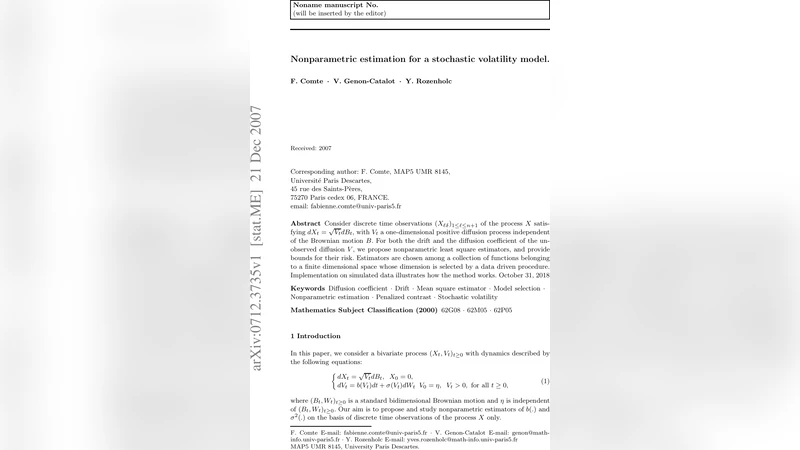
Consider discrete time observations (X_{\ell\delta})_{1\leq \ell \leq n+1}$ of the process $X$ satisfying $dX_t= \sqrt{V_t} dB_t$, with $V_t$ a one-dimensional positive diffusion process independent of the Brownian motion $B$. For both the drift and the diffusion coefficient of the unobserved diffusion $V$, we propose nonparametric least square estimators, and provide bounds for theirrisk. Estimators are chosen among a collection of functions belonging to a finite dimensional space whose dimension is selected by a data driven procedure. Implementation on simulated data illustrates how the method works.
💡 Research Summary
The paper addresses the problem of estimating the drift and diffusion functions of an unobserved volatility process (V_t) in the stochastic differential equation (dX_t=\sqrt{V_t},dB_t), when only discrete‑time observations ({X_{\ell\delta}}{\ell=1}^{n+1}) are available. The volatility process (V_t) is a one‑dimensional positive diffusion, independent of the driving Brownian motion (B_t). Because (V_t) cannot be observed directly, the authors first construct a proxy (\widehat V{\ell\delta}= (\Delta X_{\ell})^{2}/\delta) from the increments of (X). This proxy is shown to be an unbiased (up to (O(\delta))) estimator of (V_{\ell\delta}) and serves as the basis for all subsequent inference.
For the drift function (b(\cdot)) of (V_t), the paper proposes a least‑squares estimator based on the approximate relationship (\Delta\widehat V_{\ell}= \widehat V_{(\ell+1)\delta}-\widehat V_{\ell\delta}\approx \delta,b(\widehat V_{\ell\delta})). The estimator is obtained by projecting onto a finite‑dimensional linear space (\mathcal S_m=\text{span}{\phi_1,\dots,\phi_m}) (e.g., polynomial or spline bases) and minimizing the empirical squared error: \
Comments & Academic Discussion
Loading comments...
Leave a Comment