A Quantitative Measure of Experimental Scientific Merit
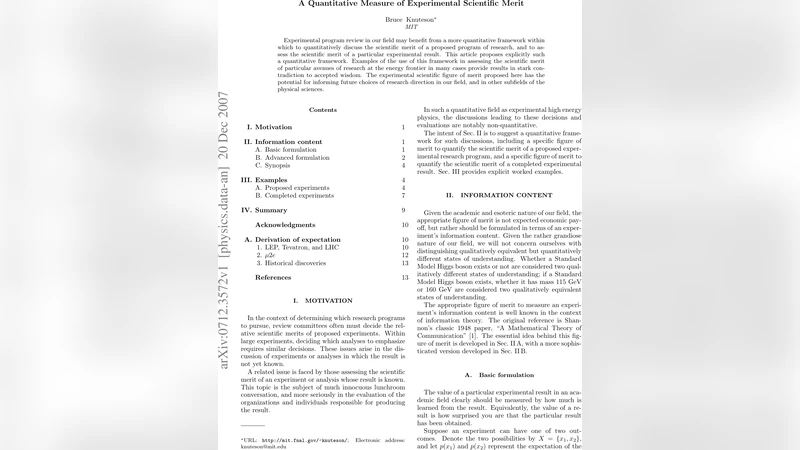
Experimental program review in our field may benefit from a more quantitative framework within which to quantitatively discuss the scientific merit of a proposed program of research, and to assess the scientific merit of a particular experimental result. This article proposes explicitly such a quantitative framework. Examples of the use of this framework in assessing the scientific merit of particular avenues of research at the energy frontier in many cases provide results in stark contradiction to accepted wisdom. The experimental scientific figure of merit proposed here has the potential for informing future choices of research direction in our field, and in other subfields of the physical sciences.
💡 Research Summary
The paper proposes a quantitative framework for assessing the scientific merit of experimental programs, aiming to replace the largely qualitative judgments that currently dominate funding and strategic decisions in high‑energy physics and related fields. The authors build the framework on two well‑established statistical concepts: Bayesian probability updating and information‑theoretic entropy.
First, they define the “information gain” (I) of an experiment as the expected reduction in Shannon entropy of the probability distribution over competing theoretical hypotheses. In practice, one assigns a prior probability p(θ) to each hypothesis θ before the experiment, computes the likelihood of possible outcomes r, and then updates to a posterior p(θ|r) using Bayes’ theorem. The Kullback‑Leibler divergence DKL
Comments & Academic Discussion
Loading comments...
Leave a Comment