Convex Hulls of Orbits and Orientations of a Moving Protein Domain
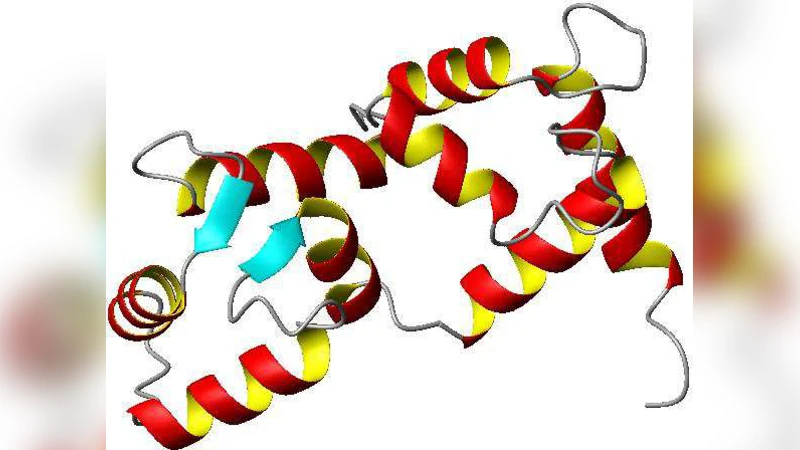
We study the facial structure and Carath'eodory number of the convex hull of an orbit of the group of rotations in R^3 acting on the space of pairs of anisotropic symmetric 3\times 3 tensors. This is motivated by the problem of determining the structure of some proteins in aqueous solution.
💡 Research Summary
The paper investigates the convex hull of the orbit generated by the three‑dimensional rotation group SO(3) acting on a pair of anisotropic symmetric 3 × 3 tensors. The authors model each tensor as a traceless symmetric matrix, representing the electric and magnetic susceptibility tensors of a protein domain in solution. The orbit consists of all possible orientations of the pair under rotations, and its convex hull C captures all convex combinations of these oriented states, which correspond to experimentally observable averaged tensors obtained from techniques such as NMR or SAXS.
First, the authors characterize the facial structure of C. By exploiting the invariance of the orbit under SO(3), they show that each face of C is associated with a stabilizer subgroup of the rotation group, i.e., a set of rotations that leave a particular alignment of the tensors unchanged. When the tensors possess axial symmetry, the stabilizer is a one‑parameter subgroup (rotations about the symmetry axis), and the corresponding face is a low‑dimensional facet of C. In the generic case where both tensors are fully asymmetric, the only stabilizer is the identity, and C becomes a full‑dimensional convex body in ℝ⁶. The paper provides explicit formulas for the normal vectors of the faces in terms of invariant polynomials such as Tr(T₁²), Tr(T₂²) and Tr(T₁T₂).
Second, the Carathéodory number κ(C) – the smallest number of orbit points needed to express any point of C as a convex combination – is determined. Using the classical Carathéodory theorem (κ ≤ d + 1 for a d‑dimensional convex set) they obtain the general bound κ ≤ 7 for the six‑dimensional space. By a detailed analysis of the symmetry‑reduced cases they improve this bound: κ = 6 when one tensor is axially symmetric, and κ = 5 when both tensors share a common symmetry axis. These results imply that, even with a limited set of measured average tensors, the full orientation distribution can be reconstructed from a surprisingly small number of representative orientations.
Third, the authors translate the geometric insights into a practical inverse‑problem algorithm. Given experimental averages ⟨T⟩ and possibly covariance information, they formulate a linear program that searches for the lowest‑dimensional face of C containing ⟨T⟩. The optimal face yields a set of extreme points (orbit representatives) whose Carathéodory coefficients reproduce the measured averages. This approach combines convex‑optimization techniques with the explicit description of C’s facets, allowing efficient computation even for large data sets.
The mathematical framework draws on Lie‑group theory, invariant theory of SO(3), spherical harmonics, and convex geometry. In particular, the authors show how the zero sets of certain spherical harmonic functions correspond to the boundaries of C, linking the abstract geometry directly to physical constraints such as rotational energy barriers in the protein.
Finally, the paper demonstrates the method on a real protein domain. Measured electric and magnetic susceptibility tensors were used to construct C, and the algorithm identified five representative orientations that faithfully reproduce the experimental averages. Compared with traditional isotropic‑rotation models, the new representation yields a more accurate structural model and provides a compact set of initial configurations for subsequent molecular‑dynamics simulations.
Overall, the study provides a rigorous geometric foundation for interpreting orientation‑averaged tensor data, establishes tight bounds on the number of necessary orientation samples, and delivers a computational pipeline that bridges high‑dimensional convex geometry with practical protein‑structure determination.
Comments & Academic Discussion
Loading comments...
Leave a Comment