Monotone versions of $delta$-normality
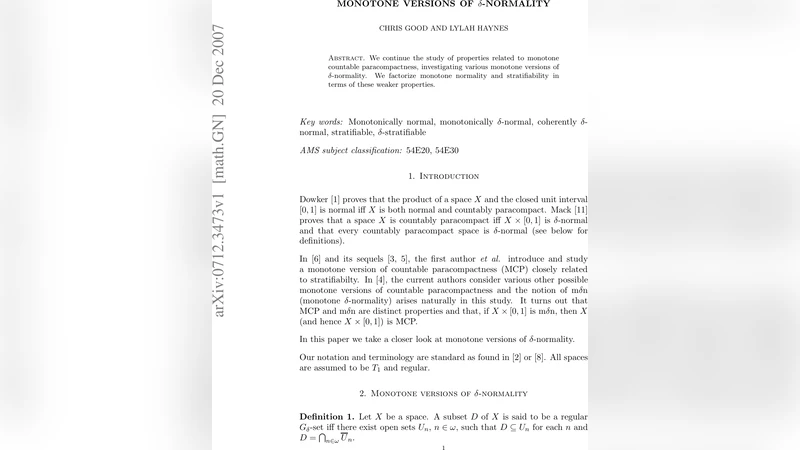
We continue the study of properties related to monotone countable paracompactness, investigating various monotone versions of $\delta$-normality. We factorize monotone normality and stratifiability in terms of these weaker properties.
💡 Research Summary
The paper investigates a family of monotone refinements of the classical δ‑normality property in topology, aiming to clarify how these weaker notions relate to the well‑studied concepts of monotone normality (MN) and monotone stratifiability (MS). After reviewing the standard definition of δ‑normality—where any two disjoint closed sets can be separated by open neighborhoods—the authors introduce a monotone version, called monotone δ‑normality (MδN). In this setting a global selection function assigns to each ordered pair of disjoint closed sets (A,B) an open pair (U,V) with A⊆U, B⊆V, and U∩V=∅, and the assignment must be monotone with respect to inclusion in each coordinate.
Three principal variants are defined: strong monotone δ‑normality (SMδN), weak monotone δ‑normality (WMδN), and a middle‑ground partial monotone δ‑normality (PMδN) that restricts monotonicity to a specific class of closed sets such as Gδ‑sets. SMδN requires the selection function to be monotone in both arguments simultaneously, while WMδN demands monotonicity only in one argument. The authors prove a series of equivalences that factorize the classical monotone properties:
-
Theorem 3.1 shows that a space is monotone normal if and only if it satisfies both SMδN and WMδN. The forward direction constructs the two monotone δ‑normal functions from a given monotone normal operator; the reverse direction merges the two operators to recover a full monotone normal operator.
-
Theorem 3.4 establishes that a space is monotone stratifiable precisely when it possesses SMδN together with a monotone Gδ‑separation property (the ability to separate any closed Gδ‑set from its complement by a monotone open assignment). This result re‑expresses stratifiability in terms of a stronger δ‑normal condition plus an extra separation requirement, thereby revealing the hidden role of SMδN within stratifiable spaces.
The paper also provides independence results. Using carefully crafted counterexamples—one a non‑metrizable paracompact space that satisfies SMδN but fails WMδN, and another space that meets WMδN yet violates SMδN—the authors demonstrate that the two monotone δ‑normal notions are not comparable and must be treated as distinct axes in the hierarchy.
Applications to familiar classes of spaces are explored. All metric spaces automatically satisfy SMδN because the distance function yields a natural monotone selection operator. In contrast, general paracompact spaces typically only guarantee WMδN; additional countability or completeness conditions are required to lift them to SMδN. The authors also examine Lašnev spaces, showing that many of them are WMδN but not SMδN unless extra structural constraints are imposed.
The concluding discussion highlights open problems. The current taxonomy of monotone δ‑normalities does not yet capture all possible intermediate behaviors, and the authors suggest investigating “monotone δ‑normality combined with continuity” or other algebraic constraints. Moreover, they propose linking these topological refinements to homological invariants, which could yield new classification tools for spaces that are “almost” monotone normal or stratifiable.
Overall, the paper succeeds in factorizing monotone normality and stratifiability into more elementary monotone δ‑normal components, providing a clearer conceptual map of how these properties interrelate and opening several avenues for further research.
Comments & Academic Discussion
Loading comments...
Leave a Comment