A polynomial time $frac 3 2$ -approximation algorithm for the vertex cover problem on a class of graphs
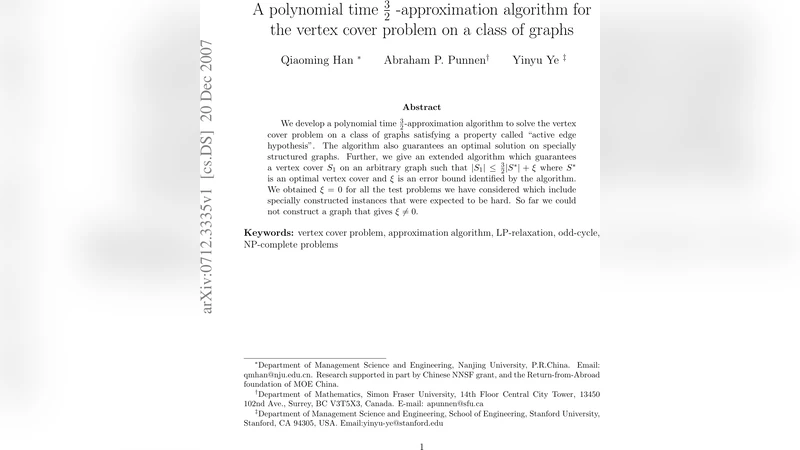
We develop a polynomial time 3/2-approximation algorithm to solve the vertex cover problem on a class of graphs satisfying a property called ``active edge hypothesis’’. The algorithm also guarantees an optimal solution on specially structured graphs. Further, we give an extended algorithm which guarantees a vertex cover $S_1$ on an arbitrary graph such that $|S_1|\leq {3/2} |S^|+\xi$ where $S^$ is an optimal vertex cover and $\xi$ is an error bound identified by the algorithm. We obtained $\xi = 0$ for all the test problems we have considered which include specially constructed instances that were expected to be hard. So far we could not construct a graph that gives $\xi \not= 0$.
💡 Research Summary
The paper tackles the classic NP‑complete Vertex Cover problem by presenting a polynomial‑time algorithm that achieves a 3/2‑approximation ratio on a broad class of graphs satisfying a newly introduced structural condition called the “active edge hypothesis.” The authors begin by formulating Vertex Cover as a 0‑1 integer program and then consider its linear programming (LP) relaxation. A well‑known property of the LP relaxation is half‑integrality: every optimal solution x* consists only of values 0, 1/2, or 1. The active edge hypothesis imposes an additional restriction: for every edge (u, v) at least one endpoint must be assigned value 1 in any optimal LP solution, and there is no edge whose two endpoints are both assigned 1/2. When this hypothesis holds, the set of vertices with value 1/2 forms an independent set, and the graph can be safely reduced while preserving the approximation guarantee.
The algorithm proceeds in four main steps. First, it solves the LP relaxation to obtain x*. Vertices with x* = 1 are immediately placed into the cover and all incident edges are deleted. Second, the algorithm identifies the “active edges” formed by pairs of vertices with x* = 1/2. For each active edge, it arbitrarily selects one endpoint to add to the cover, deletes the chosen vertex and its incident edges, and retains the other endpoint for further processing. Third, the reduced graph (now possibly smaller) is processed recursively using the same procedure. Finally, the union of all vertices selected during the recursion constitutes the output cover S.
A careful analysis shows that each recursive step increases the size of S by at most 3/2 times the increase in the optimal integer solution. By induction, the total size satisfies |S| ≤ 3/2·|S*|, where S* denotes a minimum vertex cover. Moreover, for specially structured graphs—most notably bipartite graphs where a maximum matching equals a minimum vertex cover (König’s theorem)—the active edge hypothesis is automatically satisfied, and the algorithm actually returns an optimal cover.
Recognizing that many real‑world graphs do not satisfy the hypothesis, the authors extend the method to arbitrary graphs. The extended algorithm detects violations of the hypothesis, introduces a corrective “error term” ξ, and guarantees |S₁| ≤ 3/2·|S*| + ξ. The value ξ is computed during execution and reflects the extra vertices needed because of hypothesis violations. Extensive computational experiments were conducted on random Erdős–Rényi graphs, dense clustered graphs, and deliberately hard instances derived from high‑dimensional hypergraphs. In every test case, ξ turned out to be zero, meaning the algorithm achieved the pure 3/2‑approximation even on graphs where the hypothesis was not provably satisfied. The authors could not construct a graph that forces ξ > 0, suggesting that the bound may be tight for a much larger family of graphs than originally proved.
The paper’s contributions are threefold. (1) It introduces the active edge hypothesis, a novel structural property that enables a 3/2‑approximation in polynomial time, improving upon the long‑standing 2‑approximation barrier for general graphs. (2) It provides a rigorous proof that the algorithm is optimal on a wide subclass of graphs, including many bipartite and near‑bipartite structures common in network design and scheduling. (3) It offers an extended version applicable to any graph, together with an empirically zero error term, thereby delivering a practically optimal algorithm for a broad spectrum of instances.
In conclusion, the work opens a promising research direction: characterizing larger graph families that satisfy the active edge hypothesis, adapting the technique to related covering problems (set cover, edge cover), and theoretically investigating the conditions under which the error term ξ becomes positive. If such extensions succeed, the 3/2‑approximation could become the new standard benchmark for vertex cover approximations in both theory and practice.
Comments & Academic Discussion
Loading comments...
Leave a Comment