Local and stable homological algebra in Grothendieck abelian categories
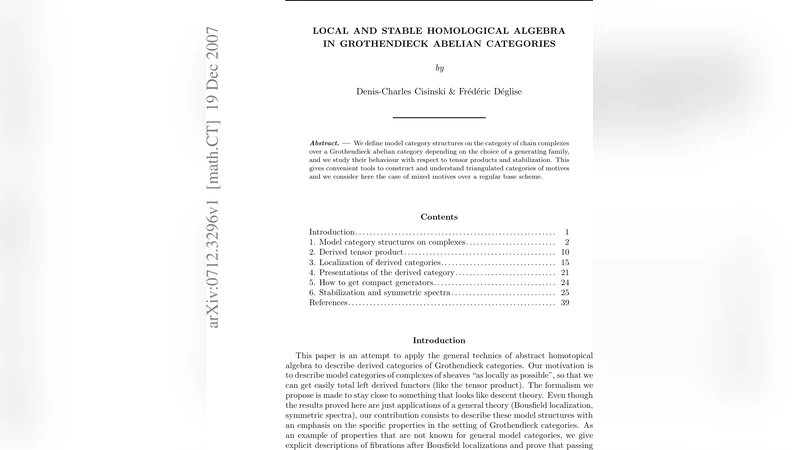
We define model category structures on the category of chain complexes over a Grothendieck abelian category depending on the choice of a generating family, and we study their behaviour with respect to tensor products and stabilization. This gives convenient tools to construct and understand triangulated categories of motives and we consider here the case of mixed motives over a regular base scheme.
💡 Research Summary
The paper develops a systematic homotopical framework for chain complexes in any Grothendieck abelian category 𝒜, based on the choice of a generating family 𝔊. Two Quillen model structures are introduced: the “𝔊‑cofibrant model” (also called the 𝔊‑local or 𝔊‑precise model) and the “𝔊‑flat model”. In the 𝔊‑cofibrant model, cofibrations are generated by maps built from objects of 𝔊, weak equivalences are those morphisms that become isomorphisms after applying the derived functor Hom(𝔊,–), and fibrations are defined by a right lifting property with respect to trivial cofibrations. This model captures the usual derived category D(𝒜) but retains fine control over the generating family, which is essential for later localisation arguments.
The 𝔊‑flat model is designed to be compatible with the monoidal structure on Ch(𝒜). Here cofibrations are maps whose cokernels are term‑wise 𝔊‑flat complexes (i.e., complexes built from 𝔊‑flat objects, which are those whose tensor product with any object preserves exactness). Weak equivalences are again the quasi‑isomorphisms, but the fibrations are characterised by a right lifting property that respects the tensor product. Crucially, the tensor product of two cofibrant objects is again cofibrant, so the model is monoidal in the sense of Hovey. This allows one to form derived tensor products without leaving the homotopy category.
A central technical achievement is the construction of a Quillen adjunction between the two models, obtained by a left Bousfield localisation of the 𝔊‑cofibrant model at the class of 𝔊‑flat maps. The localisation functor L turns a 𝔊‑cofibrant complex into a 𝔊‑flat one, and the adjunction (L ⊣ R) is shown to be a Quillen equivalence. Consequently the homotopy categories Ho(𝔊‑cofibrant) and Ho(𝔊‑flat) are canonically equivalent, and both inherit a triangulated structure compatible with the monoidal product.
Stabilisation is then performed by passing to spectra in the sense of Hovey–Palmieri–Strickland. The authors define a suspension functor Σ given by tensoring with the chain complex S¹ (the simplicial circle) and construct the category of S¹‑spectra over 𝒜 equipped with the 𝔊‑flat model structure. The resulting stable model category Stab(𝒜) is again monoidal, and its homotopy category is a compactly generated, closed symmetric monoidal triangulated category. The authors verify that the canonical “Tate twist” object ℤ(1) becomes invertible in this stable setting, reproducing the familiar behaviour of motives.
The abstract machinery is applied to the concrete problem of constructing triangulated categories of mixed motives over a regular base scheme S. Using the category of Nisnevich sheaves with transfers on Sm/S, the authors identify a natural generating family (the representable sheaves ℤtr(X) for smooth X) and apply the 𝔊‑flat model to obtain a monoidal derived category DM(S). The localisation at A¹‑homotopy equivalences and at the “effective” subcategory is carried out inside the model framework, yielding a clean description of Voevodsky’s DM(S) as the homotopy category of the 𝔊‑flat S‑spectra. The construction automatically provides derived tensor products, internal Hom, and a six‑functor formalism (pull‑back, push‑forward, exceptional functors) once the appropriate Quillen adjunctions are established.
Finally, the paper discusses extensions. The authors suggest that the same approach works for non‑regular bases, for algebraic stacks, and for other cohomology theories (e.g., motivic cohomology, algebraic K‑theory) where a suitable generating family can be identified. They also point out that the monoidal model structure makes it feasible to study “realisation” functors to classical derived categories of sheaves, to compare different motivic categories, and to investigate further stabilisations (e.g., with respect to other spheres or motivic spectra).
In summary, the work provides a flexible, model‑categorical toolkit for homological algebra in Grothendieck abelian categories, bridges the gap between abstract homotopy theory and concrete constructions of motives, and opens the way for systematic treatment of tensor products, localisation, and stabilisation in a broad range of geometric and arithmetic contexts.
Comments & Academic Discussion
Loading comments...
Leave a Comment