It is demonstrated that in photoabsorption by endohedral atoms some atomic Giant resonances are almost completely destroyed while the others are totally preserved due to different action on it of the fullerenes shell. As the first example we discuss the 4d10 Giant resonance in Xe@C60 whereas as the second serves the Giant autoionization resonance in Eu@C60. The qualitative difference comes from the fact that photoelectrons from the 4d Giant resonance has small energies (tens of eV) and are strongly reflected by the C60 fullerenes shell. As to the Eu@C60, Giant autoionization leads to fast photoelectrons (about hundred eV) that go out almost untouched by the C60 shell. As a result of the outgoing electrons energy difference the atomic Giant resonances will be largely destroyed in A@C60 while the Giant autoionization resonance will be almost completely preserved. Thus, on the way from Xe@C60 Giant resonance to Eu@C60 Giant autoionization resonance the oscillation structure should disappear. Similar will be the decrease of oscillations on the way from pure Giant to pure Giant autoionization resonances for the angular anisotropy parameters. At Giant resonance frequencies the role of polarization of the fullerenes shell by the incoming photon beam is inessential. Quite different is the situation for the outer electrons in Eu@C60, the photoionization of which will be also considered.
Deep Dive into Destruction and Resurrection of Atomic Giant resonances in Endohedral Atoms A@C60.
It is demonstrated that in photoabsorption by endohedral atoms some atomic Giant resonances are almost completely destroyed while the others are totally preserved due to different action on it of the fullerenes shell. As the first example we discuss the 4d10 Giant resonance in Xe@C60 whereas as the second serves the Giant autoionization resonance in Eu@C60. The qualitative difference comes from the fact that photoelectrons from the 4d Giant resonance has small energies (tens of eV) and are strongly reflected by the C60 fullerenes shell. As to the Eu@C60, Giant autoionization leads to fast photoelectrons (about hundred eV) that go out almost untouched by the C60 shell. As a result of the outgoing electrons energy difference the atomic Giant resonances will be largely destroyed in A@C60 while the Giant autoionization resonance will be almost completely preserved. Thus, on the way from Xe@C60 Giant resonance to Eu@C60 Giant autoionization resonance the oscillation structure should disappe
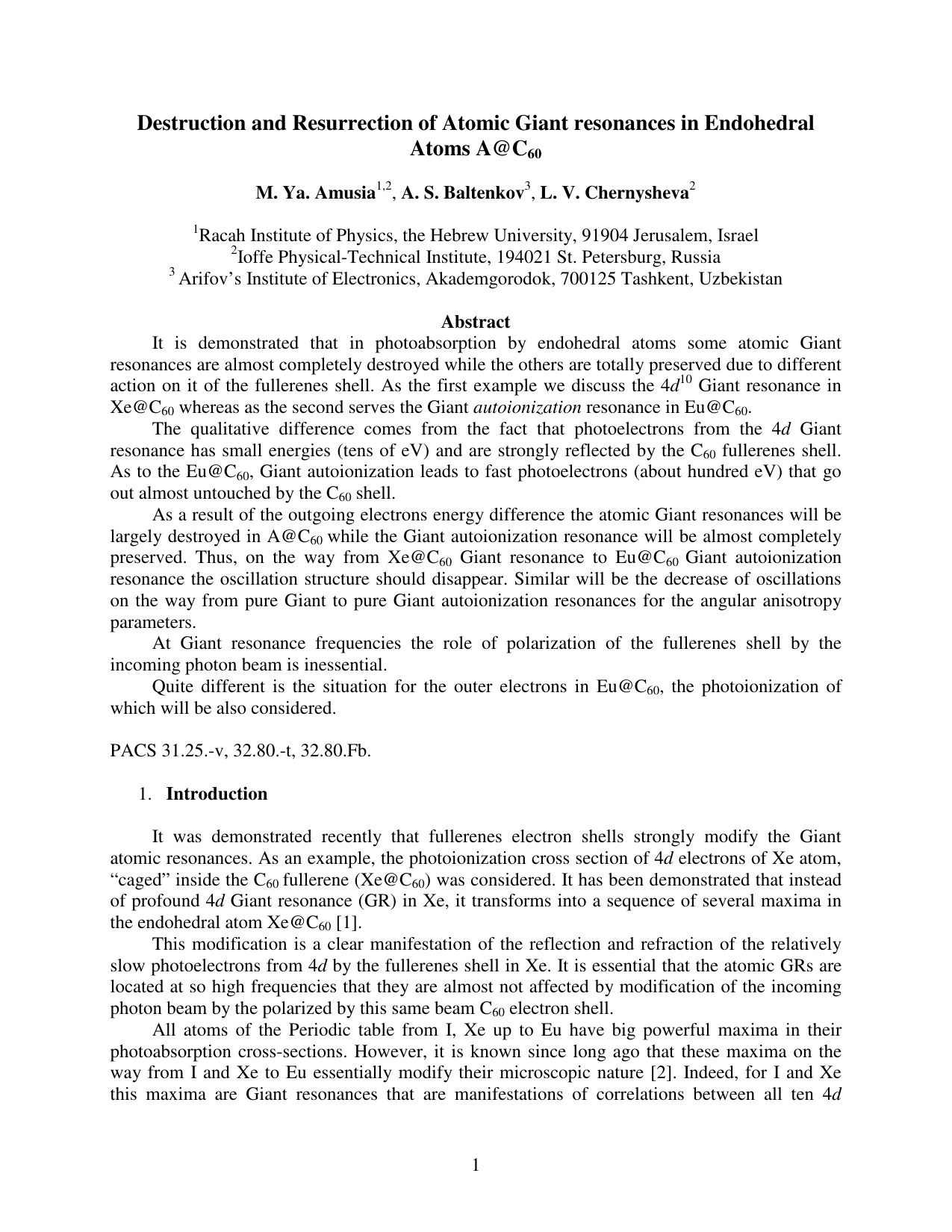
It was demonstrated recently that fullerenes electron shells strongly modify the Giant atomic resonances. As an example, the photoionization cross section of 4d electrons of Xe atom, "caged" inside the C 60 fullerene (Xe@C 60 ) was considered. It has been demonstrated that instead of profound 4d Giant resonance (GR) in Xe, it transforms into a sequence of several maxima in the endohedral atom Xe@C 60 [1].
This modification is a clear manifestation of the reflection and refraction of the relatively slow photoelectrons from 4d by the fullerenes shell in Xe. It is essential that the atomic GRs are located at so high frequencies that they are almost not affected by modification of the incoming photon beam by the polarized by this same beam C 60 electron shell.
All atoms of the Periodic table from I, Xe up to Eu have big powerful maxima in their photoabsorption cross-sections. However, it is known since long ago that these maxima on the way from I and Xe to Eu essentially modify their microscopic nature [2]. Indeed, for I and Xe this maxima are Giant resonances that are manifestations of correlations between all ten 4d electrons 1 . The photoelectrons formed by the Giant resonance are from the same d 4 subshell and therefore have relatively low energy of about two Rydbergs.
In Eu with its semi-filled f 4 subshell the photoabsorption cross section is instead a pure Giant autoionization resonance that originates from decay of a very powerful . As a result, the photoelectrons originate not from d 4 as in Xe but from the outer f 4 subshell. Therefore, they have much higher energy, of about ten Rydbergs and other angular momenta than photoelectrons from 4d in Xe. On the way from Xe to Eu the role of pure Giant resonance decreases while the contribution of autoionization decay grows up. There are indications that already in Ce the autoionization portion is dominant.
This difference in photoelectron energies has profound effect upon the photoabsorption cross sections of endohedral atoms near d 4 threshold, since slow electrons are reflected by the fullerenes shell while the fast are not. As a result, one should expect strong modification of the Giant d 4 resonance, while 4d Giant autoionization resonance remains untouched. When inside the fullerene, the “caged” atom of the Lanthanides group can lose one or two of its electrons to the fullerenes shell. As a result, the oscillator strength of the f d 4 4 → transition increases, thus leading to Giant autoionization instead of a Giant resonance with corresponding increase of the photoelectron energy. As it was already mentioned, the increase of photoionization energy leads to elimination of the oscillations in the photoabsorption of endohedral atoms as compared to the isolated ones.
To check this conception, we have performed calculations of the partial and total crosssection of photoionization of Eu@C 60 and compared this with cross-sections for atomic Eu [3] and Xe@C 60 . The research presented in this paper was stimulated by the publication of R. Phaneuf and his group [4] 2 , where they measured the photoabsorption cross-section of Ce@C 82 + in order to find variations in the d 4 region similar to that predicted in [1], and failed. In their analyses they assumed that inside the fullerenes cage Ce is stripped off its three outer electrons.
We believe now that the result obtained in this paper explains the absence of visible fine structure in the photoabsorption cross-section in the endohedral Ce@C 82 + in the Ce Giant resonance region. The decisive answer can, however, come from electron spectroscopy research with coincidental measurement of the photoelectron energy and the ion yield.
We present here also the results for the outer shells of Eu@C 60 , where similar to the case of Xe@C 60 new so-called Giant endohedral resonances are formed [6] due to combined action of two factors: the reflection of the photoelectron from the “caged” atom and the amplification of the electromagnetic field acting upon this atom. The new Giant endohedral resonances in the outer shells appear stronger or weaker in all endohedrals, so that we call the phenomenon Giant resonance resurrection.
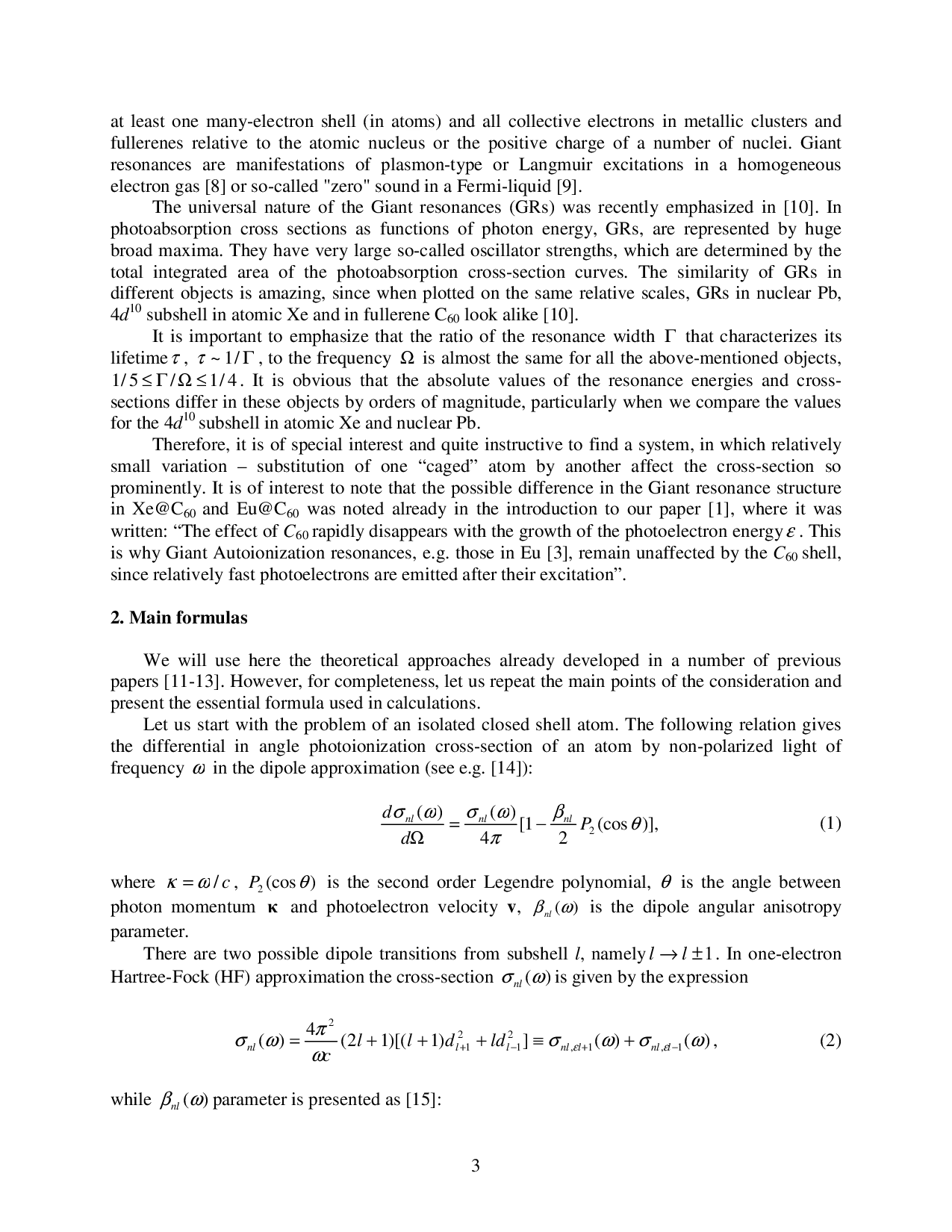
All this discussion is of great general interest and value, since Giant resonances are universal features of the excitation of any finite many-fermion systems: nuclei, atoms, fullerenes, and clusters. They represent collective, coherent oscillations of many particles and manifest themselves most prominently in photon absorption cross sections. In a nucleus Giant resonances represent the excitation of coherent oscillatory motion of all protons relative to all neutrons [7], while in all other objects mentioned above they represent the coherent motion of all electrons of at least one many-electron shell (in atoms) and all collective electrons in metallic clusters and fullerenes relative to the atomic nucleus or the positive charge of a number of nuclei. Giant resonances are manifestations of plasmon
…(Full text truncated)…
This content is AI-processed based on ArXiv data.