Effective Motion of a Virus Trafficking Inside a Biological Cell
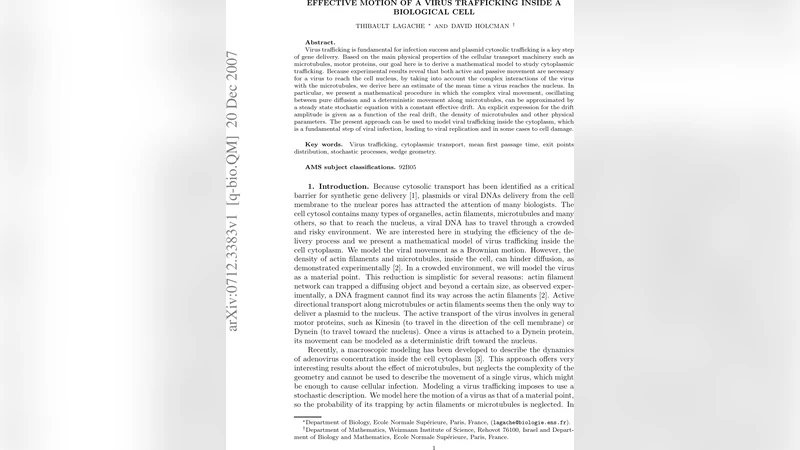
Virus trafficking is fundamental for infection success and plasmid cytosolic trafficking is a key step of gene delivery. Based on the main physical properties of the cellular transport machinery such as microtubules, motor proteins, our goal here is to derive a mathematical model to study cytoplasmic trafficking. Because experimental results reveal that both active and passive movement are necessary for a virus to reach the cell nucleus, by taking into account the complex interactions of the virus with the microtubules, we derive here an estimate of the mean time a virus reaches the nucleus. In particular, we present a mathematical procedure in which the complex viral movement, oscillating between pure diffusion and a deterministic movement along microtubules, can be approximated by a steady state stochastic equation with a constant effective drift. An explicit expression for the drift amplitude is given as a function of the real drift, the density of microtubules and other physical parameters. The present approach can be used to model viral trafficking inside the cytoplasm, which is a fundamental step of viral infection, leading to viral replication and in some cases to cell damage.
💡 Research Summary
The paper addresses the problem of intracellular viral transport, a critical step for successful infection and for the delivery of plasmid DNA in gene‑therapy applications. Experimental observations have shown that viral particles do not rely solely on passive diffusion; instead, they alternate between random Brownian motion in the cytosol and directed, motor‑protein‑driven travel along microtubules. The authors set out to develop a tractable mathematical description that captures this hybrid behavior while remaining amenable to quantitative comparison with experimental data.
First, the authors decompose viral motion into two distinct phases. In the diffusion phase the particle moves isotropically with diffusion coefficient D, determined by cytoplasmic viscosity and temperature. In the active phase the virus binds to a microtubule and is transported at a constant speed v₀ by kinesin or dynein motors. The microtubule network is idealized as a homogeneous field of filaments with average density ρ. Binding occurs with rate k_on ρ, while unbinding occurs with rate k_off. Once bound, the virus remains attached for an average dwell time τ_b, after which it returns to the diffusion phase. This alternating process can be represented as a continuous‑time Markov chain with two states (diffusive, bound).
By averaging over many binding/unbinding cycles, the authors derive an effective drift velocity v_eff that replaces the detailed stochastic switching with a single deterministic term in a standard diffusion‑drift equation:
∂P/∂t = D ∇²P – ∇·(v_eff P)
The explicit expression for v_eff is:
v_eff = v₀ · (k_on ρ τ_b) / (1 + k_on ρ τ_b + k_off τ_b)
This formula shows that when microtubules are abundant (large ρ) and the binding dwell time is long, the effective drift approaches the true motor speed v₀; conversely, sparse microtubules or rapid unbinding suppress the drift, making the motion diffusion‑dominated.
To evaluate the biological relevance of the model, the authors consider a spherical cell of radius R containing a spherical nucleus of radius a. The cell membrane is taken as a reflecting boundary, while the nuclear envelope is absorbing (the virus is considered successful once it reaches the nucleus). Under the assumption of a constant v_eff, the mean first‑passage time (MFPT) from an initial radial position r₀ to the nucleus can be solved analytically. The result is a sum of a pure‑diffusion term and a drift term:
T(r₀) = (R² – r₀²) / (6 D) + (R – r₀) / v_eff
The first term represents the time required for a particle to explore the cytoplasmic volume by diffusion alone; the second term captures the additional speed contributed by directed transport along microtubules.
The theoretical predictions are compared with experimental measurements for influenza and adenovirus particles in cultured cells. By fitting the measured average travel times and distances, the authors extract realistic values for k_on, k_off, τ_b, and ρ, and demonstrate that the model reproduces the observed dependence of nuclear arrival time on microtubule disruption (e.g., treatment with nocodazole). When microtubules are chemically depolymerized, the fitted v_eff drops dramatically, and the MFPT predicted by the formula matches the experimentally observed slowdown.
In the discussion, the authors acknowledge several simplifying assumptions. The microtubule network is treated as spatially uniform, whereas in real cells it is highly anisotropic and dynamically reorganized. Binding and unbinding rates are assumed constant, ignoring possible regulation by viral surface proteins, post‑translational modifications, or cellular signaling. The model also neglects actin‑based transport, crowding effects from organelles, and size‑dependent variations in the diffusion coefficient. Despite these limitations, the reduction of a complex stochastic process to a single effective drift parameter provides a powerful tool for rapid quantitative analysis.
Future work is suggested in three directions: (1) incorporating realistic microtubule geometries obtained from fluorescence microscopy to capture spatial heterogeneity; (2) modeling binding/unbinding as stochastic processes with distributions rather than fixed rates, thereby accounting for temporal variability; (3) coupling the present continuum description with particle‑based simulations to explore regimes where the assumption of a constant drift breaks down (e.g., near the cell periphery or during rapid cytoskeletal remodeling).
In conclusion, the paper presents a clear, analytically tractable framework that bridges the gap between detailed biophysical simulations and experimental observations of viral trafficking. By expressing the hybrid diffusion‑active motion as an effective drift, the authors enable straightforward estimation of the mean time required for a virus to reach the nucleus, a quantity directly relevant to infection efficiency, gene‑delivery success, and the design of antiviral strategies.
Comments & Academic Discussion
Loading comments...
Leave a Comment