Baxterization of GL_q(2) and its application to the Liouville model and some other models on a lattice
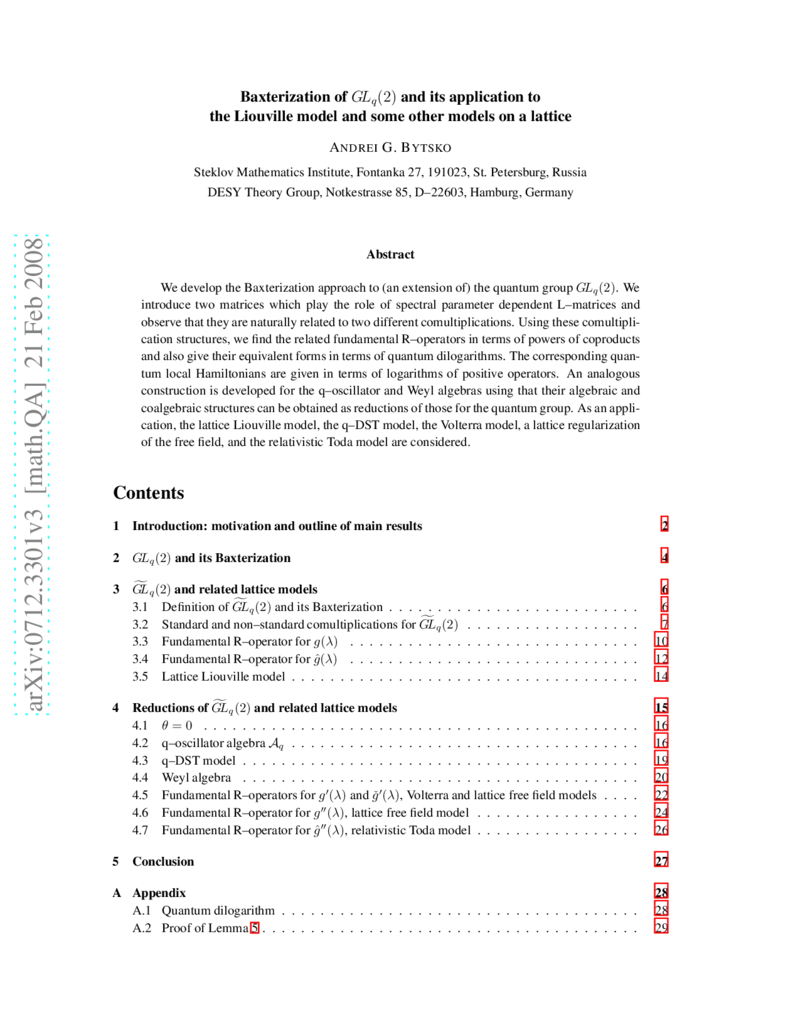
We develop the Baxterization approach to (an extension of) the quantum group GL_q(2). We introduce two matrices which play the role of spectral parameter dependent L-matrices and observe that they are naturally related to two different comultiplications. Using these comultiplication structures, we find the related fundamental R-operators in terms of powers of coproducts and also give their equivalent forms in terms of quantum dilogarithms. The corresponding quantum local Hamiltonians are given in terms of logarithms of positive operators. An analogous construction is developed for the q-oscillator and Weyl algebras using that their algebraic and coalgebraic structures can be obtained as reductions of those for the quantum group. As an application, the lattice Liouville model, the q-DST model, the Volterra model, a lattice regularization of the free field, and the relativistic Toda model are considered.
💡 Research Summary
The paper develops a systematic Baxterization scheme for the quantum group GL_q(2) and its extension fGL_q(2), and applies the resulting constructions to a variety of integrable lattice models. Starting from the standard presentation of GL_q(2) with generators a, b, c, d satisfying the well‑known q‑commutation relations, the authors introduce two spectral‑parameter dependent L‑matrices, g(λ) and \hat g(λ). These matrices are linear combinations of the generators with coefficients λ and λ⁻¹ and satisfy the RLL relations with the usual 4×4 R‑matrices R⁺ and R⁻.
A key observation is that two distinct comultiplications can be defined on fGL_q(2): the familiar Δ (the standard Hopf‑algebra coproduct) and a non‑standard coproduct δ that involves the additional generator θ. The authors show that the fundamental R‑operators solving the intertwining relation R_{23}(λ) L_{13}(λμ) L_{12}(μ) = L_{12}(μ) L_{13}(λμ) R_{23}(λ) can be expressed as simple powers of the coproducts of central elements: Δ(bc) for g(λ) and δ(ad−qbc) for \hat g(λ). After appropriate normalization these R‑operators satisfy regularity (R(1)=1⊗1) and thus generate local integrals of motion via logarithmic derivatives of the transfer matrix at λ=1. The resulting local Hamiltonians are written as logarithms of positive operators, which can be further rewritten in terms of the quantum dilogarithm function. The authors provide both power‑law and dilogarithmic forms, the latter being essential for the case |q|=1 because of its self‑dual analytic properties.
The paper then defines the extended algebra fGL_q(2) by adding a generator θ with relations θb= bθ, θc= cθ, θa= q⁻¹ aθ, θd= q⁻¹ dθ. The central elements become D_q = ad−qbc and η’_q = θb, η’’_q = θc. For this algebra the λ‑dependence of g(λ) and \hat g(λ) cannot be removed by similarity transformations, i.e., they constitute genuine Baxterizations. Their q‑determinants acquire λ‑dependent factors, confirming the non‑trivial spectral parameter dependence.
Using these constructions the authors identify the L‑matrices of several lattice models:
- Lattice Liouville model – its L‑matrix coincides with \hat g(λ); the associated fundamental R‑operator is a power of Δ(bc).
- q‑DST model – its L‑matrix is g(λ); the fundamental R‑operator is a power of δ(ad−qbc).
- q‑oscillator algebra A_q – obtained by setting θ=0; reductions of g(λ) and \hat g(λ) lead to R‑operators for the Volterra model and a lattice regularization of the free field.
- Weyl algebra W_q – further reduction yields R‑operators for the relativistic Toda model.
In each case the authors write explicit expressions for the local Hamiltonians as logarithms of the corresponding R‑operators, and then translate them into quantum dilogarithm form. The paper includes an appendix summarizing the definition, functional equations, and analytic properties of the quantum dilogarithm, together with proofs of auxiliary lemmas used throughout.
Overall, the work demonstrates that by exploiting both the standard and a novel non‑standard coproduct on an extended quantum group, one can generate fundamental R‑operators for a broad class of integrable lattice systems in a unified algebraic framework. The presentation of R‑operators both as simple coproduct powers and as quantum dilogarithms provides computationally convenient formulas and clarifies the analytic structure of the models, especially in the regime |q|=1. This methodology opens the way for constructing new integrable lattice models and for re‑examining known models within a more general quantum‑group‑theoretic setting.
Comments & Academic Discussion
Loading comments...
Leave a Comment