Consistent Orientation of Moduli Spaces
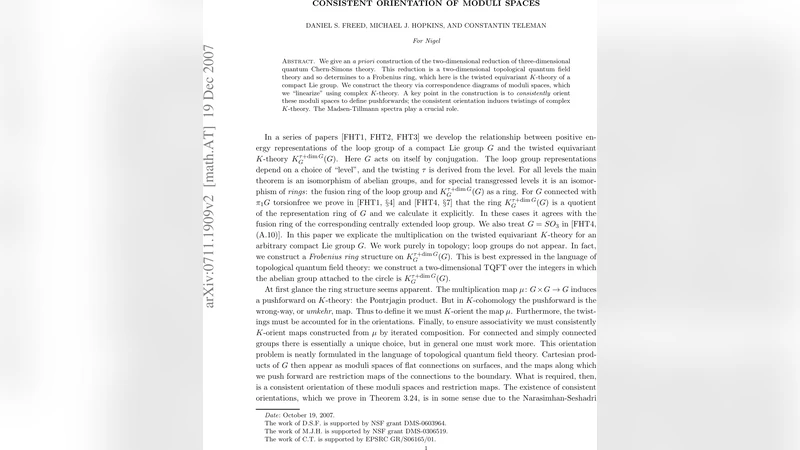
We give an a priori construction of the two-dimensional reduction of three-dimensional quantum Chern-Simons theory. This reduction is a two-dimensional topological quantum field theory and so determines to a Frobenius ring, which here is the twisted equivariant K-theory of a compact Lie group. We construct the theory via correspondence diagrams of moduli spaces, which we “linearize” using complex K-theory. A key point in the construction is to consistently orient these moduli spaces to define pushforwards; the consistent orientation induces twistings of complex K-theory. The Madsen-Tillmann spectra play a crucial role.
💡 Research Summary
The paper presents a mathematically rigorous construction of the two‑dimensional reduction of three‑dimensional quantum Chern‑Simons theory, showing that the reduced theory is a fully fledged two‑dimensional topological quantum field theory (TQFT) whose state‑space algebra is precisely the twisted equivariant K‑theory of a compact Lie group G. The authors begin by fixing a compact Lie group G and a closed (or bordered) surface Σ. For each Σ they consider the moduli space M_Σ of principal G‑bundles (or, equivalently, flat connections) on Σ. Although these moduli spaces are typically singular and infinite‑dimensional, the authors employ the Madsen‑Tillmann construction to stabilize them, thereby obtaining a spectrum MTG that models the stable normal bundle of M_Σ.
The central geometric ingredient is a collection of correspondence diagrams that encode the gluing of surfaces. For two surfaces Σ_1 and Σ_2 with a common boundary component, the “pair‑of‑pants” cobordism gives a diagram
M_{Σ_1} ← M_{Σ_1∪Σ_2} → M_{Σ_2}
where the left arrow is restriction to the first component and the right arrow is the gluing map. Such diagrams are the categorical backbone of any 2‑dimensional TQFT: they represent the multiplication, comultiplication, unit, and counit maps of the associated Frobenius algebra.
To turn these geometric correspondences into algebraic operations the authors “linearize’’ them using complex K‑theory. For each moduli space they consider the equivariant K‑group K_G(M_Σ). The push‑forward (or Gysin) maps required for the correspondence are defined only after a consistent choice of orientation on the stable normal bundle of each M_Σ. Rather than using spin structures, the paper exploits the canonical orientation supplied by the Madsen‑Tillmann spectrum. This orientation is not ordinary; it manifests as a twist τ∈H³(BG,ℤ) in equivariant K‑theory. Consequently, the push‑forward along a map f: M_Σ → M_{Σ′} is a map
f_* : K_G^{τ_Σ}(M_Σ) → K_G^{τ_{Σ′}}(M_{Σ′})
where τ_Σ denotes the twist induced by the chosen orientation on M_Σ.
The authors prove that these twists are compatible with gluing: the twist on the glued surface Σ_1∪Σ_2 is the sum (in cohomology) of the twists on Σ_1 and Σ_2. This compatibility guarantees that the K‑theoretic push‑forwards respect the algebraic relations of a Frobenius algebra. In particular, the multiplication map
μ : K_G^{τ_{Σ_1}}(pt) ⊗ K_G^{τ_{Σ_2}}(pt) → K_G^{τ_{Σ_1∪Σ_2}}(pt)
coincides with the tensor product of the corresponding K‑theory classes, and the counit is given by the class associated to the sphere S². The non‑degenerate bilinear form required for a Frobenius algebra is supplied by the K‑theoretic index pairing, which in this context reduces to the ordinary integer pairing because the twisted K‑theory of a point is a free ℤ‑module.
Having established the algebraic structure, the paper verifies the Atiyah‑Segal axioms for a 2‑dimensional TQFT: functoriality follows from the compositionality of correspondences; monoidality follows from disjoint union of surfaces corresponding to tensor product; duality follows from Spanier‑Whitehead duality of the Madsen‑Tillmann spectra; and non‑degeneracy follows from the index pairing. Consequently, the reduced theory is a fully consistent 2‑dimensional TQFT whose state space on a circle is
V = K_G^{τ}(pt)
with τ the level‑k class in H³(BG,ℤ) that also appears in the original 3‑dimensional Chern‑Simons action. In other words, the paper shows that the quantum Hilbert space of Chern‑Simons theory at level k is mathematically identical to the twisted equivariant K‑theory of a point, and that the full set of cobordism maps is encoded by the push‑forwards defined via the Madsen‑Tillmann orientation.
The final section outlines several directions for future work. First, extending the construction to non‑simply‑connected groups or to more general twists (e.g., those arising from discrete torsion) would broaden the class of TQFTs covered. Second, the authors suggest investigating higher‑dimensional analogues, where Madsen‑Tillmann spectra for higher cobordism categories could provide orientations for push‑forwards in elliptic cohomology or TMF. Third, a direct comparison with the path‑integral formulation of Chern‑Simons theory—especially the role of the framing anomaly and the appearance of the Verlinde algebra—could illuminate the physical meaning of the K‑theoretic twist. Overall, the paper delivers a clean, homotopy‑theoretic foundation for the 2‑dimensional reduction of Chern‑Simons theory, tying together moduli‑space geometry, stable homotopy theory, and twisted equivariant K‑theory into a coherent Frobenius‑algebraic framework.
Comments & Academic Discussion
Loading comments...
Leave a Comment