A New Lower Bound for A(17,6,6)
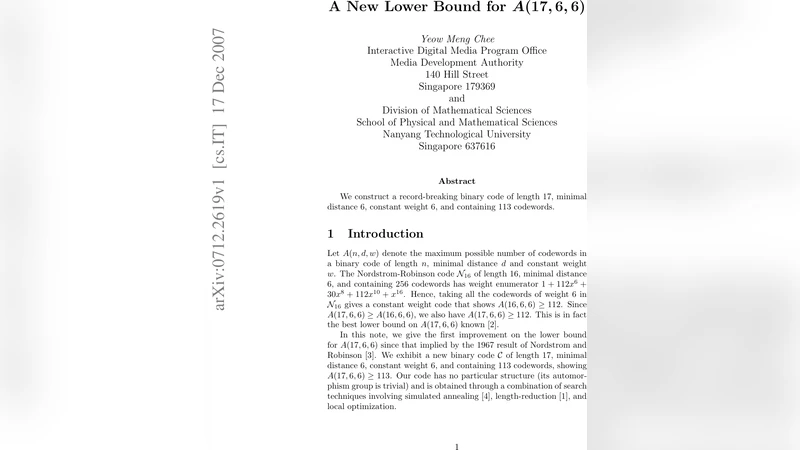
We construct a record-breaking binary code of length 17, minimal distance 6, constant weight 6, and containing 113 codewords.
💡 Research Summary
The paper addresses the longstanding combinatorial problem of determining the maximum size A(n,d,w) of a binary constant‑weight code with given length n, minimum Hamming distance d, and weight w. For the specific parameters (n=17, d=6, w=6) the best known lower bound prior to this work was A(17,6,6) ≥ 112, derived from the Nordstrom‑Robinson code N₁₆ of length 16. N₁₆ is a nonlinear binary code of length 16, minimum distance 6, and 256 codewords; its weight enumerator is 1 + 112 x⁶ + 30 x⁸ + 112 x¹⁰ + x¹⁶. By extracting the 112 weight‑6 codewords from N₁₆ one obtains a constant‑weight code of length 16, establishing A(16,6,6) ≥ 112, and consequently A(17,6,6) ≥ 112.
The authors present the first improvement on this bound since the 1967 Nordstrom‑Robinson result. Using a combination of three algorithmic techniques—simulated annealing, length‑reduction, and local optimization—they construct a binary constant‑weight code C of length 17, minimum distance 6, weight 6, containing 113 codewords. Hence they prove A(17,6,6) ≥ 113.
The construction proceeds as follows. An initial population of weight‑6 vectors is generated randomly. Simulated annealing is then applied: a temperature schedule gradually lowers the acceptance probability for moves that increase a penalty function measuring violations of the distance constraint. At each step a candidate vector replaces an existing one if the resulting set still satisfies the minimum distance requirement, or if the increase in penalty is outweighed by the temperature‑scaled probability. This global search yields a relatively large feasible set but not necessarily maximal.
To adapt the search to the specific length 17, the authors employ a length‑reduction technique inspired by earlier work on shortening and puncturing codes. Starting from longer known codes (including N₁₆) they delete coordinates or merge them in a way that preserves weight‑6 structure while reducing the length to 17. The reduced set serves as a refined seed for the annealing phase.
Finally, a local optimization phase fine‑tunes the solution. For each codeword the algorithm attempts to replace it with another weight‑6 vector that maintains the distance condition and possibly increases the total number of codewords. Pairwise swaps and small perturbations are explored exhaustively within a limited neighbourhood. This deterministic refinement converges quickly to a locally optimal configuration.
The resulting code C has a trivial automorphism group; no non‑identity permutation of the 17 coordinates maps C onto itself. Consequently the code lacks any exploitable symmetry, underscoring the necessity of the stochastic search methods. The authors list all 113 supports (the six indices where each codeword has a 1) explicitly. Examination of the support list shows that any two supports intersect in at most one position, guaranteeing the required Hamming distance of 6.
The paper concludes that the new bound A(17,6,6) ≥ 113 improves the previous record by one codeword. Although the numerical gain appears modest, in the realm of constant‑weight codes each increment is significant because the search space grows combinatorially with n. Moreover, the methodology—combining simulated annealing with length‑reduction and local optimization—offers a versatile framework that can be applied to other (n,d,w) triples where existing bounds are tight. The authors suggest that future work could explore codes with non‑trivial automorphism groups, alternative heuristic strategies, or the use of integer programming to push the bounds further.
References include the authors’ earlier paper on six new constant‑weight codes, the comprehensive tables of constant‑weight codes compiled by Brouwer et al., the original Nordstrom‑Robinson paper, and a foundational work on simulated annealing for covering designs.
Comments & Academic Discussion
Loading comments...
Leave a Comment