On Lower Bound for W(K_{2n})
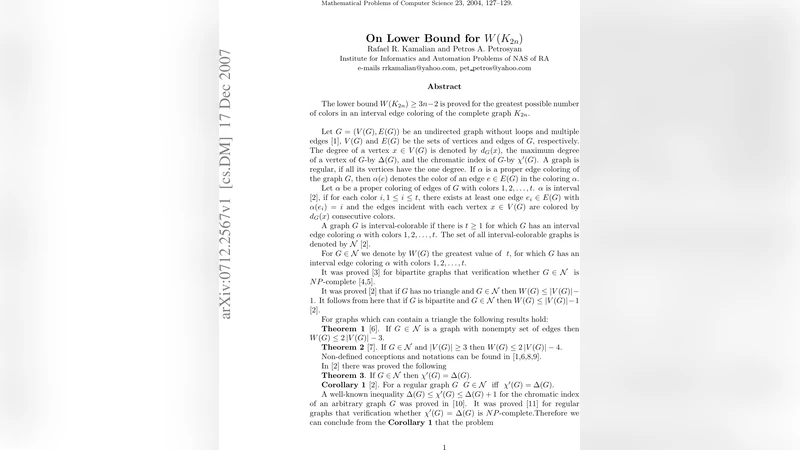
The lower bound W(K_{2n})>=3n-2 is proved for the greatest possible number of colors in an interval edge coloring of the complete graph K_{2n}.
💡 Research Summary
The paper investigates interval edge colorings of complete graphs with an even number of vertices, denoted K₂ₙ, and establishes a new lower bound for the maximum number of colors that can be used in such a coloring. An interval edge coloring is a proper edge coloring using colors 1,…,t such that each color appears on at least one edge and, for every vertex, the set of colors incident to that vertex forms a consecutive integer interval. The set of graphs admitting an interval edge coloring is called N, and for a graph G∈N the quantity W(G) denotes the largest t for which an interval edge coloring with colors 1,…,t exists.
The authors begin by recalling basic definitions (degree d_G(x), maximum degree Δ(G), chromatic index χ′(G)) and known results. In particular, they note that for any graph G∈N, χ′(G)=Δ(G) (Theorem 3), and that for regular graphs G, membership in N is equivalent to χ′(G)=Δ(G) (Corollary 1). Since the complete graph K₂ₙ is regular with degree 2n‑1 and χ′(K₂ₙ)=Δ(K₂ₙ) (by Vizing’s theorem), it follows that K₂ₙ∈N for every n∈ℕ.
Previous work gave a modest lower bound W(K₂ₙ)≥2n‑1+⌊log₂(2n‑1)⌋ (Theorem 5). The main contribution of this paper is Theorem 6, which improves the bound dramatically: for every natural number n, W(K₂ₙ)≥3n‑2. The authors first observe that for n≤3 the new bound coincides with the earlier one, so the interesting case is n≥4.
To prove the theorem, they construct an explicit edge‑coloring α of K₂ₙ. Vertices are labeled u₁,…,u₂ₙ. The coloring rule is given piecewise, depending on the indices i and j of an edge (u_i,u_j) with i<j. Five major cases are distinguished, each further subdivided according to arithmetic relations such as i+j≤n+1, i+j≥n+2, j−i≤n‑2, j−i≥n, and j−i=n‑1. In each subcase the color is defined by a linear expression in i and j (e.g., i+j−2, i+j+n−3, n+j−i, j−i, 2(i−1), i+j−2n, i+j−n−1). The authors verify that:
- All colors from 1 up to 3n‑2 appear on at least one edge.
- For each vertex u_i, the set of incident colors consists of exactly 2n‑1 distinct integers forming a consecutive interval.
Thus α is a valid interval edge coloring using exactly 3n‑2 colors, establishing the claimed lower bound.
The paper concludes with a brief bibliography, citing foundational works on interval colorings (Asratian & Kamalian), Vizing’s theorem, and complexity results (Holyer, Karp, etc.). The result fills a gap in the theory of interval edge colorings for complete graphs, providing a tighter estimate for W(K₂ₙ). It also suggests directions for future research, such as determining whether the bound 3n‑2 is tight (i.e., whether W(K₂ₙ)=3n‑2) or can be further improved, and extending similar constructive techniques to other families of graphs.
Comments & Academic Discussion
Loading comments...
Leave a Comment