Constructions for Difference Triangle Sets
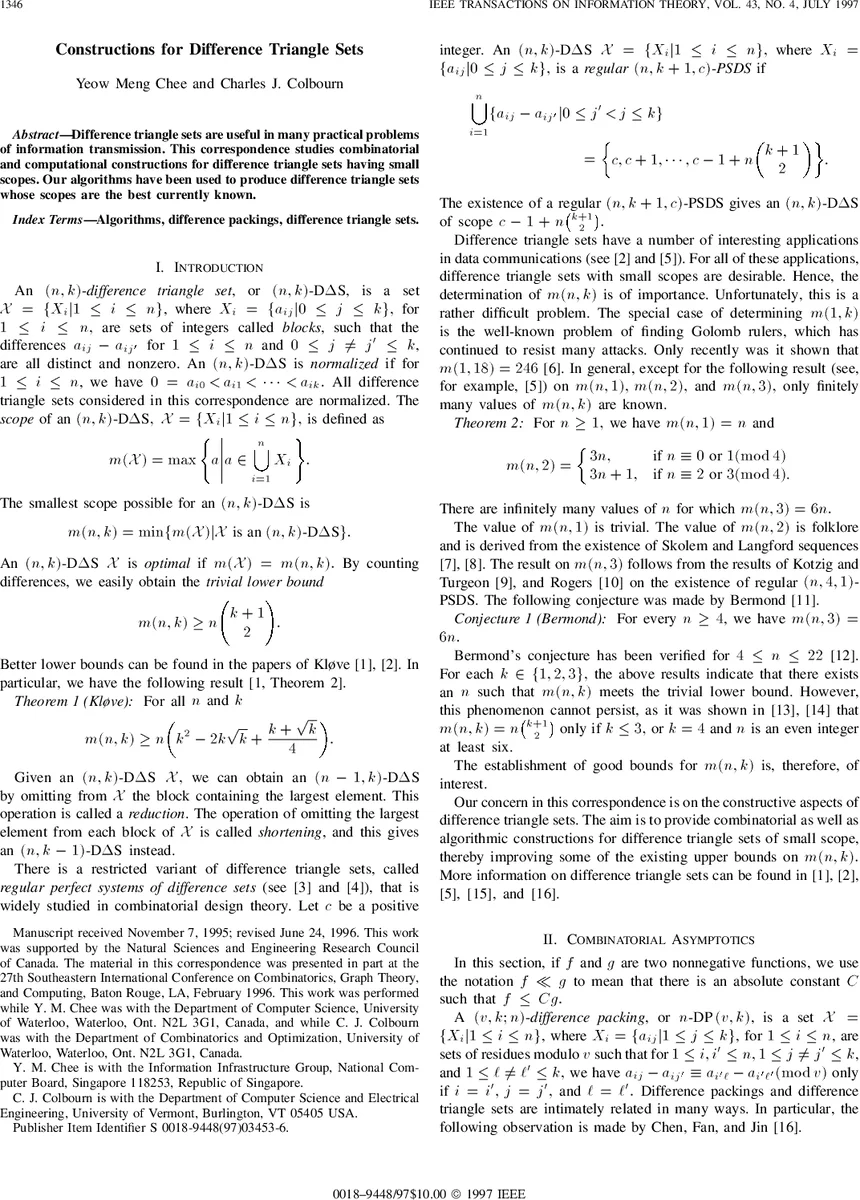
Difference triangle sets are useful in many practical problems of information transmission. This correspondence studies combinatorial and computational constructions for difference triangle sets having small scopes. Our algorithms have been used to produce difference triangle sets whose scopes are the best currently known.
💡 Research Summary
**
The paper investigates the construction of difference triangle sets (DTS), denoted ((n;k)), with the goal of minimizing their scope, i.e., the largest integer appearing in any block. A DTS consists of (n) blocks (X_i={a_{i0},a_{i1},\dots ,a_{ik}}) such that all pairwise differences (a_{ij}-a_{ij’}) (for (j\neq j’)) are distinct and non‑zero. The smallest possible scope for given parameters is denoted (m(n;k)).
The authors first recall the trivial lower bound (m(n;k)\ge n\binom{k+1}{2}) and the improved bound by Kløve, (m(n;k)\ge n\frac{k^{2}}{2}+O(k)). Exact values are known only for a few small (k) (e.g., (m(n;1)=n), (m(n;2)=3n) with a simple parity condition, and (m(n;3)=6n) for many (n)).
Combinatorial and Number‑Theoretic Constructions
A central observation is the relationship between difference packings (DP) and DTS: an (n)-DP((v;k)) yields an ((n;k-1))-DTS of scope at most (v-1) (Lemma 1). Using Singer’s construction of a 1‑DP((q^{2}+q+1;q+1)) for any prime power (q) and a technique of Colbourn & Colbourn, Chen, Fan, and Jin proved that for any prime power (q) and any prime (p>q) there exists an (n)-DP((n(q^{2}+q+1);q+1)).
The authors combine this with the Heath‑Brown–Iwaniec result on gaps between consecutive primes, which states that the difference between the (n)‑th and ((n+1))‑st prime is (O(p_{n}^{0.525})). By choosing the smallest primes (p\ge n) and (q\ge k) with (p>q), they obtain a DTS whose scope is at most ((1+o(1)),nk^{2}/2). This yields Theorem 5: for any (n>k) (or (n=1)) there exists an ((n;k))-DTS with scope ((1+o(1))nk^{2}/2). Corollary 1 extends the result to any function (k=f(n)) satisfying (\limsup_{n\to\infty} f(n)/n<1), showing that (m(n;k)) asymptotically equals the trivial lower bound in this regime.
Algorithmic Approaches
-
Exhaustive Search – Feasible only for very small parameters. The authors used a week‑long distributed backtracking search to prove that (m(2;7)=70), providing explicit blocks.
-
Greedy Algorithms – Two variants are introduced:
Set‑greedy fills the array representation row‑by‑row, always inserting the smallest admissible integer.
Transversal‑greedy fills column‑by‑column. The latter is linked to Wythoff’s game; the positions ((r_{i2},r_{i2}+n)) generated by the algorithm correspond to the winning positions ((u_i,v_i)) of the game. Consequently, for (k=2) the greedy construction yields a scope at most (\frac{5+\sqrt{5}}{2},n), i.e., only about 1.21 times the optimal bound. -
Randomized Heuristics – The authors define three families of “templates” (T_1,T_2,T_3) that specify which cells of the current array are cleared at each iteration: a single cell, an entire row, or one cell from each row, respectively. After clearing, all feasible completions (using numbers ≤ current scope) are enumerated, and one is chosen uniformly at random. Repeating this process (N) times yields progressively smaller scopes. Empirically, the combination of the transversal‑greedy initialization followed by heuristics in the order (T_1\rightarrow T_2\rightarrow T_3) (or (T_1\rightarrow T_3\rightarrow T_2)) improves many previously known upper bounds. Table I in the paper lists numerous ((n,k)) pairs where the new bounds beat those of Kløve, Chen‑Fan‑Jin, and Chen.
Asymptotic Behaviour and Open Problems
The paper establishes that when (k=o(n)) the optimal scope behaves like (nk^{2}/2). However, the case where (k) grows proportionally to (n) or faster remains open. Determining tighter upper and lower bounds in that regime is highlighted as a direction for future research.
Concluding Remarks
Overall, the work blends deep combinatorial constructions, number‑theoretic insights, and practical heuristic algorithms to push the frontier of known bounds for difference triangle sets. The randomized template‑based heuristics, in particular, demonstrate that substantial improvements over classical greedy methods are achievable even for moderate values of (n) and (k). The asymptotic result for (k=o(n)) provides a near‑optimal benchmark, while the unresolved cases for larger (k) invite further investigation.
Comments & Academic Discussion
Loading comments...
Leave a Comment