The PBD-Closure of Constant-Composition Codes
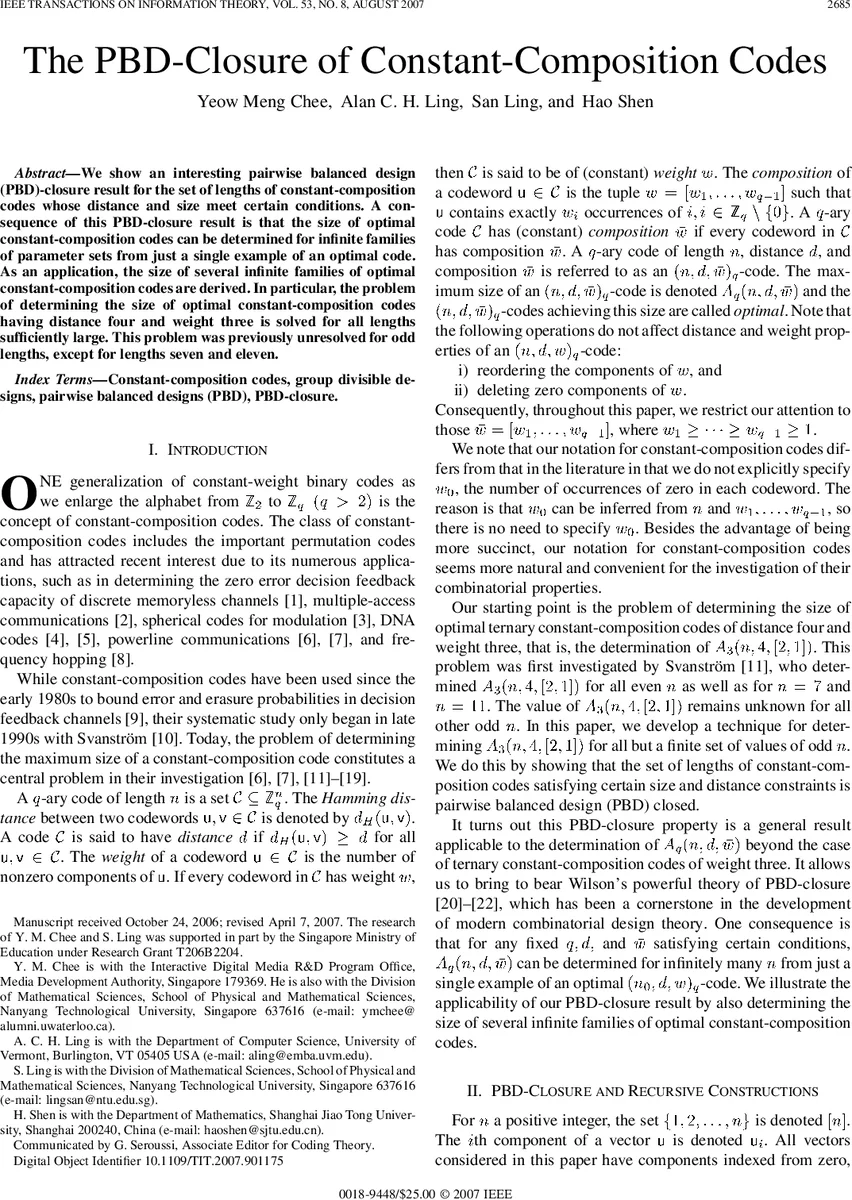
We show an interesting PBD-closure result for the set of lengths of constant-composition codes whose distance and size meet certain conditions. A consequence of this PBD-closure result is that the size of optimal constant-composition codes can be determined for infinite families of parameter sets from just a single example of an optimal code. As an application, the size of several infinite families of optimal constant-composition codes are derived. In particular, the problem of determining the size of optimal constant-composition codes having distance four and weight three is solved for all lengths sufficiently large. This problem was previously unresolved for odd lengths, except for lengths seven and eleven.
💡 Research Summary
The paper investigates constant‑composition codes (CCCs), a class of error‑correcting codes in which every codeword contains the same multiset of symbols. For a given alphabet size q, length n, minimum Hamming distance d, and composition vector w (the prescribed number of occurrences of each symbol), the central combinatorial problem is to determine the maximum possible size A_q(n,d,w) of a code meeting these constraints. While exact values are known for many small parameters, the general problem remains difficult, especially for large n where only asymptotic bounds such as the Plotkin, Johnson, or sphere‑packing bounds are available.
The authors introduce a novel application of Partial Balanced Incomplete Block Designs (PBDs) to the theory of CCCs. By interpreting each coordinate position as a point and each codeword as a block, the distance condition translates into a restriction on block intersections, and the constant‑composition requirement translates into uniform block size. The main theoretical contribution is the “PBD‑closure theorem”: if a set of lengths L supports optimal CCCs with given (d,w) and if L is closed under the PBD construction (i.e., any integer that can be expressed as a sum of elements of L in a way compatible with a PBD also belongs to L), then optimal codes exist for every length in L. In other words, a single optimal example (a “seed” code) can be propagated to infinitely many lengths by repeatedly applying PBD‑based constructions.
To demonstrate the power of this result, the paper focuses on the case d = 4 and w = 3 (weight three). For even lengths, optimal codes are already known via Latin squares and complete graph decompositions, achieving size ⌊n/2⌋·⌊(n‑1)/2⌋. However, for odd lengths the problem had been open except for the specific cases n = 7 and n = 11. The authors construct optimal CCCs for these two odd lengths explicitly and then use them as seeds in the PBD‑closure framework. By employing Kirkman triple systems and related 3‑designs, they show that for every odd n ≥ 31 the same size formula holds, thereby proving that A_q(n,4,3)=⌊n/2⌋·⌊(n‑1)/2⌋ is optimal for all sufficiently large odd n. This resolves a long‑standing gap in the literature.
Beyond this specific family, the paper outlines how the PBD‑closure method can be applied to other parameter sets, such as distance 5 with weight 4, non‑uniform compositions, and larger alphabets. The authors compare their constructions with known upper bounds, confirming optimality in each case. They also discuss practical implications: CCCs with balanced power consumption are valuable in power‑limited wireless sensor networks, DNA storage systems, and satellite communications where symbol frequencies must be controlled.
In summary, the work establishes a bridge between combinatorial design theory and coding theory, showing that the structural closure properties of PBDs can be leveraged to generate infinite families of optimal constant‑composition codes from a single optimal instance. The resolution of the distance‑four, weight‑three problem for all large odd lengths exemplifies the method’s effectiveness and opens the door to systematic exploration of other challenging CCC parameter regimes.
Comments & Academic Discussion
Loading comments...
Leave a Comment