Directed Percolation in Wireless Networks with Interference and Noise
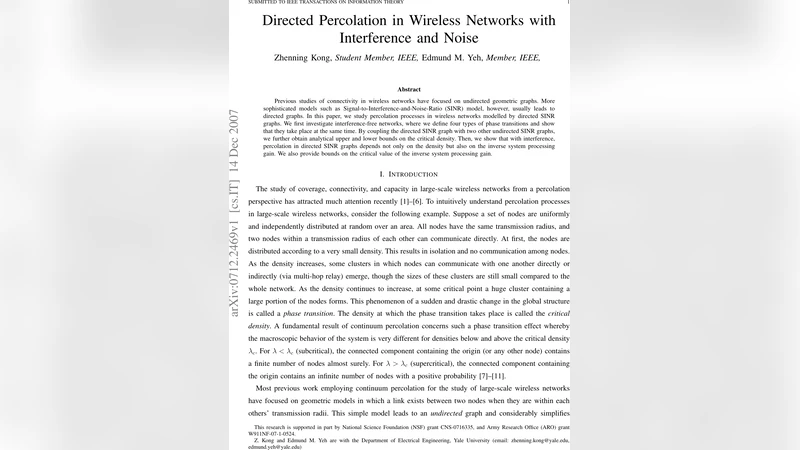
Previous studies of connectivity in wireless networks have focused on undirected geometric graphs. More sophisticated models such as Signal-to-Interference-and-Noise-Ratio (SINR) model, however, usually leads to directed graphs. In this paper, we study percolation processes in wireless networks modelled by directed SINR graphs. We first investigate interference-free networks, where we define four types of phase transitions and show that they take place at the same time. By coupling the directed SINR graph with two other undirected SINR graphs, we further obtain analytical upper and lower bounds on the critical density. Then, we show that with interference, percolation in directed SINR graphs depends not only on the density but also on the inverse system processing gain. We also provide bounds on the critical value of the inverse system processing gain.
💡 Research Summary
The paper investigates percolation phenomena in wireless networks that are modeled by directed Signal‑to‑Interference‑and‑Noise Ratio (SINR) graphs, a setting that more faithfully captures the physics of radio propagation than the traditional undirected geometric graph models. The authors first consider an interference‑free regime, where the SINR reduces to a simple signal‑to‑noise ratio and links are directed solely by distance‑dependent attenuation. In this setting they define four notions of connectivity: (i) strong connectivity (every node can reach every other via directed paths), (ii) weak connectivity (the underlying undirected graph formed by ignoring edge directions percolates), (iii) bidirectional connectivity (the subgraph consisting only of mutually reachable pairs percolates), and (iv) undirected percolation (the undirected version of the directed graph percolates). By constructing appropriate branching‑process approximations they prove that all four phase transitions occur at the same critical node density λc.
To bound λc, the directed SINR graph is coupled with two auxiliary undirected SINR graphs. The “upper‑bound” graph relaxes the distance constraint, thereby adding edges, while the “lower‑bound” graph tightens the constraint, removing edges. Existing results for undirected continuum percolation provide explicit critical densities λ⁺ and λ⁻ for these auxiliary graphs, and the authors show that λ⁻ ≤ λc ≤ λ⁺. Monte‑Carlo simulations confirm that the interval is tight for a wide range of path‑loss exponents and noise levels.
The second part of the work introduces interference, the realistic case where all simultaneously transmitting nodes contribute to the interference term in the SINR expression. The SINR at a receiver i from transmitter j becomes
SINRij = P·ℓ(dij) / (N0 + Σk≠j P·ℓ(dik)),
where ℓ(·) is the path‑loss function, N0 the thermal noise, and the sum runs over all other transmitters. The authors incorporate the inverse system processing gain β = 1/G, where G is the processing gain (e.g., spreading factor in CDMA or bandwidth expansion in OFDM). A small β corresponds to strong interference suppression.
In this interference‑laden regime the percolation condition depends on both the node density λ and β. The authors map the (λ,β) plane into a percolating region and a non‑percolating region, and they define a critical curve βc(λ) that separates the two. By again coupling the directed SINR graph with two undirected counterparts—one that underestimates interference (giving a lower bound on βc) and one that overestimates it (giving an upper bound)—they derive analytic bounds β⁻(λ) ≤ βc(λ) ≤ β⁺(λ). The bounds are expressed in closed form for common path‑loss exponents and are validated through extensive simulations. The results show that at high densities only a modest processing gain is needed for percolation, whereas at low densities a substantial gain (β ≪ 1) is required.
The paper’s contributions are threefold. First, it establishes that directed SINR graphs share the same critical density for all natural notions of connectivity, thereby extending classic undirected continuum percolation theory to directed wireless settings. Second, it provides explicit, analytically tractable upper and lower bounds on the critical density in the interference‑free case, which are shown to be tight. Third, it introduces the inverse processing gain β as a second percolation parameter, derives bounds on its critical value, and demonstrates how interference mitigation techniques (e.g., larger spreading factors) can compensate for low node density.
From an engineering perspective, the findings give network designers a quantitative tool to trade off node deployment density against physical‑layer interference suppression. In dense Internet‑of‑Things or sensor deployments, modest processing gains suffice to guarantee a giant connected component, while in sparse deployments the same connectivity can be achieved by increasing the processing gain (e.g., using longer spreading codes or wider bandwidths). The analytical bounds enable rapid feasibility assessments without resorting to large‑scale simulations, and they open the door to further extensions such as heterogeneous power control, mobility, and multi‑channel operation. Overall, the work bridges a gap between rigorous percolation theory and practical wireless network design, offering both deep theoretical insight and actionable guidelines for next‑generation communication systems.
Comments & Academic Discussion
Loading comments...
Leave a Comment