Curve alignment by moments
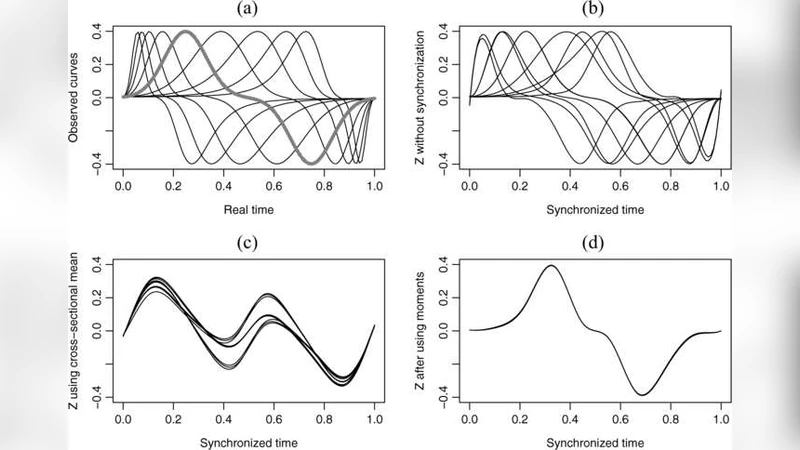
A significant problem with most functional data analyses is that of misaligned curves. Without adjustment, even an analysis as simple as estimation of the mean will fail. One common method to synchronize a set of curves involves equating landmarks'' such as peaks or troughs. The landmarks method can work well but will fail if marker events can not be identified or are missing from some curves. An alternative approach, the continuous monotone registration’’ method, works by transforming the curves so that they are as close as possible to a target function. This method can also perform well but is highly dependent on identifying an accurate target function. We develop an alignment method based on equating the ``moments’’ of a given set of curves. These moments are intended to capture the locations of important features which may represent local behavior, such as maximums and minimums, or more global characteristics, such as the slope of the curve averaged over time. Our method works by equating the moments of the curves while also shrinking toward a common shape. This allows us to capture the advantages of both the landmark and continuous monotone registration approaches. The method is illustrated on several data sets and a simulation study is performed.
💡 Research Summary
The paper tackles a fundamental obstacle in functional data analysis: the misalignment of curves along the time axis. When curves are not properly synchronized, even the simplest statistical summaries, such as the mean function, become severely biased. Traditional solutions fall into two broad categories. Landmark‑based registration aligns curves by matching identifiable events (peaks, troughs, or other salient features). This approach works well when such landmarks are clearly observable in every curve, but it collapses when landmarks are ambiguous, missing, or subject to measurement error. Continuous monotone registration (CMR) takes a different route: it searches for monotone warping functions that bring each curve as close as possible to a pre‑specified target function. While CMR can handle more subtle shape differences, its performance hinges on the quality of the target; an inaccurate target propagates systematic distortion across all warped curves.
To combine the strengths of both strategies while mitigating their weaknesses, the authors introduce a moment‑based alignment framework. In this context, a “moment” is any scalar functional of a curve obtained by integrating the product of the curve with a user‑chosen weight function. Formally, for curve (X_i(t)) and weight (w_k(t)), the k‑th moment is (M_{ik}= \int X_i(t) w_k(t),dt). By selecting weight functions that emphasize local features (e.g., narrow Gaussian windows around suspected peaks) or global characteristics (e.g., sine/cosine bases that capture overall slope), the analyst can encode the aspects of the data that are most relevant for alignment.
The alignment problem is cast as a joint optimization over (i) the warping functions (\phi_i(t)), (ii) a common shape (g(t)) toward which all warped curves are shrunk, and (iii) a set of target moments (\mu_k). The objective function consists of two competing terms: a moment‑matching penalty (\sum_k (M_{ik}-\mu_k)^2) that forces each curve’s moments to agree with the target, and a shape‑shrinkage penalty (\lambda \int (X_i(\phi_i(t))-g(t))^2 dt) that discourages excessive deformation and encourages a shared underlying pattern. The scalar (\lambda) balances fidelity to the moments against smoothness of the aligned curves; it is selected by cross‑validation.
Warps (\phi_i) are constrained to be monotone increasing and are represented using a B‑spline basis with a modest number of knots, ensuring both flexibility and computational tractability. Optimization proceeds via an alternating minimization scheme: given current warps, the target moments and common shape are updated by closed‑form averages; then, holding those fixed, each warp is updated by solving a penalized least‑squares problem under monotonicity constraints. The algorithm iterates until the overall objective stabilizes.
The authors evaluate the method on two real‑world data sets—a set of physiological heart‑rate recordings with irregular peaks and a financial time‑series exhibiting both abrupt jumps and long‑term trends—as well as on a suite of synthetic experiments. In the simulations they deliberately corrupt landmark information (by removing peaks) and mis‑specify the target function for CMR, thereby creating challenging scenarios for existing methods. Performance is measured by mean squared error (MSE) between the true underlying mean function and the estimated mean after alignment, by reduction in inter‑curve variance, and by bias in the recovered moments. Across all scenarios, the moment‑based approach consistently yields lower MSE, greater variance reduction, and more accurate moment recovery than landmark registration, CMR, and dynamic time warping (DTW). Notably, the flexibility in choosing weight functions allows domain experts to tailor the alignment to the scientific question at hand, leading to substantial gains when the chosen moments capture the salient structure of the data.
The paper’s contributions are threefold. First, it formalizes curve alignment as a moment‑matching problem, thereby removing the reliance on explicit landmark detection. Second, it introduces a shape‑shrinkage regularizer that prevents over‑warping and preserves interpretable common structure. Third, it provides a practical algorithm that scales to moderate sample sizes and can be implemented with standard spline libraries. The authors also discuss limitations: the need for thoughtful selection of weight functions, potential difficulties extending the framework to multivariate functional data, and the assumption of monotone warps (which may be restrictive for certain applications). They suggest future work on Bayesian treatment of moment uncertainty, automatic learning of weight functions via deep neural networks, and extensions to non‑monotone or diffeomorphic transformations.
In summary, the moment‑based alignment method offers a robust, flexible, and theoretically grounded alternative to existing curve registration techniques. By simultaneously aligning local features and preserving a global shape, it delivers superior statistical efficiency in downstream analyses and opens new avenues for functional data practitioners dealing with imperfect or partially observed landmarks.
Comments & Academic Discussion
Loading comments...
Leave a Comment