The rarity of DNA profiles
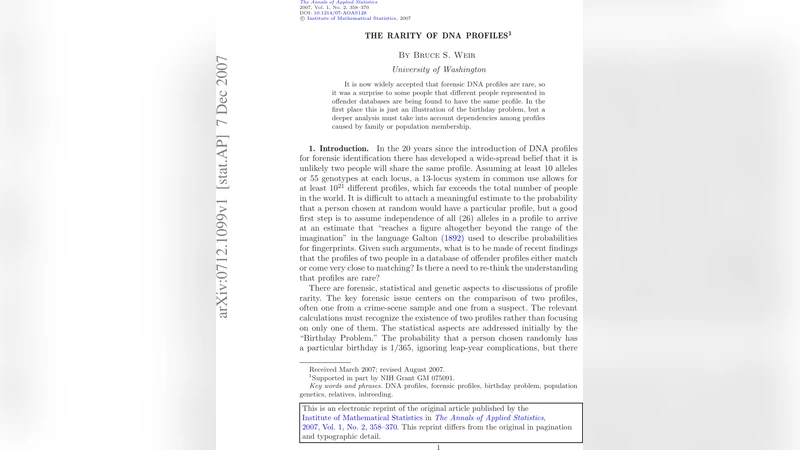
It is now widely accepted that forensic DNA profiles are rare, so it was a surprise to some people that different people represented in offender databases are being found to have the same profile. In the first place this is just an illustration of the birthday problem, but a deeper analysis must take into account dependencies among profiles caused by family or population membership.
💡 Research Summary
The paper “The rarity of DNA profiles” revisits the widely held belief that forensic DNA profiles are extremely rare and examines why identical profiles sometimes appear in large offender databases. The authors begin by outlining the conventional calculation of random match probability (RMP), which assumes that each genetic marker is independent and that the combined probability of a full profile is on the order of 1 in 10⁹ to 1 in 10¹⁴. While this figure supports the use of DNA evidence as highly probative in court, the authors note that recent reports of duplicate profiles in national databases have raised questions about the absolute rarity assumption.
To address this, the study poses two central questions: (1) How does the probability of at least one duplicate profile increase as the size of a database grows, analogous to the classic birthday problem? (2) How do dependencies among profiles caused by population substructure and familial relationships modify the effective match probability?
The methodological section first derives the birthday‑problem formula for DNA profiles. If M denotes the total number of possible profiles, the probability that at least one pair matches among N profiles is approximately 1 – exp
Comments & Academic Discussion
Loading comments...
Leave a Comment