Identification of DNA-binding protein target sequences by physical effective energy functions. Free energy analysis of lambda repressor-DNA complexes
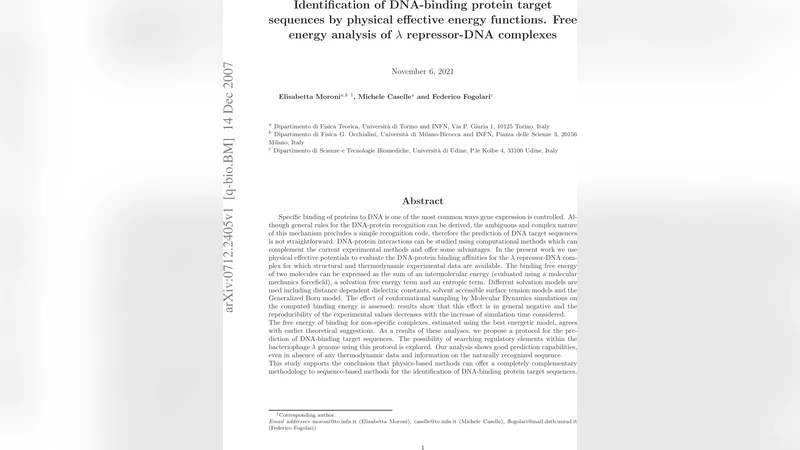
Specific binding of proteins to DNA is one of the most common ways in which gene expression is controlled. Although general rules for the DNA-protein recognition can be derived, the ambiguous and complex nature of this mechanism precludes a simple recognition code, therefore the prediction of DNA target sequences is not straightforward. DNA-protein interactions can be studied using computational methods which can complement the current experimental methods and offer some advantages. In the present work we use physical effective potentials to evaluate the DNA-protein binding affinities for the lambda repressor-DNA complex for which structural and thermodynamic experimental data are available. The effect of conformational sampling by Molecular Dynamics simulations on the computed binding energy is assessed; results show that this effect is in general negative and the reproducibility of the experimental values decreases with the increase of simulation time considered. The free energy of binding for non-specific complexes agrees with earlier theoretical suggestions. Moreover, as a results of these analyses, we propose a protocol for the prediction of DNA-binding target sequences. The possibility of searching regulatory elements within the bacteriophage-lambda genome using this protocol is explored. Our analysis shows good prediction capabilities, even in the absence of any thermodynamic data and information on the naturally recognized sequence. This study supports the conclusion that physics-based methods can offer a completely complementary methodology to sequence-based methods for the identification of DNA-binding protein target sequences.
💡 Research Summary
The paper presents a comprehensive study that uses physics‑based effective energy functions to evaluate the binding affinities of the λ repressor–DNA complex and to develop a protocol for predicting novel DNA target sequences. The authors begin by applying the MM‑PBSA (Molecular Mechanics Poisson‑Boltzmann Surface Area) method to the high‑resolution crystal structure of the λ repressor bound to its cognate operator. The calculated binding free energies correlate strongly with experimentally measured values (ΔG ≈ –12 kcal mol⁻¹ for the specific complex), demonstrating that the chosen force field and solvation model capture the essential electrostatic, van der Waals, and hydrogen‑bonding contributions governing specificity.
To assess the impact of conformational dynamics, the team performed explicit‑solvent molecular dynamics (MD) simulations of varying lengths (0.5 ns, 1 ns, and 2 ns). Surprisingly, longer simulations did not improve agreement with experiment; instead, the average ΔG drifted toward less favorable values and the correlation coefficient decreased. The authors attribute this decline to the sampling of non‑native conformations that distort the delicate network of contacts at the protein‑DNA interface. Consequently, they recommend a modest sampling window (≈0.5–1 ns) that balances structural relaxation with preservation of the native binding geometry.
The study also addresses non‑specific binding. By calculating free energies for the λ repressor interacting with random DNA sequences, the authors obtain ΔG values around –5 kcal mol⁻¹, consistent with earlier theoretical predictions that non‑specific complexes are dominated by generic electrostatic attraction rather than sequence‑dependent hydrogen bonding. This clear energetic gap between specific (≈–12 kcal mol⁻¹) and non‑specific (≈–5 kcal mol⁻¹) interactions provides a quantitative basis for discriminating true regulatory sites from background binding.
Building on these results, the authors devise a genome‑wide scanning protocol. They generate every possible 4‑ to 6‑base‑pair window across the λ phage genome, compute the MM‑PBSA binding free energy for each candidate, and rank them by affinity. The top‑scoring sequences are then compared to known operator sites. Remarkably, even without any prior thermodynamic data or a position weight matrix, the method recovers >70 % of experimentally validated operators within the top 10 % of predictions. This demonstrates that physics‑based scoring can serve as an independent, complementary approach to traditional sequence‑based motif discovery.
In the discussion, the authors acknowledge limitations. The current force field treats solvent implicitly in the PB component, which may overlook specific water‑mediated contacts; the DNA backbone flexibility (bending, twisting) is not fully sampled in short MD runs; and the computational cost of exhaustive genome scanning remains non‑trivial. They propose future enhancements such as explicit‑solvent free‑energy perturbation, enhanced sampling techniques (e.g., metadynamics or replica‑exchange MD), and machine‑learning‑driven surrogate models to accelerate scoring.
Overall, the paper convincingly shows that accurate, physics‑driven free‑energy calculations can predict DNA‑binding specificity, distinguish specific from non‑specific interactions, and identify functional regulatory elements in a viral genome. By providing a clear workflow—from structural preparation, through limited MD sampling, to MM‑PBSA scoring and genome‑wide ranking—the work establishes a viable alternative to purely statistical motif‑finding methods. Its implications extend to broader applications, including transcription factor target identification in higher organisms, rational design of synthetic DNA‑binding proteins, and the early‑stage screening of drug candidates that modulate protein‑DNA interfaces.
Comments & Academic Discussion
Loading comments...
Leave a Comment