Maximum-rate, Minimum-Decoding-Complexity STBCs from Clifford Algebras
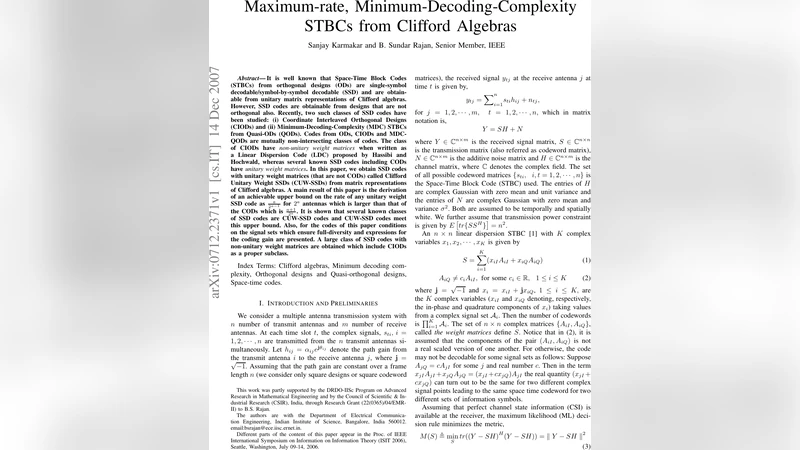
It is well known that Space-Time Block Codes (STBCs) from orthogonal designs (ODs) are single-symbol decodable/symbol-by-symbol decodable (SSD) and are obtainable from unitary matrix representations of Clifford algebras. However, SSD codes are obtainable from designs that are not orthogonal also. Recently, two such classes of SSD codes have been studied: (i) Coordinate Interleaved Orthogonal Designs (CIODs) and (ii) Minimum-Decoding-Complexity (MDC) STBCs from Quasi-ODs (QODs). Codes from ODs, CIODs and MDC-QODs are mutually non-intersecting classes of codes. The class of CIODs have {\it non-unitary weight matrices} when written as a Linear Dispersion Code (LDC) proposed by Hassibi and Hochwald, whereas several known SSD codes including CODs have {\it unitary weight matrices}. In this paper, we obtain SSD codes with unitary weight matrices (that are not CODs) called Clifford Unitary Weight SSDs (CUW-SSDs) from matrix representations of Clifford algebras. A main result of this paper is the derivation of an achievable upper bound on the rate of any unitary weight SSD code as $\frac{a}{2^{a-1}}$ for $2^a$ antennas which is larger than that of the CODs which is $\frac{a+1}{2^a}$. It is shown that several known classes of SSD codes are CUW-SSD codes and CUW-SSD codes meet this upper bound. Also, for the codes of this paper conditions on the signal sets which ensure full-diversity and expressions for the coding gain are presented. A large class of SSD codes with non-unitary weight matrices are obtained which include CIODs as a proper subclass.
💡 Research Summary
The paper addresses a long‑standing limitation of space‑time block codes (STBCs) derived from orthogonal designs (ODs): while ODs guarantee single‑symbol decodability (SSD) and thus minimal decoding complexity, their unitary weight matrices force the transmission rate to decay rapidly as the number of transmit antennas grows. Recent work on Coordinate‑Interleaved Orthogonal Designs (CIODs) and Minimum‑Decoding‑Complexity STBCs from Quasi‑ODs (MDC‑QODs) shows that SSD can be achieved without strict orthogonality, but these constructions either employ non‑unitary weight matrices or rely on more intricate algebraic structures.
The authors propose a new family of SSD codes called Clifford Unitary‑Weight SSDs (CUW‑SSDs). The construction is based on matrix representations of Clifford algebras. A Clifford algebra with (a) generators provides a (2^{a})-dimensional real (or complex) vector space equipped with generators (\gamma_{i}) that satisfy (\gamma_{i}^{2}=-I) and (\gamma_{i}\gamma_{j}=-\gamma_{j}\gamma_{i}) for (i\neq j). By selecting a faithful unitary representation of these generators, the authors build weight matrices (W_{k}) that are all unitary ((W_{k}W_{k}^{H}=I)) yet not mutually orthogonal. When the STBC is written in the linear dispersion form \
Comments & Academic Discussion
Loading comments...
Leave a Comment