What is a superrigid subgroup?
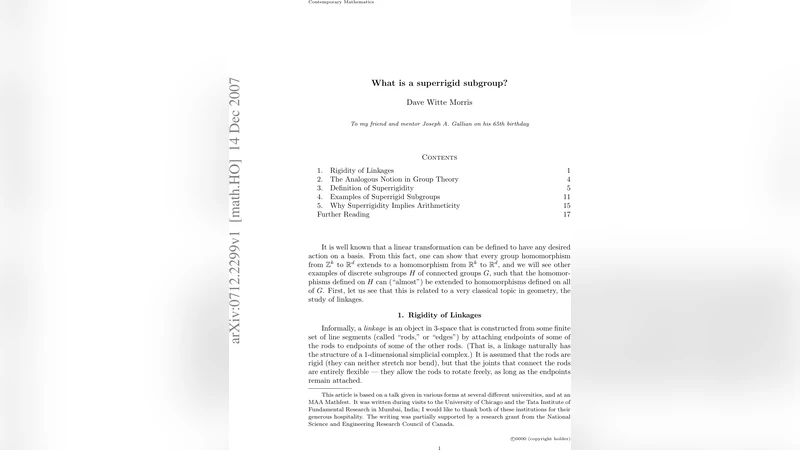
This is an expository paper. It is well known that a linear transformation can be defined to have any desired action on a basis. From this fact, one can show that every group homomorphism from Z^k to R^d extends to a homomorphism from R^k to R^d, and we will see other examples of discrete subgroups H of connected groups G, such that the homomorphisms defined on $H$ can (“almost”) be extended to homomorphisms defined on all of G. This is related to a very classical topic in geometry, the study of linkages.
💡 Research Summary
The paper is an expository introduction to the notion of a “super‑rigid subgroup.” It begins with the elementary linear‑algebra fact that a linear transformation is uniquely determined by its action on a basis. From this, the author shows that any group homomorphism φ : ℤ^k → ℝ^d can be extended uniquely to a continuous linear map Φ : ℝ^k → ℝ^d. The argument is straightforward: choose the images of the standard generators e₁,…,e_k in ℝ^d, then define Φ on arbitrary real vectors by linearity; the discreteness of ℤ^k inside ℝ^k guarantees that φ agrees with Φ on the lattice points. This simple example serves as the prototype for the more general phenomenon of super‑rigidity.
Super‑rigidity is then defined for a connected Lie group G and a discrete subgroup H⊂G. H is called super‑rigid if every homomorphism from H into any target Lie group (or, more modestly, into ℝ^d) can be “almost” extended to a homomorphism defined on the whole of G. The qualifier “almost” allows for finite‑index corrections, central twists, or the need to pass to a finite‑cover of G. The paper presents three canonical families of examples.
- The lattice ℤ^k in ℝ^k is completely super‑rigid, as shown in the introductory argument.
- The arithmetic lattice SL_n(ℤ) inside the real Lie group SL_n(ℝ) (for n ≥ 3) satisfies the celebrated Margulis–Garland super‑rigidity theorem: any linear representation of SL_n(ℤ) extends to a representation of SL_n(ℝ). The proof relies on the existence of a “Margulis algebra” and on the chain condition that forces any homomorphism to be essentially algebraic.
- Discrete cocompact subgroups of the isometry group of hyperbolic space also enjoy super‑rigidity; any isometric action of such a lattice on a hyperbolic manifold extends to the full isometry group.
The author connects these abstract results with the classical geometry of linkages. A planar or spatial linkage—bars connected by revolute joints—can be modeled combinatorially by a graph whose edges correspond to fixed‑length constraints. The configuration space of the linkage is a semi‑algebraic set that, after linearization, looks like a lattice (the integer constraints coming from the number of full rotations of each joint). The continuous motions of the mechanism correspond to a connected Lie group acting on this space. Thus, the problem of extending a motion defined on the discrete set of “integer‑valued” configurations to a full continuous motion is precisely a super‑rigidity question.
The paper sketches the general strategy for proving super‑rigidity: (i) show that H is dense or generates G at the level of Lie algebras, (ii) use continuity or smoothness to force any homomorphism on H to respect the Lie algebra structure, and (iii) invoke structural rigidity results (e.g., Margulis’s arithmeticity, chain conditions, or bounded cohomology) to eliminate exotic extensions. The author briefly outlines the Margulis–Garland proof, emphasizing the role of the Margulis algebra and the “boundary map” that controls how a homomorphism behaves at infinity.
In the concluding discussion, the paper highlights the interdisciplinary impact of super‑rigidity. In algebraic group theory it provides a bridge between discrete arithmetic groups and their ambient continuous groups; in differential geometry it informs the study of locally symmetric spaces; in dynamics it constrains possible group actions on manifolds; and in robotics it suggests that the design of linkages with prescribed discrete motions automatically yields robust continuous control laws. By presenting the elementary ℤ^k→ℝ^d example alongside deep arithmetic cases, the author makes the concept accessible while underscoring its far‑reaching significance.
Comments & Academic Discussion
Loading comments...
Leave a Comment