How to Create a New Integer Sequence
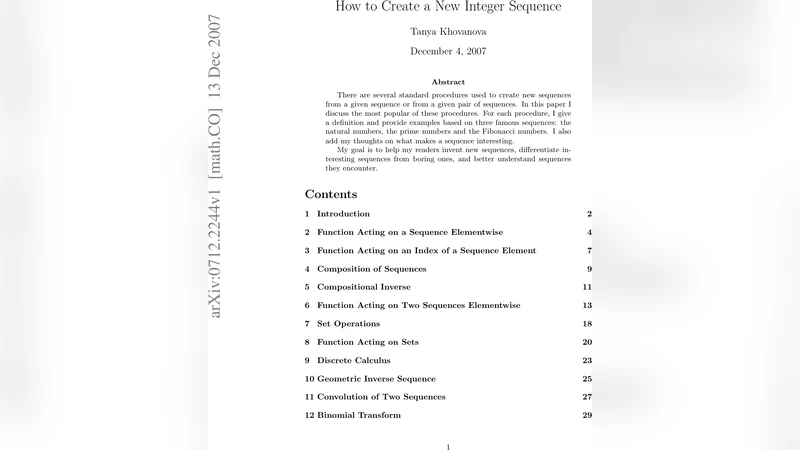
There are several standard procedures used to create new sequences from a given sequence or from a given pair of sequences. In this paper I discuss the most popular of these procedures. For each procedure, I give a definition and provide examples based on three famous sequences: the natural numbers, the prime numbers and the Fibonacci numbers. I also add my thoughts on what makes a sequence interesting. My goal is to help my readers invent new sequences, differentiate interesting sequences from boring ones, and better understand sequences they encounter.
💡 Research Summary
The paper provides a systematic survey of the most widely used operations for generating new integer sequences from existing ones, with the explicit aim of helping readers both invent novel sequences and assess their “interestingness.” It begins by positioning integer sequences as fundamental objects across mathematics, computer science, and cryptography, and raises the central question: what should one strive for when creating a new sequence? The author proposes four criteria for “interesting” sequences: (1) non‑trivial growth or periodic behavior, (2) connections to well‑known sequences, (3) intrinsic mathematical structure such as self‑similarity or symmetry, and (4) potential for practical applications (e.g., cryptographic primitives, combinatorial constructions).
The core of the paper is a detailed taxonomy of seven transformation procedures, each accompanied by a formal definition, a discussion of its effect on the underlying structure, and concrete examples using three canonical sequences—the natural numbers (N), the prime numbers (P), and the Fibonacci numbers (F).
-
Linear Transformations (scaling, shifting, sign reversal). The author shows that applying a map a↦c·a+d to N yields the odd numbers (2n+1), to P yields a “scaled prime” sequence (3p+2), and to F yields a shifted Fibonacci variant (5f−3). Linear maps preserve the order of growth (linear, quadratic, exponential) while altering the arithmetic progression or parity.
-
Difference Operators. First‑order differences reduce variability; for N the result is the constant sequence 1, for P it reveals the prime gaps (2,2,4,2,4,…), and for F the first difference reproduces the original Fibonacci sequence, illustrating a self‑referential property. Higher‑order differences eventually converge to zero, highlighting the polynomial degree of the original sequence.
-
Partial Sums (Cumulative Sums). Summing N produces the triangular numbers, summing P yields the cumulative prime sum sequence, and summing F generates the “Fibonacci partial sum” (1,2,4,7,12,…). This operation raises the growth order by one degree (linear → quadratic, etc.) and often introduces new combinatorial interpretations.
-
Interleaving and Convolution. Interleaving merges two sequences element‑by‑element, creating hybrid patterns such as 1,2,2,3,3,5,4,7,… from N and P. Convolution treats one sequence as a filter applied to the other, producing mixed sequences that inherit spectral characteristics from both inputs. The paper demonstrates N∗P and F∗P as concrete cases, emphasizing how convolution can generate sequences with both additive and multiplicative flavor.
-
Recursive Redefinition. By altering the recurrence relation, one can retain the “spirit” of a known sequence while dramatically changing its dynamics. For example, redefining the Fibonacci recurrence as aₙ = aₙ₋₁ + 2aₙ₋₂ yields a sequence that grows faster than the classic Fibonacci numbers, illustrating how a modest change in coefficients can produce a wholly new family.
-
Generating Functions and Modulo Reduction. Transforming the ordinary generating function (OGF) of a sequence—e.g., multiplying by (1−x) or composing with another OGF—creates new sequences with altered combinatorial meanings. Modulo reduction (taking each term mod m) introduces periodicity; the primes modulo 10 produce the pattern 2,3,5,7,1,3,…, which is both simple to compute and non‑trivial to predict.
-
Compound Operations. The author stresses that the true creative power lies in chaining the above operations. A sample pipeline—linear scaling → first difference → cumulative sum—applied to N yields a sequence that simultaneously exhibits altered growth, reduced variability, and restored accumulation, resulting in a novel pattern not achievable by any single operation.
For each operation, the paper supplies explicit tables showing the transformed N, P, and F sequences, allowing readers to see at a glance how structural properties evolve. The discussion also covers computational aspects, noting that most transformations are linear‑time and can be implemented trivially in any programming language, while convolution may require O(n log n) algorithms for large n.
The final section revisits the “interestingness” criteria. The author argues that a sequence should be judged not merely by novelty but by the richness of its mathematical features and its applicability. Sequences that display unexpected regularities, link disparate domains (e.g., a prime‑based recurrence that yields a known combinatorial sequence), or admit efficient generation are deemed especially valuable.
In conclusion, the paper delivers a practical toolkit for sequence designers: a clear taxonomy of transformations, concrete examples with three benchmark sequences, and a thoughtful framework for evaluating the aesthetic and functional merit of the results. It also outlines future directions, including automated sequence generation via symbolic computation, machine‑learning models that predict “interestingness” scores, and exploration of these methods in cryptographic key generation, pseudo‑random number construction, and combinatorial design. The work thus bridges the gap between elementary sequence manipulation and deeper research, empowering both hobbyists and scholars to create and recognize compelling new integer sequences.
Comments & Academic Discussion
Loading comments...
Leave a Comment