Cycle time of stochastic max-plus linear systems
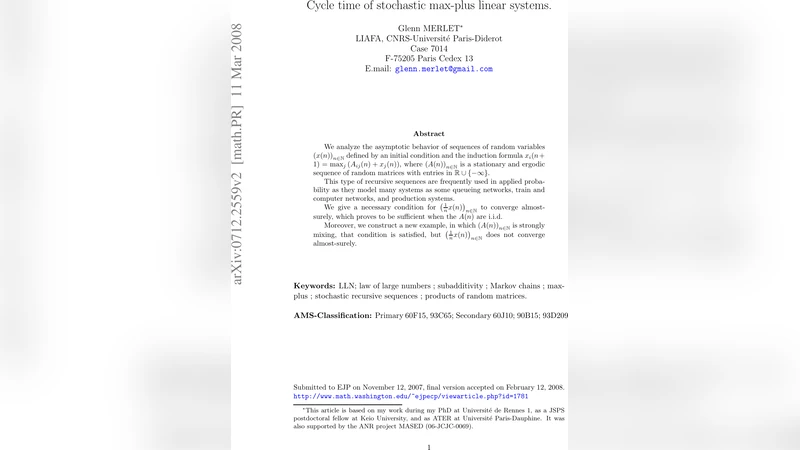
We analyze the asymptotic behavior of sequences of random variables defined by an initial condition, a stationary and ergodic sequence of random matrices, and an induction formula involving multiplication is the so-called max-plus algebra. This type of recursive sequences are frequently used in applied probability as they model many systems as some queueing networks, train and computer networks, and production systems. We give a necessary condition for the recursive sequences to satisfy a strong law of large numbers, which proves to be sufficient when the matrices are i.i.d. Moreover, we construct a new example, in which the sequence of matrices is strongly mixing, that condition is satisfied, but the recursive sequence do not converges almost surely.
💡 Research Summary
The paper investigates the long‑run behavior of stochastic max‑plus linear recursions of the form
(x_{n}=A_{n}\otimes x_{n-1}),
where (x_{0}) is a deterministic initial vector, ({A_{n}}{n\ge1}) is a stationary and ergodic sequence of random matrices, and (\otimes) denotes the max‑plus matrix‑vector product ((A\otimes x){i}=\max_{j}(A_{ij}+x_{j})). Such recursions appear in a wide variety of applied‑probability models, including queueing networks, railway timetabling, computer packet routing, and production lines, where the “cycle time” – the asymptotic average increase per step – is a key performance indicator.
Main contributions
- Necessary condition for a strong law of large numbers (SLLN).
The authors derive a set of four conditions that must hold for the sequence ({x_{n}}) to satisfy
(\frac{1}{n}x_{n}\xrightarrow{\text{a.s.}}\gamma)
for some deterministic vector (\gamma). The conditions are:- (A) Stationarity and ergodicity of the matrix sequence.
- (B) Finite first moments of all matrix entries, i.e. (\mathbb{E}
Comments & Academic Discussion
Loading comments...
Leave a Comment