Complexes of Injective Words and Their Commutation Classes
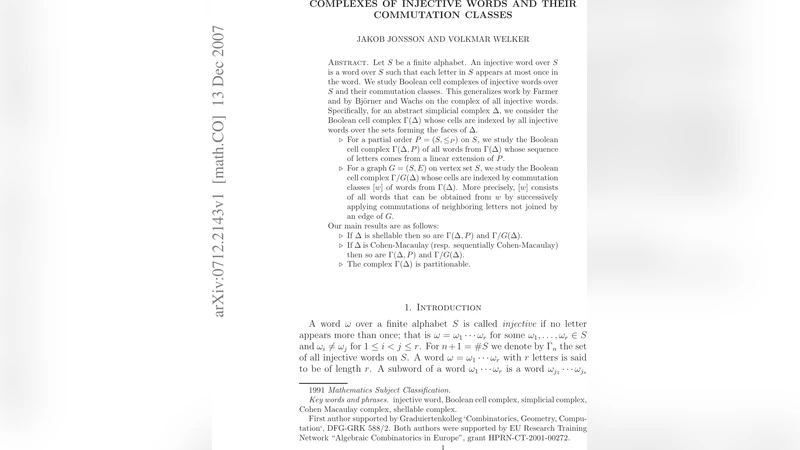
Let $S$ be a finite alphabet. An injective word over $S$ is a word over $S$ such that each letter in $S$ appears at most once in the word. We study Boolean cell complexes of injective words over $S$ and their commutation classes. This generalizes work by Farmer and by Bj"orner and Wachs on the complex of all injective words.
💡 Research Summary
The paper investigates Boolean cell complexes built from injective words over a finite alphabet S and the equivalence classes that arise when certain letters are allowed to commute. An injective word is a sequence in which each letter of S appears at most once. The set of all injective words, ordered by sub‑word inclusion, forms a poset P(S); the order complex of this poset is the Boolean cell complex Δ(S), where each word w corresponds to a cell of dimension |w| − 1. This construction recovers the classical “complex of all injective words” studied by Farmer and later by Björner and Wachs, which is known to be homotopy equivalent to a wedge of (|S| − 2)-dimensional spheres, shellable, and Cohen–Macaulay.
The novel contribution is the introduction of a commutation relation defined by an undirected graph G = (S,E). Two distinct letters a and b are declared commuting if {a,b}∉E; consequently, any injective word can be transformed by repeatedly swapping commuting adjacent letters. The transitive closure of this operation partitions the set of injective words into commutation classes
Comments & Academic Discussion
Loading comments...
Leave a Comment