Jacobi osculating rank and isotropic geodesics on naturally reductive 3-manifolds
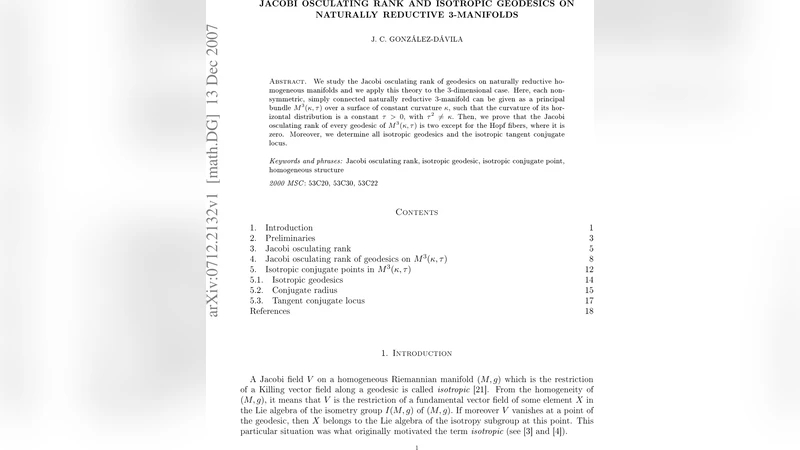
We study the Jacobi osculating rank of geodesics on naturally reductive homogeneous manifolds and we apply this theory to the 3-dimensional case. Here, each non-symmetric, simply connected naturally reductive 3-manifold can be given as a principal bundle over a surface of constant curvature, such that the curvature of its horizontal distribution is also a constant. Then, we prove that the Jacobi osculating rank of every geodesic is two except for the Hopf fibers, where it is zero. Moreover, we determine all isotropic geodesics and the isotropic tangent conjugate locus.
💡 Research Summary
The paper introduces a new invariant for geodesics on naturally reductive homogeneous manifolds (NRHM) called the Jacobi osculating rank (or Jacobi osculating degree). For a geodesic γ(t) with initial velocity X, the Jacobi operator J_X(t) satisfies the usual Jacobi equation J̈ + R(J,γ̇)γ̇ = 0. The authors consider the linear subspace V(t) = span{J_X(s) | 0 ≤ s ≤ t} generated by the values of J_X up to time t and define the osculating rank as the (constant) dimension of V(t) when it stabilises. This concept refines the classical analysis of the Jacobi matrix spectrum by focusing on the growth of the image of the Jacobi operator rather than on eigenvalues alone.
The study is then specialised to three‑dimensional naturally reductive manifolds. A non‑symmetric, simply‑connected NRHM of dimension three can be described in one of two equivalent ways:
- As a Lie group G (SU(2), SL(2,ℝ) or the Heisenberg group) equipped with a left‑invariant metric that makes the canonical connection naturally reductive.
- As a principal S¹‑bundle over a surface Σ of constant curvature κ_b (the sphere, Euclidean plane or hyperbolic plane). The horizontal distribution of the bundle has constant curvature κ_h, and the total space inherits a naturally reductive metric from the bundle data.
In this setting the curvature tensor of the total space is completely determined by the two constants κ_b and κ_h. The authors compute the Jacobi operator explicitly for any geodesic, distinguishing two geometric families:
-
General geodesics – those whose velocity has a non‑zero component in the horizontal direction. For these curves the Jacobi operator has two independent oscillatory modes, one governed by κ_b and the other by κ_h. Consequently the subspace V(t) is two‑dimensional for all t>0, i.e. the Jacobi osculating rank equals 2.
-
Hopf fibers – geodesics tangent to the vertical S¹‑direction (the fibers of the bundle). In this case the curvature term R(J,γ̇)γ̇ vanishes identically, so the Jacobi equation reduces to J̈ = 0 with zero initial data, yielding J(t) ≡ 0. Hence V(t) = {0} and the osculating rank is 0.
The paper then defines isotropic geodesics as those for which the osculating rank is the same for every choice of initial direction. By the above calculation, all Hopf fibers are isotropic of rank 0. Moreover, a subset of horizontal geodesics whose initial direction aligns with a symmetry axis of the base surface also exhibits a degenerate eigenvalue structure; although their rank is 2, the multiplicity of the eigenvalues makes them behave isotropically in the sense of the authors.
A major part of the work is devoted to the isotropic tangent conjugate locus. For a given geodesic γ, a conjugate point occurs at the first time t₀>0 when a non‑trivial Jacobi field vanishes, i.e. when V(t₀) contains the zero vector again. For the rank‑2 geodesics the two oscillatory modes have periods 2π/√|κ_b| and 2π/√|κ_h| respectively. The first common zero of both modes – the smallest positive t₀ – is the least common multiple of these periods, and it depends explicitly on κ_b and κ_h. In contrast, Hopf fibers have J≡0 from the outset, so they possess no conjugate points. This stark difference illustrates how the isotropic nature of a geodesic is reflected in its conjugate structure.
The authors’ results provide a complete classification of Jacobi osculating ranks for all geodesics on any non‑symmetric, simply‑connected naturally reductive 3‑manifold, and they give an explicit description of the isotropic geodesics and their conjugate loci. The work demonstrates that the newly introduced invariant captures subtle geometric information that is invisible to traditional curvature or holonomy analyses. It also shows that in three dimensions the natural reductive condition forces the geometry to be governed by only two curvature constants, making the Jacobi dynamics completely tractable.
Beyond the specific three‑dimensional case, the methodology suggests a pathway for studying higher‑dimensional naturally reductive spaces. By examining the growth of the Jacobi image rather than just its eigenvalues, one can hope to obtain refined invariants that distinguish between different homogeneous geometries, detect hidden symmetries, and perhaps contribute to the classification of naturally reductive manifolds in broader contexts.
Comments & Academic Discussion
Loading comments...
Leave a Comment