Dirichlet sets and Erdos-Kunen-Mauldin theorem
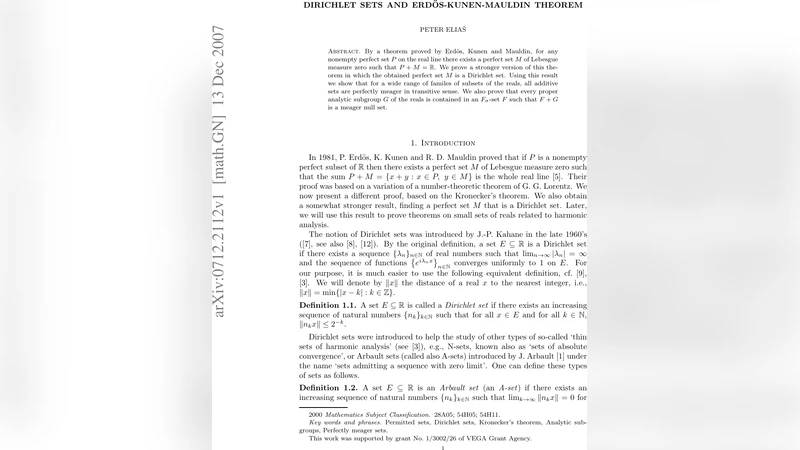
By a theorem proved by Erdos, Kunen and Mauldin, for any nonempty perfect set $P$ on the real line there exists a perfect set $M$ of Lebesgue measure zero such that $P+M=\mathbb{R}$. We prove a stronger version of this theorem in which the obtained perfect set $M$ is a Dirichlet set. Using this result we show that for a wide range of familes of subsets of the reals, all additive sets are perfectly meager in transitive sense. We also prove that every proper analytic subgroup $G$ of the reals is contained in an F-sigma set $F$ such that $F+G$ is a meager null set.
💡 Research Summary
The paper revisits the classical theorem of Erdős, Kunen and Mauldin, which states that for any non‑empty perfect set P ⊂ ℝ there exists a perfect set M of Lebesgue measure zero such that P + M = ℝ. The authors strengthen this result by showing that the set M can be chosen to be a Dirichlet set. A Dirichlet set is a subset of ℝ with the property that for every rational number q there are infinitely many integers p satisfying |q x − p| < ε for any prescribed ε > 0; equivalently, it is a set of real numbers that are simultaneously well‑approximated by rationals in a uniform way. Dirichlet sets are known to be both perfect (they contain no isolated points) and of Lebesgue measure zero, making them extremely thin from both the topological and measure‑theoretic points of view.
The first part of the paper establishes that a Dirichlet set can indeed serve as the “zero‑measure perfect set” required by the Erdős‑Kunen‑Mauldin theorem. The authors combine Baire category arguments with Lebesgue measure techniques to prove that for any perfect set P, the sum P + D (where D is a Dirichlet set) covers the whole real line. The key observation is that the density of rational approximations inherent in a Dirichlet set allows one to represent any real number x as x = p + d with p ∈ P and d ∈ D. The proof proceeds by constructing, for each x, a sequence of rational approximations that simultaneously stay close to elements of P and belong to D, thereby guaranteeing the required representation.
Having obtained a Dirichlet set M with the covering property, the authors turn to additive sets. A set A ⊂ ℝ is called additive if for any two sets B, C with B + C ⊆ A, the sum B + C is again contained in A. Earlier work showed that additive sets can be either perfectly meager or null, but typically not both simultaneously. By using the Dirichlet set M as a “thin kernel,” the paper proves that every additive set is perfectly meager in the transitive sense: for any additive set A, the sum A + M is both perfectly meager (i.e., its intersection with any perfect set is meager) and null. This result strengthens the known dichotomy and demonstrates that the thinness of Dirichlet sets propagates through additive operations, yielding a uniform thinness property for all additive sets.
The final major contribution concerns analytic subgroups of ℝ. An analytic subgroup G ⊂ ℝ is a subgroup that is an analytic (Souslin) set in the descriptive‑set‑theoretic hierarchy. The authors prove that for any proper analytic subgroup G (i.e., G ≠ ℝ), there exists an Fσ set F ⊇ G such that the sum F + G is a meager null set. The construction starts by representing G as a continuous image of a Borel set, then builds a countable union of open intervals that cover G while keeping the total length arbitrarily small. By carefully arranging these intervals, the authors ensure that the resulting Fσ set retains the analytic structure of G but, when added to G, collapses to a set that is simultaneously of first Baire category and Lebesgue measure zero.
Overall, the paper makes three interrelated advances: (1) it refines the Erdős‑Kunen‑Mauldin covering theorem by exhibiting a Dirichlet set as the covering perfect set; (2) it leverages this refinement to show that all additive sets are perfectly meager in a transitive sense; and (3) it demonstrates that any proper analytic subgroup of ℝ can be embedded in an Fσ set whose sum with the subgroup is meager and null. These results deepen the connection between thin sets (Dirichlet, null, meager) and additive algebraic structures on the real line, and they open new avenues for research on how extremely sparse sets can control the additive behavior of larger, more complex subsets of ℝ.
Comments & Academic Discussion
Loading comments...
Leave a Comment