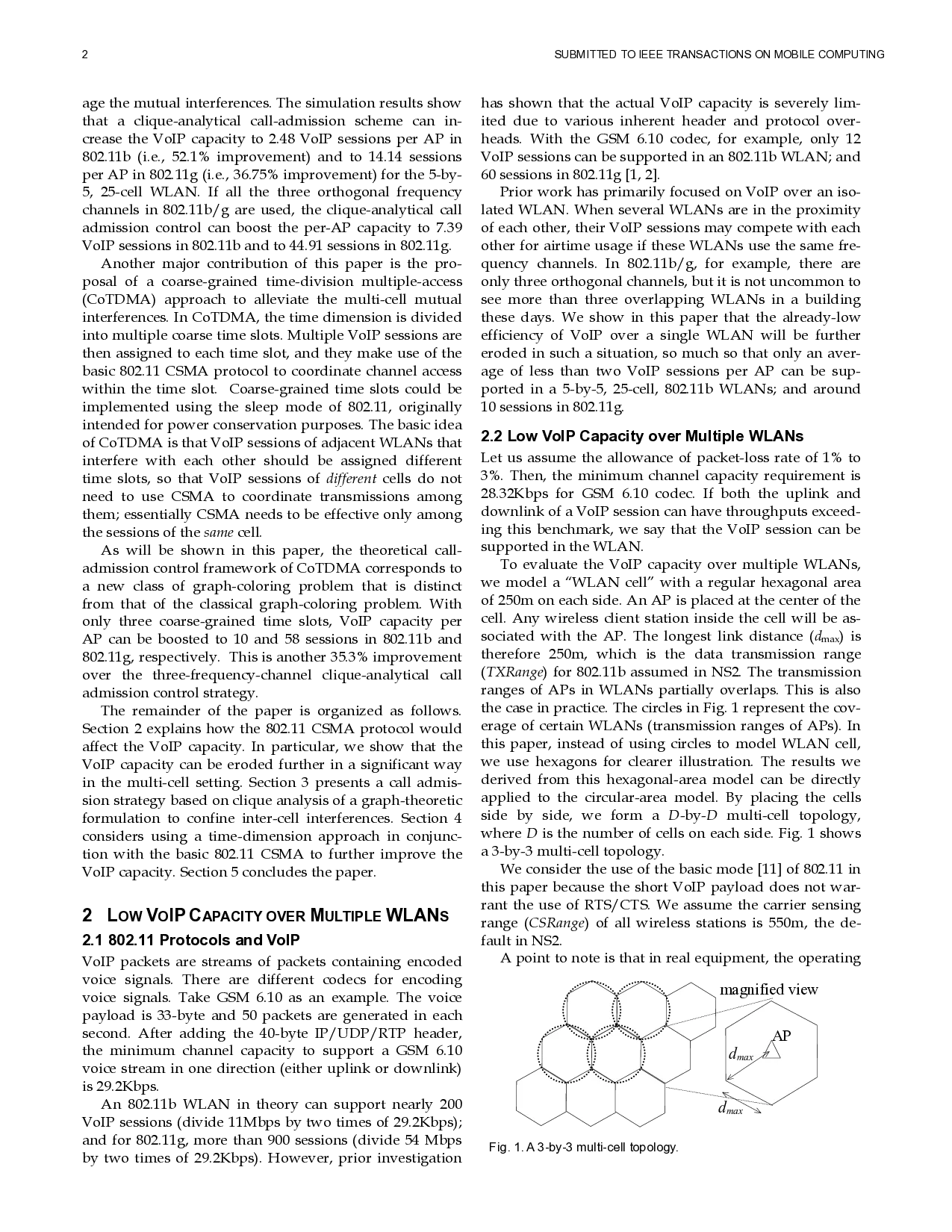
Prior work indicates that 802.11 is extremely inefficient for VoIP transport. Only 12 and 60 VoIP sessions can be supported in an 802.11b and an 802.11g WLAN, respectively. This paper shows that the bad news does not stop there. When there are multiple WLANs in the vicinity of each other, the already-low VoIP capacity can be further eroded in a significant manner. For example, in a 5-by-5, 25-cell multi-WLAN network, the VoIP capacities for 802.11b and 802.11g are only 1.63 and 10.34 sessions per AP, respectively. This paper investigates several solutions to improve the VoIP capacity. Based on a conflict graph model, we propose a clique-analytical call-admission scheme, which increases the VoIP capacity by 52% and 37% in 802.11b and 802.11g respectively. If all the three orthogonal frequency channels available in 11b and 11g are used, the capacity can be nearly tripled by the call-admission scheme. This paper also proposes for the first time the use of coarse-grained time-division multiple access (CoTDMA) in conjunction with the basic 802.11 CSMA to eliminate the performance-degrading exposed-node and hidden-node problems. We find that CoTDMA can further increase the VoIP capacity in the multi-WLAN scenario by an additional 35%.
Deep Dive into VoIP over Multiple IEEE 802.11 Wireless LANs.
Prior work indicates that 802.11 is extremely inefficient for VoIP transport. Only 12 and 60 VoIP sessions can be supported in an 802.11b and an 802.11g WLAN, respectively. This paper shows that the bad news does not stop there. When there are multiple WLANs in the vicinity of each other, the already-low VoIP capacity can be further eroded in a significant manner. For example, in a 5-by-5, 25-cell multi-WLAN network, the VoIP capacities for 802.11b and 802.11g are only 1.63 and 10.34 sessions per AP, respectively. This paper investigates several solutions to improve the VoIP capacity. Based on a conflict graph model, we propose a clique-analytical call-admission scheme, which increases the VoIP capacity by 52% and 37% in 802.11b and 802.11g respectively. If all the three orthogonal frequency channels available in 11b and 11g are used, the capacity can be nearly tripled by the call-admission scheme. This paper also proposes for the first time the use of coarse-grained time-division mult
OICE-OVER-IP (VoIP) is one of the fastest growing applications for the Internet today. At the same time, driven by huge demands for portable access, the market for wireless Local Area Network (WLAN) based on the IEEE 802.11 standard is taking off quickly. Many cities are planning on city-wide deployment of WLAN. An important application over these networks will be VoIP over WLAN.
A hurdle, however, is the low number of voice conversations that can be supported. As shown in previous investigations [1,2] by one of the authors, although in theory many voice sessions can be supported in an 802.11b WLAN based on simplistic raw-bandwidth calculation, in reality only less than 12 can be accommodated. There has been much subsequent work on how to improve the quality-of-service (QoS) of VoIP over WLAN. Part of the IEEE 802.11e standard [3], for example, is to address that.
Most of the prior investigative efforts [1,2,[4][5][6], have been focused on the single isolated WLAN scenario. In practice, with the proliferation of WLAN these days, it is common to find numerous WLANs within a small geographical area -one only needs to do a cursory scan with a WLAN-equipped personal computer to see the considerable number of WLANs within a building. Although recently there has been much attention paid to multihop wireless mesh networks and VoIP over such networks [7][8][9], infrastructure WLAN is still the most widely deployed architecture nowadays. This paper is a first attempt to examine the VoIP capacity in the “multi-cell” environment in which many WLANs are deployed in the same geographical area.
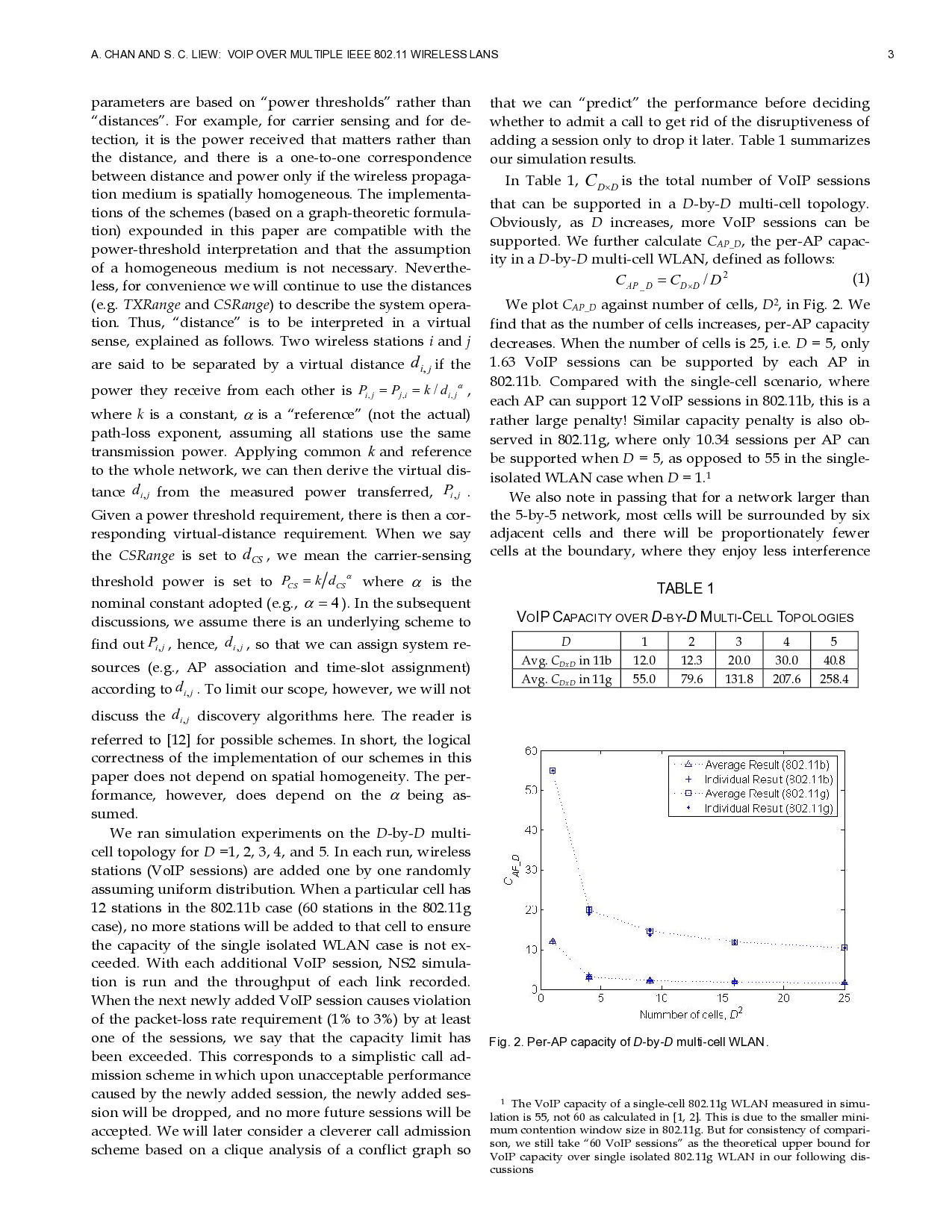
We find that the VoIP capacity is further eroded in the multi-cell scenario, and substantially so. For example, our NS2 [10] simulations show that the capacity of a 5-by-5, 25-cell WLAN is only 1.63 VoIP sessions per access point (AP) in 802.11b, and 10.34 sessions per AP in 802.11g. This dismal performance has important implications that deserve further attention in view of the accelerating productization of VoIP-over-WLAN technologies.
Besides pointing out the alarmingly low efficiency of VoIP over multi-cell WLAN, and identifying the mutual interferences of the CSMA operation of adjacent cells as the major culprit for the dismal performance, this paper is also a first foray into finding solutions to alleviate the problem. Based on a conflict-graph model, we set up a framework for call admission control so as to better man-age the mutual interferences. The simulation results show that a clique-analytical call-admission scheme can increase the VoIP capacity to 2.48 VoIP sessions per AP in 802.11b (i.e., 52.1% improvement) and to 14.14 sessions per AP in 802.11g (i.e., 36.75% improvement) for the 5-by-5, 25-cell WLAN. If all the three orthogonal frequency channels in 802.11b/g are used, the clique-analytical call admission control can boost the per-AP capacity to 7.39 VoIP sessions in 802.11b and to 44.91 sessions in 802.11g.
Another major contribution of this paper is the proposal of a coarse-grained time-division multiple-access (CoTDMA) approach to alleviate the multi-cell mutual interferences. In CoTDMA, the time dimension is divided into multiple coarse time slots. Multiple VoIP sessions are then assigned to each time slot, and they make use of the basic 802.11 CSMA protocol to coordinate channel access within the time slot. Coarse-grained time slots could be implemented using the sleep mode of 802.11, originally intended for power conservation purposes. The basic idea of CoTDMA is that VoIP sessions of adjacent WLANs that interfere with each other should be assigned different time slots, so that VoIP sessions of different cells do not need to use CSMA to coordinate transmissions among them; essentially CSMA needs to be effective only among the sessions of the same cell.
As will be shown in this paper, the theoretical calladmission control framework of CoTDMA corresponds to a new class of graph-coloring problem that is distinct from that of the classical graph-coloring problem. With only three coarse-grained time slots, VoIP capacity per AP can be boosted to 10 and 58 sessions in 802.11b and 802.11g, respectively. This is another 35.3% improvement over the three-frequency-channel clique-analytical call admission control strategy.
The remainder of the paper is organized as follows. Section 2 explains how the 802.11 CSMA protocol would affect the VoIP capacity. In particular, we show that the VoIP capacity can be eroded further in a significant way in the multi-cell setting. Section 3 presents a call admission strategy based on clique analysis of a graph-theoretic formulation to confine inter-cell interferences. Section 4 considers using a time-dimension approach in conjunction with the basic 802.11 CSMA to further improve the VoIP capacity. Section 5 concludes the paper.
VoIP packets are streams of packets containing encoded voice signals. There are different codecs for encoding voice signals. Take GSM 6.10 as an examp
…(Full text truncated)…
This content is AI-processed based on ArXiv data.