Critique du rapport signal `a bruit en theorie de linformation -- A critical appraisal of the signal to noise ratio in information theory
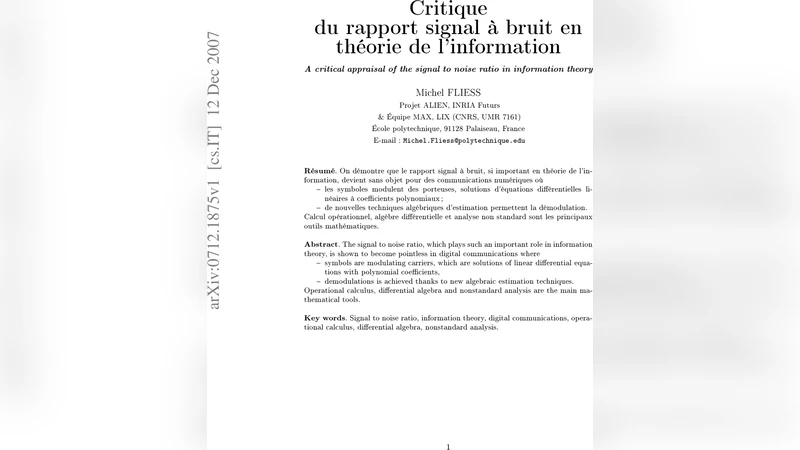
The signal to noise ratio, which plays such an important role in information theory, is shown to become pointless in digital communications where - symbols are modulating carriers, which are solutions of linear differential equations with polynomial coefficients, - demodulations is achieved thanks to new algebraic estimation techniques. Operational calculus, differential algebra and nonstandard analysis are the main mathematical tools.
💡 Research Summary
The paper challenges the long‑standing centrality of the signal‑to‑noise ratio (SNR) in information theory, arguing that in modern digital communication systems the concept becomes essentially meaningless. The authors propose a novel mathematical framework that models carrier waves as solutions of linear differential equations (LDEs) with polynomial coefficients, and they replace conventional statistical demodulation with an algebraic estimation technique. Three advanced mathematical tools are combined: operational calculus to express the modulation process as an operator polynomial P(D) acting on a signal, differential algebra to handle the algebraic relationships among the unknown symbols, and nonstandard analysis to treat noise as an infinitesimal perturbation that can be rigorously ignored.
The paper proceeds in several stages. First, it reviews the classic Shannon‑Hartley capacity formula C = B·log₂(1+SNR) and emphasizes how SNR has traditionally quantified the trade‑off between transmitted power and channel disturbances. Next, it redefines modulation: each transmitted symbol is mapped onto the initial conditions or coefficients of an LDE such as a₂ d²y/dt² + a₁ dy/dt + a₀ y = 0. In this view the carrier is not a sinusoid with an amplitude‑phase pair but the entire solution trajectory of a differential operator. This representation captures the continuous‑time dynamics without resorting to sampling approximations.
Demodulation is then performed by solving the algebraic equation P(D)·z(t) ≈ 0, where z(t) is the received waveform and P(D) is the known operator associated with the transmitted symbol. The residual term, traditionally modeled as additive white Gaussian noise, is decomposed using nonstandard analysis into an infinitesimal ε multiplied by an unlimited quantity η. By proving that ε·η contributes a negligible effect on the algebraic identity, the authors claim that the conventional SNR ratio is unnecessary; instead, the ability to uniquely identify the underlying operator (structural identifiability) becomes the performance metric.
The authors list several theoretical advantages: (1) operator‑based modeling preserves the exact continuous‑time behavior, reducing information loss due to discretization; (2) algebraic estimation does not rely on statistical assumptions about noise, potentially allowing reliable recovery even in low‑power, low‑SNR regimes; (3) nonstandard analysis provides a rigorous way to bound the error introduced by infinitesimal disturbances.
However, the paper also acknowledges significant limitations. Real wireless channels exhibit multipath fading, nonlinear amplification, and frequency‑selective attenuation, phenomena that cannot be captured by a single linear differential equation. The algebraic estimator requires high‑order derivatives, raising concerns about numerical stability and computational load in digital hardware. Moreover, the infinitesimal noise model, while mathematically elegant, lacks a clear quantitative link to the empirically observed Gaussian noise spectra, demanding experimental validation. Finally, the authors’ outright dismissal of SNR may be premature; a more balanced approach would introduce new metrics (e.g., structural identifiability indices) while establishing their relationship to traditional SNR.
In conclusion, the paper opens a provocative line of inquiry by recasting modulation/demodulation in an operator‑algebraic language and by questioning the relevance of SNR in such a setting. Future work should address (i) extensions to nonlinear or time‑varying differential operators, (ii) efficient digital algorithms for high‑order derivative estimation, (iii) experimental studies that compare infinitesimal‑noise predictions with measured channel data, and (iv) a systematic mapping between the proposed algebraic performance measures and classical SNR‑based capacity results. If these challenges are met, the community may acquire a richer set of tools for evaluating and designing communication systems beyond the traditional SNR paradigm.
Comments & Academic Discussion
Loading comments...
Leave a Comment