The fairness of IEEE 802.11 wireless networks (including Wireless LAN and Ad-hoc networks) is hard to predict and control because of the randomness and complexity of the MAC contentions and dynamics. Moreover, asymmetric channel conditions such as those caused by capture and channel errors often lead to severe unfairness among stations. In this paper we propose a novel distributed scheduling algorithm that we call VLS, for ``{\em variable-length scheduling}'', that provides weighted fairness to all stations despite the imperfections of the MAC layer and physical channels. Distinct features of VLS include the use of variable transmission lengths based on distributed observations, compatibility with 802.11's contention window algorithm, opportunistic scheduling to achieve high throughput in time-varying wireless environments, and flexibility and ease of implementation. Also, VLS makes the throughput of each station more smooth, which is appealing to real-time applications such as video and voice. Although the paper mostly assumes 802.11 protocol, the idea generally applies to wireless networks based on CSMA (Carrier Sensing Multiple Access).
Deep Dive into Distributed Fair Scheduling Using Variable Transmission Lengths in Carrier-Sensing-based Wireless Networks.
The fairness of IEEE 802.11 wireless networks (including Wireless LAN and Ad-hoc networks) is hard to predict and control because of the randomness and complexity of the MAC contentions and dynamics. Moreover, asymmetric channel conditions such as those caused by capture and channel errors often lead to severe unfairness among stations. In this paper we propose a novel distributed scheduling algorithm that we call VLS, for ``{\em variable-length scheduling}’’, that provides weighted fairness to all stations despite the imperfections of the MAC layer and physical channels. Distinct features of VLS include the use of variable transmission lengths based on distributed observations, compatibility with 802.11’s contention window algorithm, opportunistic scheduling to achieve high throughput in time-varying wireless environments, and flexibility and ease of implementation. Also, VLS makes the throughput of each station more smooth, which is appealing to real-time applications such as video a
In this paper, we propose a simple distributed scheduling algorithm that provides weighted fairness in IEEE 802.11 [1] wireless networks, despite the unpredictability of the 802.11 MAC layer and physical channels.
In 802.11 wireless networks, MAC-layer contention, dynamics and bandwidth allocation are hard to predict. For such networks, the fixed-point model in [4] gives a method for computing the long-term throughput of the Binary Exponential Backoff (BEB) algorithm [1]. However, the shortterm dynamics and unfairness are quite unpredictable. In a certain period, a station may randomly backoff more than others, and therefore have a smaller chance of winning the channel, which in turn makes that station backoff even more.
Meanwhile, the BEB amplifies the unfairness caused by the impairments of the wireless channels. This aggravation is an unintentional side effect of BEB that was designed to reduce collisions, not to guarantee fairness. The following two effects cause the unfairness: (1) Capture: Capture occurs when the signals from different transmitters have very different strengths at a receiver [8]. For instance, a ratio of 2 in distances from the stations to the AP can lead to approximately a ratio of 16 in received signal strengths. When more than one station transmit packets to the AP at the same time, the AP may be able to capture and correctly decode the packet from the closer station, while ignoring the other packets. This effect increases the aggregate throughput since the AP receives one packet even when multiple transmissions overlap in time. However, capture may result in unfairness since the stations that are further away backoff more with the BEB algorithm, and consequently obtain much less throughput than closer stations [7]. (2) Channel errors: In addition to packet collisions, channel errors are another important cause of packet loss. A more lossy channel to the AP drops more packets because of channel errors. The transmitting station interprets all packet losses as collisions and doubles its contention window. Accordingly, the BEB algorithm magnifies the asymmetry of the lossy channels. To alleviate this problem, reference [11] describes a way to differentiate the two kinds of packet losses (due to collisions or channel errors). The algorithm proposed in this paper provides a simpler solution.
With a more complicated MAC, IEEE 802.11e [2] provides Differentiated Service (DiffServ), by adopting different minimum Contention Windows (CW min ) and inter-frame Spaces (IFS) for different service classes such as voice, video and data. This protocol provides relative performance differentiation among different classes: the classes with smaller CW min and IFS have a relative priority over others. To evaluate the performance of 802.11e, reference [14] provides a simulation study; while reference [13] uses an analytical model (a Markov chain) to find the saturated throughput of 802.11e. However, the model there is quite complicated, indicating that the “amount” of relative priority is hard to quantify and control. For instance, it is not clear how much more bandwidth the protocol gives to video with a particular setting of CW min and IFS, nor how to adjust the amount of priority by varying these parameters.
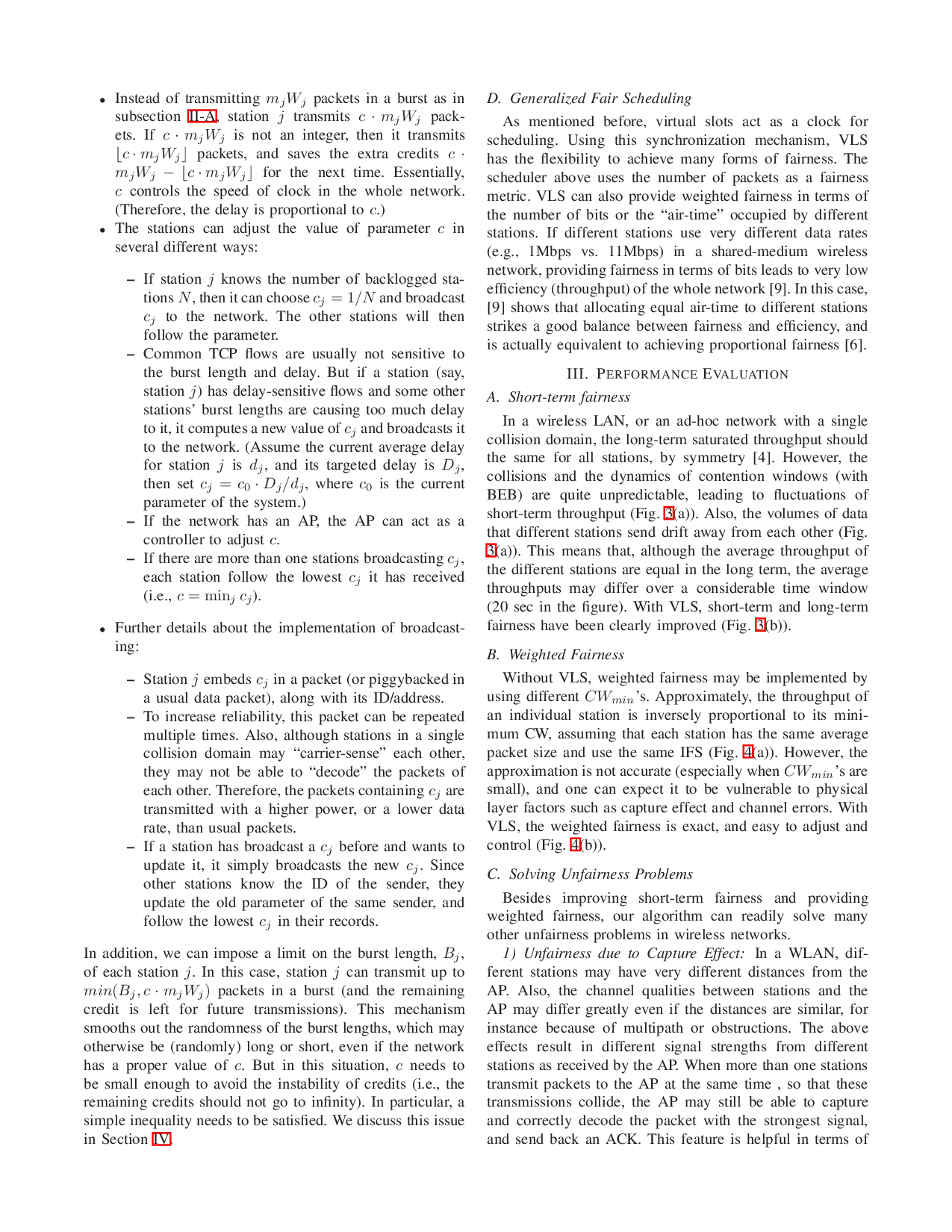
In this paper, we describe a simple, easy to implement, distributed fair scheduling algorithm that we call VLS, for"variable-length scheduling," to cope with the above problems. VLS provides exact weighted fairness despite the unpredictability of the 802.11 MAC layer and physical channels. In this section, we assume that there is only one collision domain. That is, each station can sense the transmissions of other stations. (We consider the case of multiple collision domains in section V.) There are two versions of the scheduling algorithm: without and with an access point (AP). The latter is an adaptation of the former that utilizes the AP to simplify the algorithm.
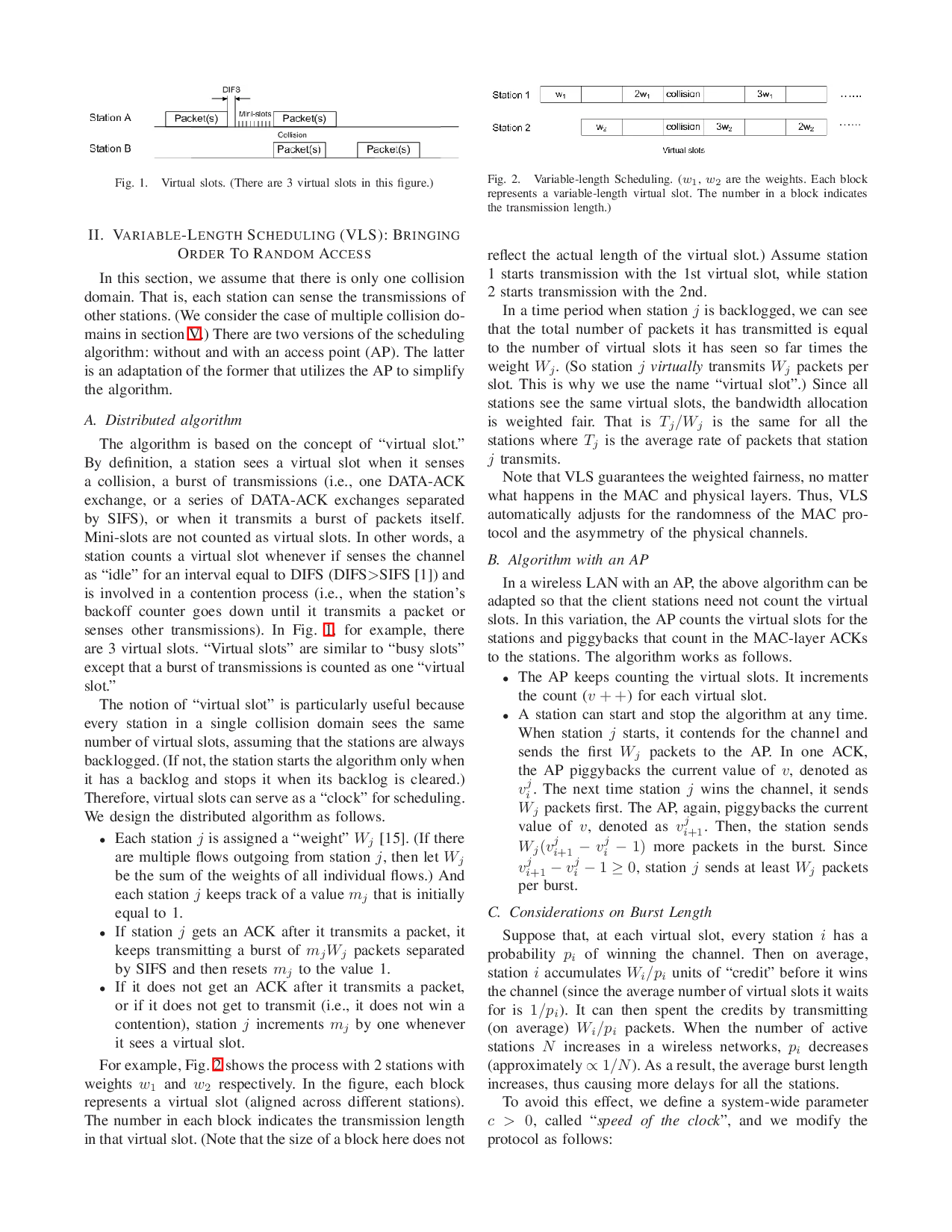
The algorithm is based on the concept of “virtual slot.” By definition, a station sees a virtual slot when it senses a collision, a burst of transmissions (i.e., one DATA-ACK exchange, or a series of DATA-ACK exchanges separated by SIFS), or when it transmits a burst of packets itself. Mini-slots are not counted as virtual slots. In other words, a station counts a virtual slot whenever if senses the channel as “idle” for an interval equal to DIFS (DIFS>SIFS [1]) and is involved in a contention process (i.e., when the station’s backoff counter goes down until it transmits a packet or senses other transmissions). In Fig. 1, for example, there are 3 virtual slots. “Virtual slots” are similar to “busy slots” except that a burst of transmissions is counted as one “virtual slot.”
The notion of “virtual slot” is particularly useful because every station in a single collision domain sees the same number of virtual slots, assuming that the stations are always backlogged. (If not, the station starts the algorithm only when it has a backl
…(Full text truncated)…
This content is AI-processed based on ArXiv data.