Random Cluster Tessellations
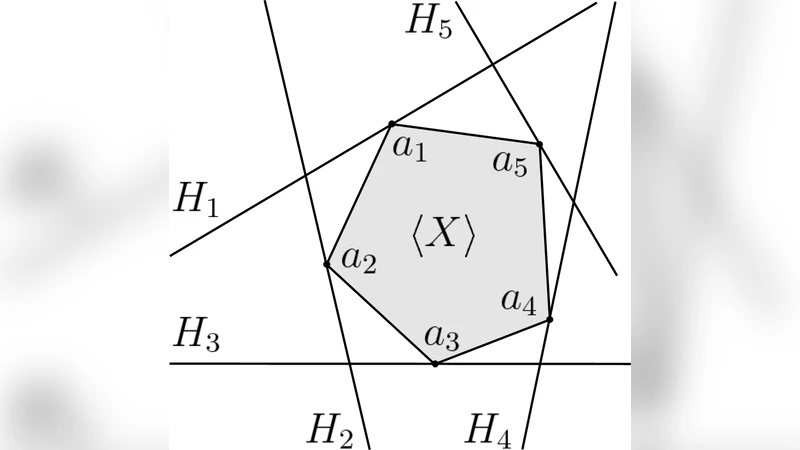
This article describes, in elementary terms, a generic approach to produce discrete random tilings and similar random structures by using point process theory. The standard Voronoi and Delone tilings can be constructed in this way. For this purpose, convex polytopes are replaced by their vertex sets. Three explicit constructions are given to illustrate the concept.
💡 Research Summary
The paper “Random Cluster Tessellations” introduces a unified, point‑process‑based framework for generating discrete random tilings and related stochastic structures. Traditional Voronoi and Delaunay (Delone) tessellations are usually built from convex polyhedra, requiring explicit handling of faces, edges, and vertices. The author’s key insight is to replace each polyhedron by its set of vertices and to let a random point process dictate the placement of those vertices. By doing so, the entire tessellation can be constructed from the point process alone, avoiding complex geometric computations while preserving the essential combinatorial structure of the tiling.
The methodology proceeds in three conceptual steps. First, a random point process is selected – the paper discusses homogeneous Poisson processes, Gibbs processes with pairwise interaction potentials, and Cox (doubly stochastic) processes that introduce hierarchical randomness. Second, for each point a “cluster” is defined as the convex hull of that point together with a suitable selection of neighboring points; the vertices of this hull become the defining set for the cluster. Because the hull is convex, the resulting clusters are automatically polyhedral, and the collection of all vertex sets can be interpreted as a random graph dual to a Voronoi diagram. Third, a matching or conflict‑resolution rule is applied to ensure that clusters partition the space without overlap. The rule may be deterministic (e.g., prioritize clusters by intensity) or stochastic (random tie‑breaking), but it always respects the underlying point‑process distribution.
To illustrate the general scheme, three explicit constructions are presented. The first construction starts with a homogeneous Poisson process, builds the ordinary Voronoi cells, extracts the vertices of each cell, and then recombines those vertices via a Delaunay triangulation. The result is a random tessellation that is simultaneously a Voronoi diagram (in the sense of cell interiors) and a Delaunay mesh (in the sense of vertex connectivity). The second construction replaces the Poisson process by a Gibbs process, introducing repulsion or attraction between points. This yields clusters whose shapes reflect the imposed interaction potential, producing tilings with more regular cell sizes or with controlled anisotropy while still retaining randomness. The third construction uses a Cox process to generate a two‑level hierarchy: a coarse Poisson process defines large “parent” clusters, and within each parent a finer Poisson or Gibbs process creates “child” clusters. The convex hulls of the child points are nested inside the hulls of the parent points, giving a multiscale tessellation that mimics porous or composite materials.
Mathematically, the paper derives expectation formulas for the number of clusters, their volume distribution, and the statistics of cell boundaries. By treating the vertex set as a marked point process, the author obtains closed‑form expressions for the first‑ and second‑order characteristics of the tessellation (e.g., mean cell volume, variance, pair‑correlation of cell faces). These results demonstrate that the random cluster approach preserves the key stochastic invariants of the underlying point process while providing a tractable geometric representation.
From a computational standpoint, the vertex‑centric approach dramatically reduces memory and time requirements. Instead of storing full polyhedral data structures, one only needs to store point coordinates and adjacency lists derived from the Delaunay graph. The paper includes simulation results in two and three dimensions, showing visual examples of the three constructions, histograms of cell sizes, and empirical verification of the derived statistical formulas.
Finally, the author discusses potential applications. In physics, random cluster tessellations can model heterogeneous media for diffusion or wave propagation studies, where the randomness of cell boundaries influences effective material properties. In materials science, the multiscale Cox construction offers a natural way to design synthetic foams or metamaterials with prescribed pore size distributions. In computer graphics, the framework provides a simple procedural method for generating textures, terrain, or architectural layouts that require both randomness and controllable geometric regularity.
The paper concludes by suggesting extensions such as incorporating fractal point processes, time‑evolving (dynamic) point sets, and higher‑dimensional (four‑dimensional and beyond) tessellations. Overall, the work bridges stochastic geometry and computational geometry, offering a flexible, mathematically rigorous, and practically efficient toolkit for creating random tilings and related structures.
Comments & Academic Discussion
Loading comments...
Leave a Comment