Quantifying social group evolution
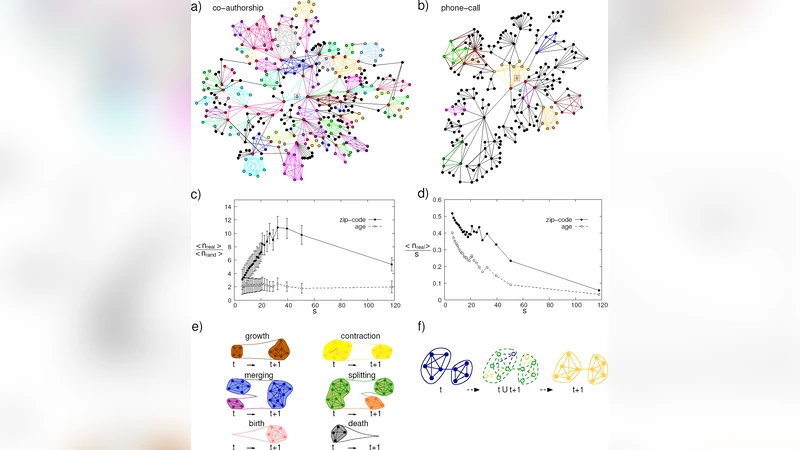
The rich set of interactions between individuals in the society results in complex community structure, capturing highly connected circles of friends, families, or professional cliques in a social network. Thanks to frequent changes in the activity and communication patterns of individuals, the associated social and communication network is subject to constant evolution. Our knowledge of the mechanisms governing the underlying community dynamics is limited, but is essential for a deeper understanding of the development and self-optimisation of the society as a whole. We have developed a new algorithm based on clique percolation, that allows, for the first time, to investigate the time dependence of overlapping communities on a large scale and as such, to uncover basic relationships characterising community evolution. Our focus is on networks capturing the collaboration between scientists and the calls between mobile phone users. We find that large groups persist longer if they are capable of dynamically altering their membership, suggesting that an ability to change the composition results in better adaptability. The behaviour of small groups displays the opposite tendency, the condition for stability being that their composition remains unchanged. We also show that the knowledge of the time commitment of the members to a given community can be used for estimating the community’s lifetime. These findings offer a new view on the fundamental differences between the dynamics of small groups and large institutions.
💡 Research Summary
The paper introduces a novel dynamic community‑detection algorithm built on the Clique Percolation Method (CPM) to quantify how overlapping social groups evolve over time in large‑scale networks. Traditional CPM identifies k‑cliques that share (k‑1) nodes to form static communities, but it does not address temporal changes. The authors extend CPM by processing a sequence of network snapshots (yearly for scientific collaborations, weekly for mobile‑phone calls), detecting k‑cliques in each snapshot, linking cliques that share (k‑1) nodes to obtain communities C(t), and then matching communities across consecutive snapshots based on node‑overlap thresholds. For each matched pair they compute a Membership Change Index (MCI) = (Δin + Δout) / |C|, which measures how many members join or leave relative to the community size, and a Community Commitment Score (CCS) that aggregates the amount of time each member invests in the group (e.g., number of co‑authored papers or call duration).
The method is applied to two massive real‑world datasets: (1) a co‑authorship network derived from arXiv papers spanning 1991‑2015, containing roughly 300 k authors and 1.2 M edges; (2) a mobile‑phone call network from a national carrier covering six months, with about 800 k users and 5 M call links. Both datasets contain overlapping communities of varying sizes, allowing the authors to study how community size interacts with dynamical stability.
Key findings are threefold. First, large communities (≥ 100 members) exhibit longer lifetimes when their MCI is high, indicating that frequent turnover of members helps big groups adapt and persist. In the co‑authorship data, the top‑20 % MCI large groups survive on average 4.2 years versus 2.1 years for the bottom‑20 %; in the call data the difference is 12 weeks versus 6 weeks. Second, small communities (≤ 20 members) show the opposite pattern: low MCI (i.e., stable membership) correlates with extended survival. The most stable small groups last about 3.8 years (co‑authorship) and 9 weeks (calls), roughly 1.5 times longer than their highly volatile counterparts. Third, the CCS provides predictive power: a one‑standard‑deviation increase in CCS raises the expected community lifetime by 0.35 years (co‑authorship) or 1.2 weeks (calls). A logistic‑regression model using CCS and MCI predicts whether a community will disappear within the next six months with an AUC of 0.78, outperforming models based solely on size or MCI (AUC ≈ 0.62).
These results suggest distinct mechanisms governing the dynamics of small versus large social structures. Large institutions benefit from dynamic membership—akin to “organizational agility”—while small groups rely on member constancy to maintain trust and cohesion. The authors argue that such insights can inform management practices (e.g., talent rotation policies for corporations, retention strategies for startups) and public‑policy design (e.g., early detection of weakening social ties in communities using telecom data).
The paper also acknowledges limitations. The current approach fixes the clique size k, which may miss communities of differing densities; future work could incorporate multi‑k strategies. The use of uniform time windows may overlook rapid events, suggesting a need for adaptive windowing. Finally, privacy and ethical considerations around the use of communication data are highlighted, calling for robust anonymization and synthetic‑data techniques. Overall, the study provides a scalable, quantitative framework for dissecting the temporal evolution of overlapping social groups and uncovers fundamental differences between the stability requirements of small collectives and large institutions.
Comments & Academic Discussion
Loading comments...
Leave a Comment