Femtosecond multiphoton pump-probe photoionization is applied to helium nanodroplets doped with rubidium (Rb). The yield of Rb+ ions features pronounced quantum interference (QI) fringes demonstrating the coherence of a superposition of electronic states on a time scale of tens of picoseconds. Furthermore, we observe QI in the yield of formed RbHe exciplex molecules. The quantum interferogram allows to determine the vibrational structure of these unstable molecules. From a sliced Fourier analysis one can not only extract the population dynamics of vibrational states but also follow their energetic evolution during the RbHe formation.
Deep Dive into Quantum interference spectroscopy of RbHe exciplexes formed on helium nanodroplets.
Femtosecond multiphoton pump-probe photoionization is applied to helium nanodroplets doped with rubidium (Rb). The yield of Rb+ ions features pronounced quantum interference (QI) fringes demonstrating the coherence of a superposition of electronic states on a time scale of tens of picoseconds. Furthermore, we observe QI in the yield of formed RbHe exciplex molecules. The quantum interferogram allows to determine the vibrational structure of these unstable molecules. From a sliced Fourier analysis one can not only extract the population dynamics of vibrational states but also follow their energetic evolution during the RbHe formation.
One of the great achievements of femtosecond (fs) lasers has been the observation in real time of the formation and breaking of chemical bonds between two atoms [1]. The molecular dynamics is visualized when initializing a non-stationary multi-state superposition (wave packet, WP) by a fs pump pulse, by letting the WP evolve freely in time, and by projecting it onto a final state by the second probe pulse (pump-probe (PP) technique). This final state is subsequently detected with time-independent methods, e.g. measuring the spontaneous fluorescence or the yield of photo ions.
A different approach to molecular WP dynamics is WP interferometry based on excitation by two identical fs pulses with a well-defined relative phase in an interferometric setup. This approach relies on the interference of WP amplitudes excited according to two temporally distinct quantum paths leading to the same final state [2]. In the limit of weak fields this approach is equivalent to quantum beats, Ramsey fringes in the time domain [3,4], Fourier spectroscopy using fs pulses [5], or temporal coherent control [6]. The measured quantum interferograms carry the high-frequency oscillation of the electronic energy modulated by the low-frequency beatings of WP motion.
Direct measurement of QI oscillations has allowed to study the dynamics of atomic Rydberg states, electronic spin and nuclear spin WPs of free atoms in the gas phase [3,4,5,6,7,8], of atoms on surfaces [9], and of atoms attached to helium nanodroplets [10]. Different variants of WP interferometry have also been applied to simple molecules [11,12,13,14,15] and even to molecular crystals [16]. Using pump-probe spectroscopy with phaselocked pulses the dynamics of electronic as well as vibrational coherence of Cl 2 molecules embedded in solid Ar has been investigated [15]. As a recent highlight, highprecision WP interferometry with HgAr and I 2 dimers has been demonstrated allowing to prepare arbitrary relative populations in different vibrational states [14].
Helium nanodroplets are widely applied as a nearly ideal cryogenic matrix for spectroscopy of embedded molecules and as nanoscopic reactors for studying chemical reactions at extremely low temperatures [17,18,19]. Only recently, the real-time dynamics of doped helium nanodroplets have been studied in pump-probe experiments [20]. Alkali atoms and molecules represent a peculiar class of dopant particles due to their extremely weak binding to the surface of helium nanodroplets. Thus they can be viewed as intermediate systems between the gas phase and conventional cryogenic matrices.
In this Letter, we report on QI spectroscopy upon excitation of Rb atoms attached to helium nanodroplets. In particular, we interpret interference structures in RbHe exciplex molecules which are formed upon excitation of Rb into the 5p state, demonstrating that coherence even survives the formation of a chemical bond. The quantum interferogram is analyzed to extract the vibrational spectrum of the unstable RbHe molecule by Fourier transformation.
In the experiment, a fs laser system is combined with a helium nanodroplet molecular beam machine. The experimental setup is identical to the one used in former experiments [21]. Superfluid helium nanodroplets are formed in a supersonic expansion of helium gas at a high stagnation pressure (50 • 10 5 Pa) from a cryogenic nozzle (T = 19 K). The generated droplets have a mean droplet size of 10 nm and cool by natural evaporation to a terminal temperature of 380 mK which is well below the transition temperature to superfluidity. The droplets are doped with single alkali atoms which are picked up in a heated vapor cell further downstream. The weak interaction of alkali atoms with helium leads to so called “bubbles” where the solvation environment is characterized by a diminished helium density. In helium droplets alkalis therefore reside in surface states, i.e. the atoms are weakly bound on top of dimple-like textures [22]. Because binding energies are only around 10 K which is small compared to energies of laser-induced processes, desorption from the droplets dominantly follows laser excitations.
Pairs of fs laser pulses with ≈ 110 fs pulse duration and equal intensity are generated by a Mach-Zehnder interferometer and propagate collinearly with variable delay time up to 100 ps with a step increment down to 220 attoseconds. In the probe step Rb + and RbHe + photoions are formed which are subsequently detected mass selectively in a quadrupole mass spectrometer.
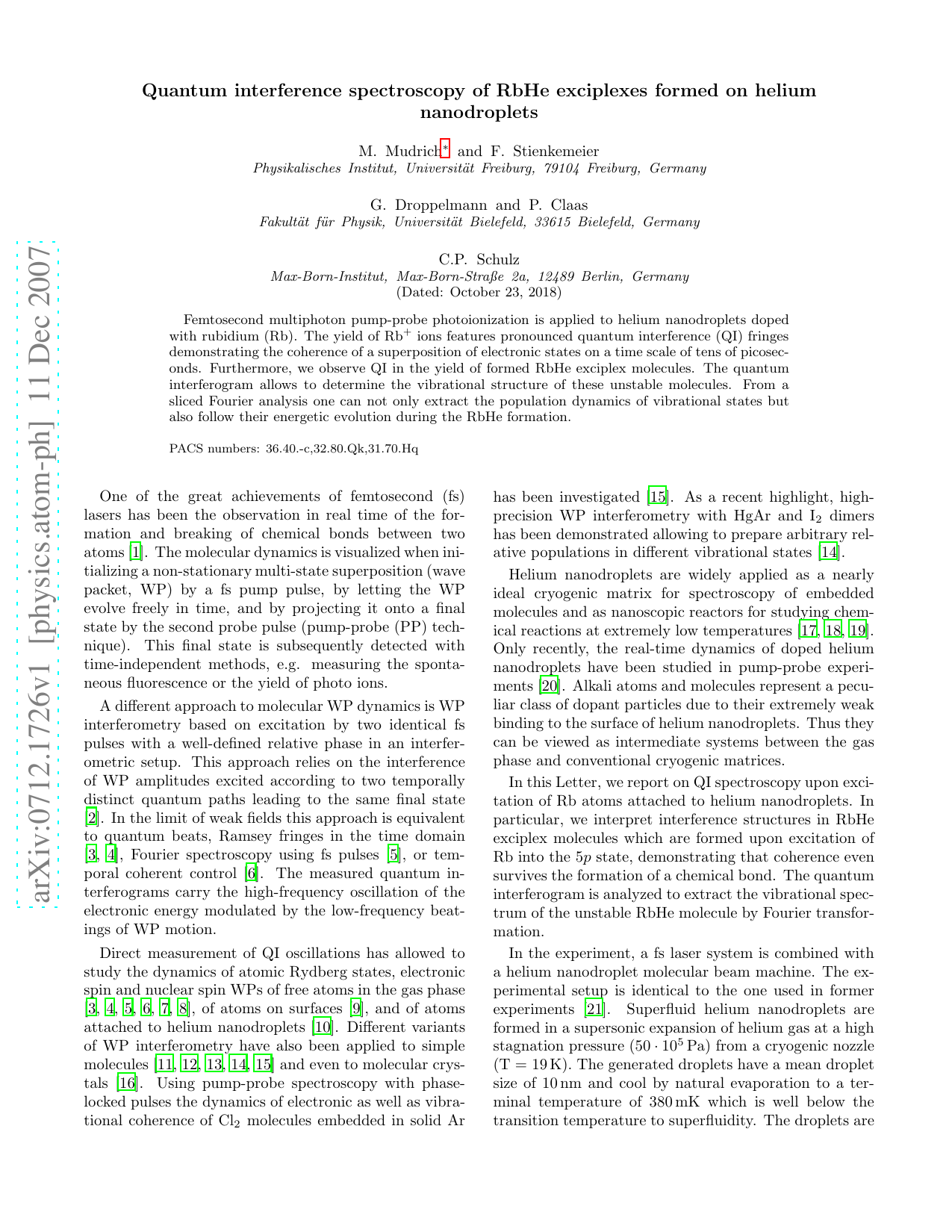
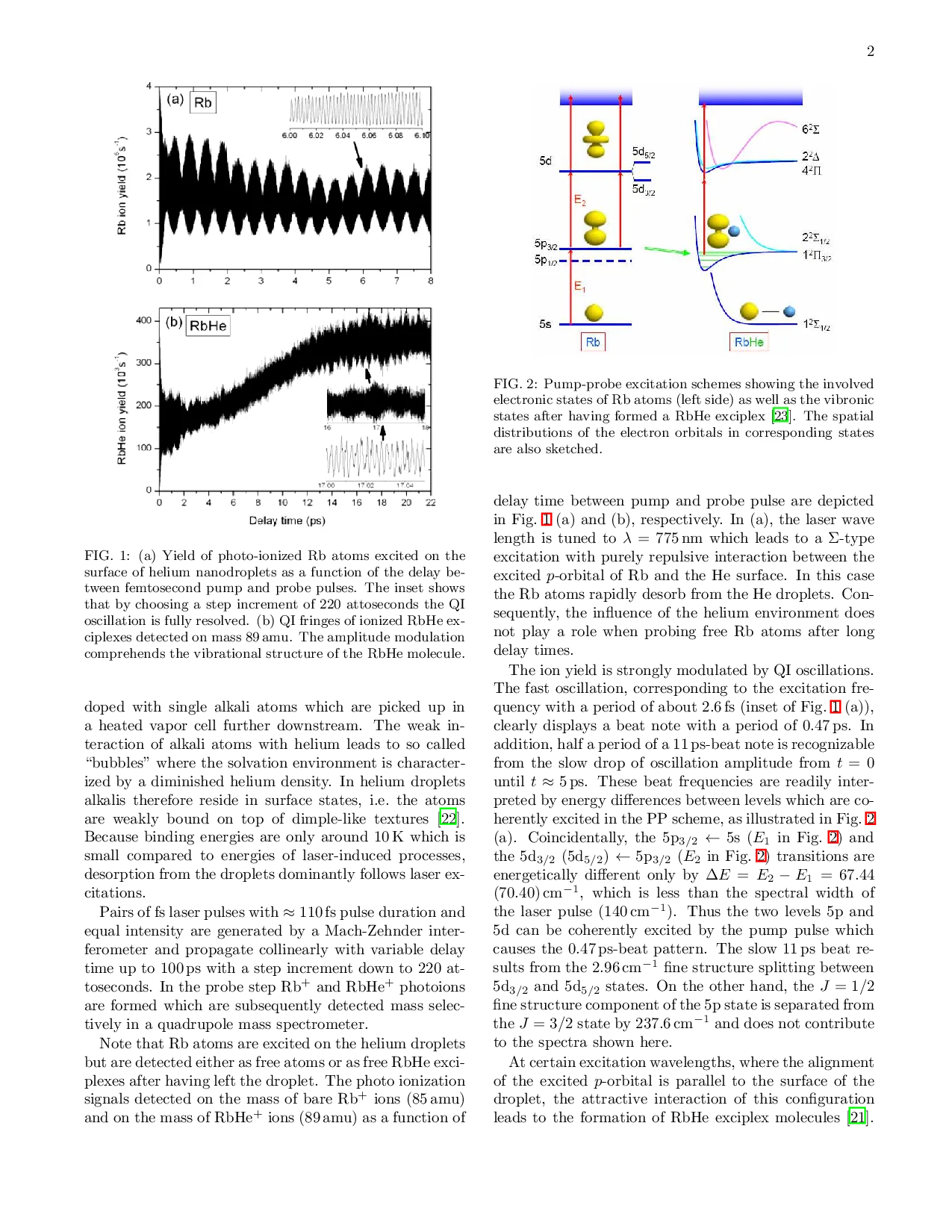
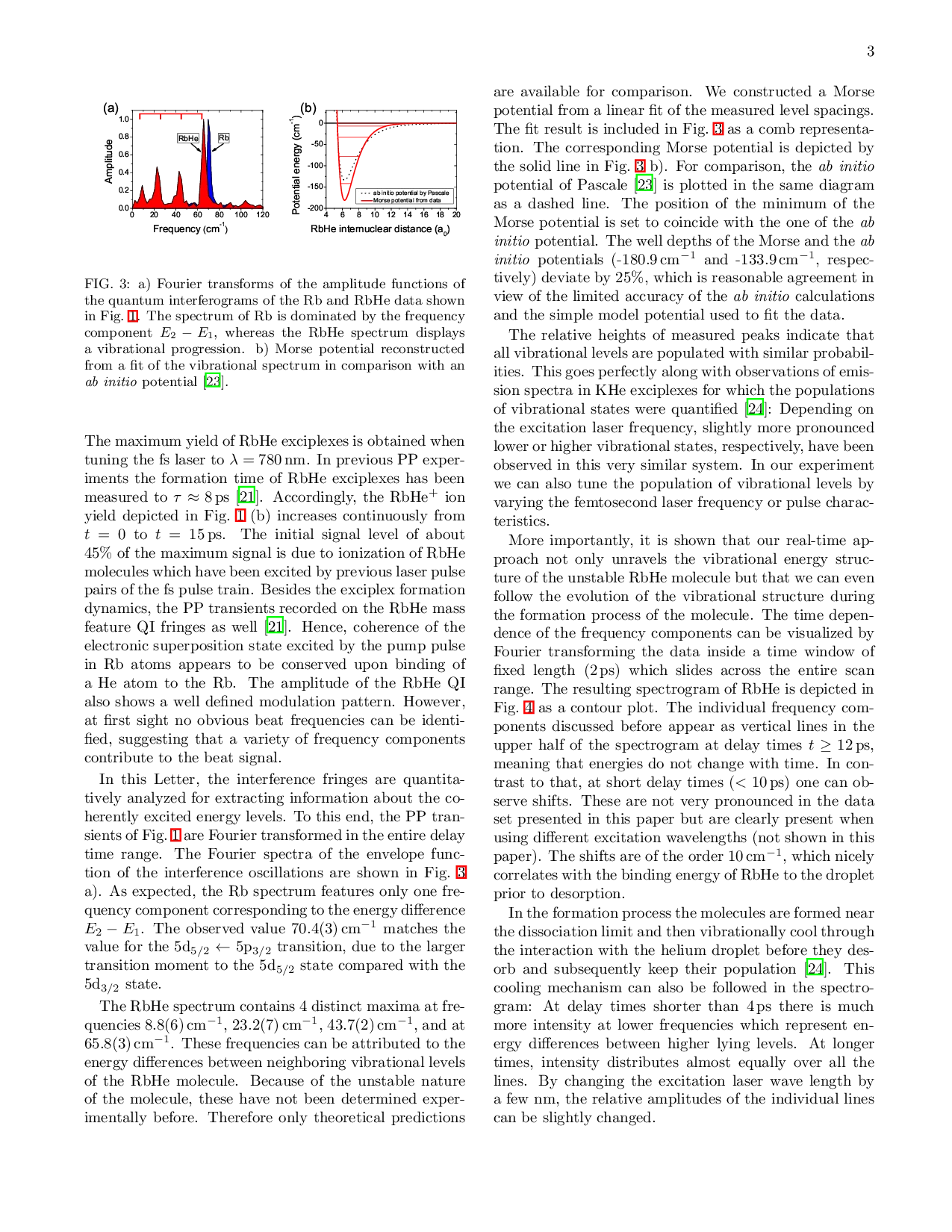
Note that Rb atoms are excited on the helium droplets but are detected either as free atoms or as free RbHe exciplexes after having left the droplet. The photo ionization signals detected on the mass of bare Rb + ions (85 amu) and on the mass of RbHe + ions (89 amu) as a function of FIG. 2: Pump-probe excitation schemes showing the involved electronic states of Rb atoms (left side) as well as the vibronic states after having formed a RbHe excip
…(Full text truncated)…
This content is AI-processed based on ArXiv data.