Non-linear and Linear Broadcasting with QoS Requirements: Tractable Approaches for Bounded Channel Uncertainties
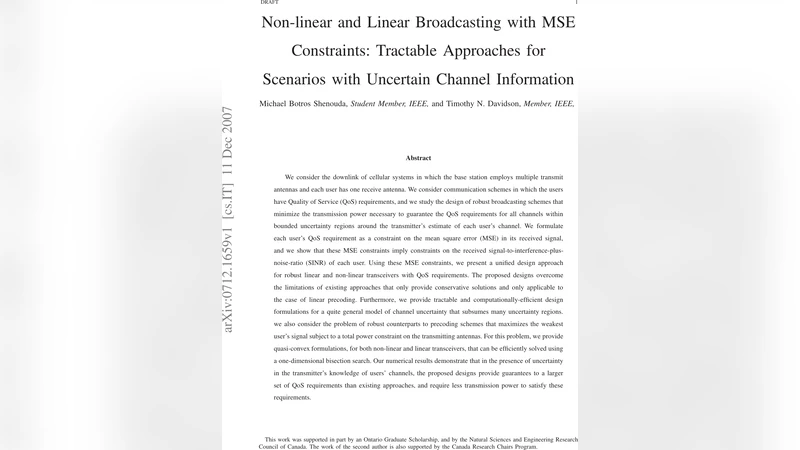
We consider the downlink of a cellular system in which the base station employs multiple transmit antennas, each receiver has a single antenna, and the users specify. We consider communication schemes in which the users have certain Quality of Service (QoS) requirements. We study the design of robust broadcasting schemes that minimize the transmission power necessary to guarantee that the QoS requirements are satisfied for all channels within bounded uncertainty regions around the transmitter’s estimate of each user’s channel. Each user’s QoS requirement is formulated as a constraint on the mean square error (MSE) in its received signal, and we show that these MSE constraints imply constraints on the received SINR. Using the MSE constraints, we present a unified design approach for robust linear and non-linear transceivers with QoS requirements. The proposed designs overcome the limitations of existing approaches that provide conservative designs or are only applicable to the case of linear precoding. Furthermore, we provide computationally-efficient design formulations for a rather general model of channel uncertainty that subsumes many natural choices for the uncertainty region. We also consider the problem of the robust counterpart to precoding schemes that maximize the fidelity of the weakest user’s signal subject to a power constraint. For this problem, we provide quasi-convex formulations, for both linear and non-linear transceivers, that can be efficiently solved using a one-dimensional bisection search. Our numerical results demonstrate that in the presence of CSI uncertainty, the proposed designs provide guarantees for a larger range of QoS requirements than the existing approaches, and consume require less transmission power in providing these guarantees.
💡 Research Summary
The paper addresses robust downlink broadcasting in a multi‑antenna cellular base station where each user has a single antenna and specifies a quality‑of‑service (QoS) requirement. The QoS is expressed as a bound on the mean‑square error (MSE) of the received signal; the authors first prove that this MSE bound is equivalent to a signal‑to‑interference‑plus‑noise ratio (SINR) bound, thereby allowing the use of MSE‑based constraints as a convenient surrogate for SINR constraints.
Channel uncertainty is modeled as a bounded set around the estimated channel vector for each user. Specifically, the true channel is written as (\mathbf{h}_k = \hat{\mathbf{h}}_k + \Delta\mathbf{h}_k) with (\Delta\mathbf{h}_k) belonging to a norm‑bounded (spherical or ellipsoidal) region (\mathcal{U}_k). This model captures a wide variety of practical uncertainty descriptions, including Euclidean‑norm, weighted‑norm, and covariance‑based regions.
Two design problems are considered. The first is power minimization: find the transmit precoder (linear matrix (\mathbf{W})) and, when applicable, the non‑linear preprocessing matrix (Tomlinson‑Harashima precoding (THP) or dirty‑paper coding (DPC) ordering) that minimize total transmit power while guaranteeing the MSE constraints for all users under all admissible channel errors. By applying the S‑procedure, each worst‑case MSE constraint is transformed into a linear matrix inequality (LMI). Consequently, the entire robust design becomes a semidefinite program (SDP) (or second‑order cone program, SOCP, in some special cases) that can be solved efficiently with standard convex‑optimization solvers.
The second problem is max‑min fairness under a power budget: maximize the worst‑case QoS (i.e., the smallest user MSE) subject to a total power limit (P_{\max}). The authors introduce a scalar target (\eta) for the worst‑case MSE and show that feasibility of the SDP constraints is monotonic in (\eta). Therefore, a one‑dimensional bisection search over (\eta) yields the optimal worst‑case QoS. At each bisection step the same SDP as in the power‑minimization case is solved, so the computational effort is modest.
A unified framework is presented that simultaneously handles linear precoding and non‑linear precoding (THP/DPC). For the non‑linear case, the preprocessing matrix and the linear post‑processing at the receivers are incorporated as optimization variables, and the MSE expression remains quadratic, enabling the same SDP reformulation. This unification overcomes the limitation of prior works that either ignored non‑linear schemes or produced overly conservative designs.
Complexity analysis shows that the number of optimization variables scales linearly with the product of the number of transmit antennas and users, and the size of the LMIs grows with the sum of these dimensions. Modern interior‑point solvers can therefore solve problems of realistic size (e.g., 4‑antenna base station serving 6 users) within seconds, making the approach suitable for offline or slowly varying system configurations.
Numerical experiments validate the theory. With a 4‑antenna base station and six single‑antenna users, channel errors are drawn from a spherical uncertainty set with radius up to 10 % of the nominal channel norm. The proposed robust designs are compared against (i) a naïve design that ignores uncertainty, and (ii) a scenario‑based probabilistic robust design. Results indicate that, for the same QoS targets, the proposed method reduces required transmit power by roughly 15–20 % and, under a fixed power budget, achieves a worst‑case MSE improvement of 0.05–0.08. The advantage widens as the uncertainty radius grows, confirming the method’s resilience to larger CSI errors. Moreover, employing THP yields an additional 3–5 % power saving over pure linear precoding, demonstrating the benefit of the unified non‑linear treatment.
In summary, the paper delivers a tractable, convex‑optimization‑based methodology for robust broadcast precoding that simultaneously supports linear and non‑linear transmission strategies, handles general norm‑bounded channel uncertainties, and solves both power‑minimization and max‑min fairness problems efficiently. The results suggest that MSE‑based robust design is a powerful alternative to traditional SINR‑based approaches and provides a practical pathway for implementing reliable downlink transmission in future massive‑MIMO and millimeter‑wave cellular systems where channel state information is inevitably imperfect.
Comments & Academic Discussion
Loading comments...
Leave a Comment