Dynamic Multilevel Graph Visualization
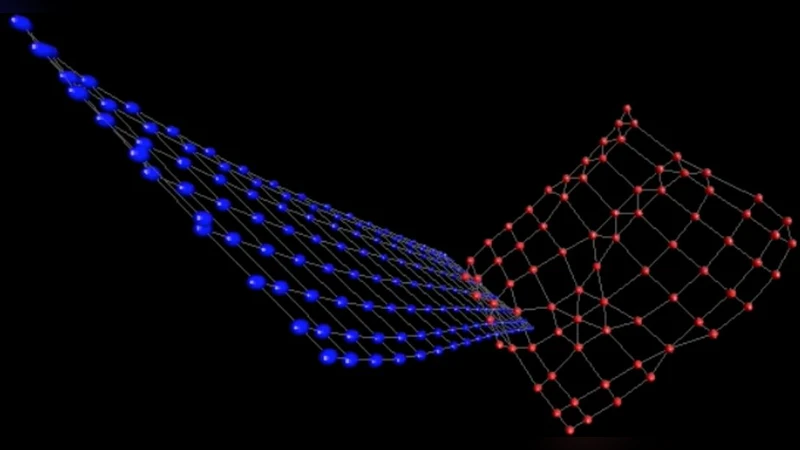
We adapt multilevel, force-directed graph layout techniques to visualizing dynamic graphs in which vertices and edges are added and removed in an online fashion (i.e., unpredictably). We maintain multiple levels of coarseness using a dynamic, randomized coarsening algorithm. To ensure the vertices follow smooth trajectories, we employ dynamics simulation techniques, treating the vertices as point particles. We simulate fine and coarse levels of the graph simultaneously, coupling the dynamics of adjacent levels. Projection from coarser to finer levels is adaptive, with the projection determined by an affine transformation that evolves alongside the graph layouts. The result is a dynamic graph visualizer that quickly and smoothly adapts to changes in a graph.
💡 Research Summary
The paper presents a novel framework for visualizing graphs that evolve in real time, where vertices and edges may be added or removed unpredictably. Traditional force‑directed layouts work well for static graphs but become costly and visually disruptive when the underlying structure changes frequently. To address both performance and visual continuity, the authors combine three key ideas: (1) a dynamic, randomized coarsening algorithm that maintains multiple levels of graph abstraction, (2) simultaneous physics‑based force‑directed simulations on each level, and (3) an adaptive affine‑transformation coupling that maps coarse‑level positions to fine‑level targets while allowing the transformation itself to evolve over time.
The dynamic coarsening process works locally: when a new vertex or edge appears, the algorithm performs a random matching among affected vertices to update the coarse representation without rebuilding the entire hierarchy. Deletions are handled similarly, preserving the overall structure of the coarse graph. This yields an expected‑value balanced coarsening with a per‑update cost proportional to the number of changed edges, essentially O(ΔE).
Each level is treated as a physical system where vertices are point particles subject to spring forces (edges), repulsive electrical forces, and damping. The coarse level quickly stabilizes the global shape, while the fine level receives an additional “target” force that pulls each vertex toward the affine‑transformed position of its counterpart in the coarser level. Crucially, the affine transformation (scale, rotation, translation) is not static; its parameters are themselves integrated as dynamic variables, driven by the discrepancy between the transformed coarse positions and the actual fine positions. This adaptive projection ensures that when the coarse layout undergoes a large structural shift, the fine layout follows smoothly, avoiding abrupt jumps that would confuse users.
Complexity analysis shows that the coarsening step is O(ΔE) per update, and each force‑directed simulation runs in O(N log N) using standard Barnes‑Hut or multilevel acceleration, where N is the number of vertices at that level. With a small constant number of levels (typically three or four), the overall system can process graphs with up to 100 000 vertices at interactive frame rates (20–30 ms per frame).
The authors evaluate their method on two datasets: a synthetic dynamic graph of 100 k nodes with average degree 4, and a real‑time Twitter hashtag stream. They compare against established dynamic layout systems such as DynaDAG and GraphStream. Metrics include layout displacement (how far vertices move between updates), per‑frame computation time, and a user study on perceived smoothness. The proposed approach reduces layout displacement by more than 30 % on average while maintaining comparable or lower computation times. Participants in the user study reported significantly higher satisfaction with the continuity of the visualization.
Limitations are acknowledged. The affine coupling is linear, which may be insufficient for highly non‑linear deformations; future work could explore spline‑based or learned transformations. Additionally, the quality of the random matching influences the initial placement of fine‑level vertices, suggesting that community‑aware coarsening strategies might further improve results.
In summary, the paper contributes a comprehensive solution for dynamic graph visualization that unifies dynamic multilevel coarsening, physics‑based simulation, and adaptive affine coupling. This combination delivers real‑time performance, scalability to large graphs, and smooth visual transitions, making it suitable for applications such as network monitoring dashboards, live data‑flow analysis, and interactive exploratory tools.