Undecidable Problems About Timed Automata
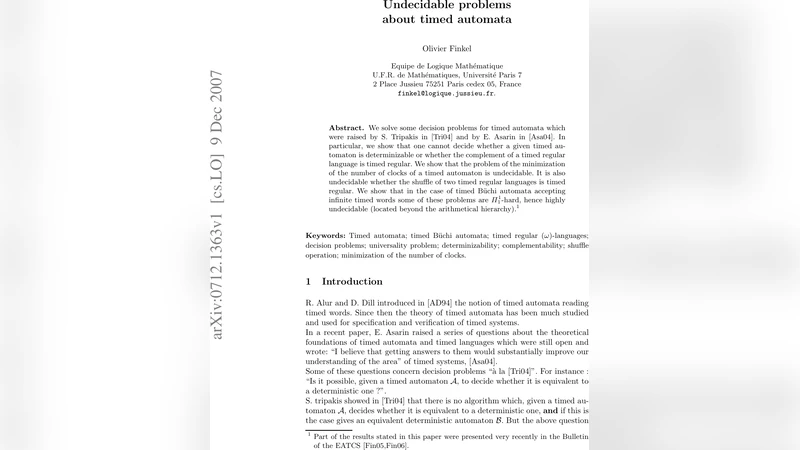
We solve some decision problems for timed automata which were recently raised by S. Tripakis in [ Folk Theorems on the Determinization and Minimization of Timed Automata, in the Proceedings of the International Workshop FORMATS'2003, LNCS, Volume 2791, p. 182-188, 2004 ] and by E. Asarin in [ Challenges in Timed Languages, From Applied Theory to Basic Theory, Bulletin of the EATCS, Volume 83, p. 106-120, 2004 ]. In particular, we show that one cannot decide whether a given timed automaton is determinizable or whether the complement of a timed regular language is timed regular. We show that the problem of the minimization of the number of clocks of a timed automaton is undecidable. It is also undecidable whether the shuffle of two timed regular languages is timed regular. We show that in the case of timed B"uchi automata accepting infinite timed words some of these problems are Pi^1_1-hard, hence highly undecidable (located beyond the arithmetical hierarchy).
💡 Research Summary
The paper investigates a collection of fundamental decision problems concerning timed automata (TA) and timed Büchi automata (TBA), establishing that most of these problems are undecidable, and in the case of infinite timed words, they are even Π¹₁‑hard, i.e., highly undecidable beyond the arithmetical hierarchy.
The authors begin by recalling the classic model of Alur and Dill, where a timed automaton reads timed words—sequences of events annotated with real‑valued time delays. They note that while timed regular languages are closed under union and intersection, they are not closed under complement, a fact that underlies many of the subsequent results.
Determinization and Complement Regularity
The paper first tackles whether a given timed language L, recognized by some TA, is accepted by a deterministic TA, and whether its complement Lᶜ is timed regular. By constructing a language L that incorporates a fresh symbol c and combines three components—(i) the original language L followed by a c, (ii) words with either no c or at least two c’s, and (iii) a language A that forces a pair of a’s to be separated by exactly one time unit—the authors reduce the question “Is L equal to the set of all timed words?” to the determinization/complement problem. Since the universality problem for timed regular languages is known to be undecidable, the reduction shows that both determinization and complement regularity are undecidable.
Clock Minimization
Next, the authors address the problem of reducing the number of clocks in a timed automaton. They define, for any n ≥ 2, a language Aₙ consisting of timed words over a single letter a that contain exactly n distinct pairs of a’s whose inter‑arrival times sum to 1. It is known that Aₙ requires at least n clocks. By embedding Aₙ into a larger language Vₙ that also contains an arbitrary language L (accepted with at most n clocks) and a fresh symbol c, they show that deciding whether Vₙ can be recognized with only n − 1 clocks is equivalent to the universality problem for TA with n clocks. Consequently, the clock‑minimization decision problem is undecidable.
Shuffle Operation
The paper then examines the shuffle operation (interleaving) on timed languages. Two simple timed regular languages are introduced: R₁, consisting of three a’s with the constraint t₁ + t₂ = 1, and R₂, consisting of two b’s separated by an arbitrary delay. The shuffle R₁ ⋊⋉ R₂ yields words where the two a‑delays become “hidden” among the b‑delays. By intersecting this shuffle with a regular language that forces the pattern a b b a, the authors obtain a language that requires simultaneous comparison of two independent delays—a capability beyond standard timed automata. Hence the shuffle of two timed regular languages need not be timed regular, and the decision problem “Is the shuffle of two given timed regular languages timed regular?” is undecidable.
Infinite Words and Π¹₁‑Hardness
Finally, the authors extend the previous results to timed Büchi automata, which accept infinite timed words. The universality problem for TBA is already Π¹₁‑hard. By adapting the constructions used for determinization, complement, clock minimization, and shuffle to the ω‑setting, each of these problems is shown to be at least as hard as TBA universality, thus Π¹₁‑hard. This places them well beyond the arithmetical hierarchy, indicating a very high level of undecidability.
Structure of the Paper
- Section 2: Formal definitions of timed words, timed automata, deterministic TA, and timed Büchi automata.
- Section 3: Proof of undecidability for determinization and complement regularity via reduction from universality.
- Section 4: Undecidability of clock‑minimization, again by reduction from universality for TA with a bounded number of clocks.
- Section 5: Non‑closure of timed regular languages under shuffle and undecidability of the shuffle‑regularity decision problem.
- Section 6: Extension of all previous results to the infinite‑word case, establishing Π¹₁‑hardness for the corresponding problems in TBA.
In summary, the paper provides a systematic and unified treatment of several core decision problems in timed automata theory, demonstrating that they are fundamentally undecidable (or highly undecidable) and that any hope of algorithmic solutions must rely on restrictive subclasses or additional assumptions. This work clarifies the limits of what can be automatically verified in timed systems and points to future research directions focused on decidable fragments or alternative models.
Comments & Academic Discussion
Loading comments...
Leave a Comment