Implementation, Compilation, Optimization of Object-Oriented Languages, Programs and Systems - Report on the Workshop ICOOOLPS2007 at ECOOP07
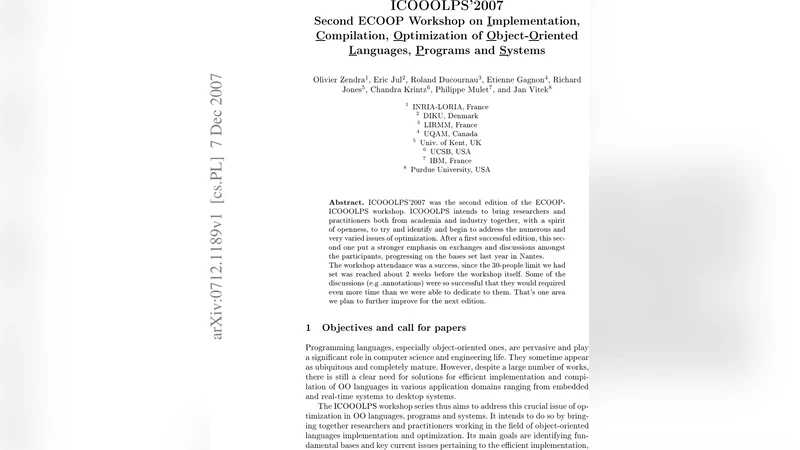
ICOOOLPS'2007 was the second edition of the ECOOP-ICOOOLPS workshop. ICOOOLPS intends to bring researchers and practitioners both from academia and industry together, with a spirit of openness, to try and identify and begin to address the numerous and very varied issues of optimization. After a first successful edition, this second one put a stronger emphasis on exchanges and discussions amongst the participants, progressing on the bases set last year in Nantes. The workshop attendance was a success, since the 30-people limit we had set was reached about 2 weeks before the workshop itself. Some of the discussions (e.g. annotations) were so successful that they would required even more time than we were able to dedicate to them. That’s one area we plan to further improve for the next edition.
💡 Research Summary
The ICOOOLPS 2007 workshop, held as a satellite event of ECOOP07, was the second edition of a gathering dedicated to the implementation, compilation, and optimization of object‑oriented languages, programs and systems. Its primary goal was to create a venue where academic researchers and industry practitioners could exchange ideas, present recent results, and jointly identify the most pressing challenges in this broad field. Attendance was capped at thirty participants, a limit that was reached two weeks before the event, underscoring the strong community interest.
The program was organized around four thematic tracks. The first track, Implementation, featured papers on modern garbage‑collector designs, memory‑layout strategies, and multiple‑dispatch mechanisms. A notable contribution demonstrated a static‑analysis‑driven layout optimizer that automatically re‑orders object fields based on predicted access patterns, achieving measurable reductions in cache misses and overall memory footprint.
The second track, Compilation, focused on intermediate‑representation (IR) design and compiler transformations. Presentations introduced a new SSA‑based IR that can faithfully model the dynamic binding and polymorphism inherent in object‑oriented languages while remaining amenable to aggressive optimizations such as inlining, dead‑code elimination, and cross‑language interoperation. The authors argued that this IR provides a solid foundation for later optimization passes without sacrificing language semantics.
The third track, Optimization, explored hybrid static‑dynamic techniques. Several papers reported on JIT‑augmented static compilation pipelines that use runtime profiling to guide speculative optimizations, loop unrolling, and parallelization. Empirical evaluations on real‑world benchmarks showed average speed‑ups of 20 % and memory reductions of up to 30 %, confirming that the proposed methods are not merely theoretical but can be deployed in production environments.
The fourth track, Annotations, generated the most vigorous discussion. Researchers proposed annotation‑based meta‑information that developers can embed directly in source code to convey optimization hints—such as expected hot paths, immutability, or parallelizable sections—to the compiler. The session examined design principles (explicitness, minimal intrusiveness, portability), the need for a common annotation standard, and compatibility with existing languages and toolchains. Participants agreed that annotations could bridge the gap between high‑level design intent and low‑level optimization, but emphasized that a community‑driven standardization effort is essential.
Following each presentation, a round‑table discussion allowed participants to probe practical concerns: integration of new techniques into legacy codebases, predictability of performance in real‑time systems, and the trade‑offs between aggressive optimization and maintainability. The annotation discussion, in particular, exceeded its allocated time, prompting the organizers to plan a dedicated session for the next edition.
The workshop concluded with a set of concrete action items for future meetings: (1) allocate more time for demos and hands‑on experiments, (2) establish a working group to draft an annotation standard, (3) foster industry‑academia joint projects that apply the presented techniques to real products, and (4) maintain an online community platform for continuous knowledge exchange between editions. These steps aim to transform the workshop’s research outputs into tangible improvements in object‑oriented language implementations and to keep the dialogue between theory and practice alive.
In summary, ICOOOLPS 2007 succeeded in showcasing cutting‑edge research across implementation, compilation, and optimization, while also surfacing a promising new direction—annotation‑driven optimization—that will likely shape the agenda of subsequent workshops and influence the evolution of object‑oriented language ecosystems.
Comments & Academic Discussion
Loading comments...
Leave a Comment