Selective screenability and the Hurewicz property
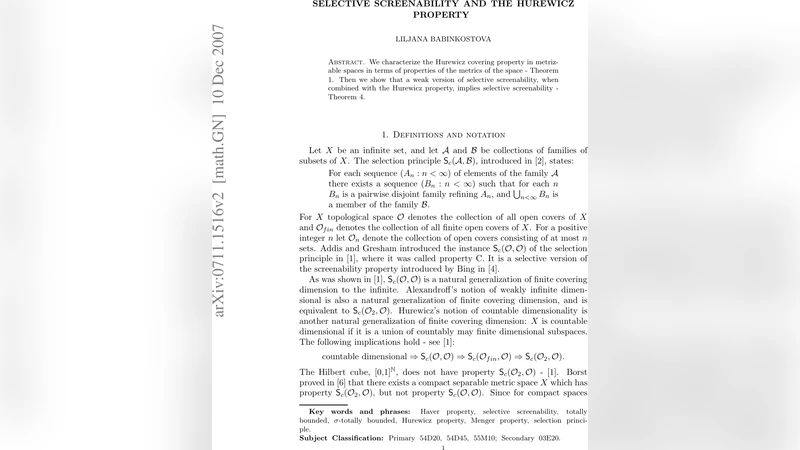
We characterize the Hurewicz covering property in metrizable spaces in terms of properties of the metrics of the space. Then we show that a weak version of selective screenability, when combined with the Hurewicz property, implies selective screenability.
💡 Research Summary
The paper investigates the interplay between two classical selective covering properties—selective screenability (SC) and the Hurewicz property (H)—within the framework of metrizable spaces, and it establishes a new bridge between them by means of metric‑based characterizations. The authors begin by recalling the standard game‑theoretic definitions: SC corresponds to the ability of player ONE to, for every open cover, select two disjoint families whose union refines the original cover, while H is equivalent to the selection principle (U_{\mathrm{fin}}(\mathcal O,\Gamma)), i.e., from each sequence of open covers one can pick finite subfamilies whose unions form a (\gamma)-cover.
The first major contribution is a metric characterization of H. For a metric space ((X,d)) and any (\varepsilon>0), consider the family (\mathcal U_\varepsilon) of all open (\varepsilon)-balls. The authors prove that (X) has the Hurewicz property if and only if for every (\varepsilon>0) there exists a sequence of finite subfamilies ({ \mathcal F_n^\varepsilon}{n\in\mathbb N}\subseteq\mathcal U\varepsilon) such that (i) each (\mathcal F_n^\varepsilon) is a finite (\varepsilon)-network, (ii) the union (\bigcup_n\mathcal F_n^\varepsilon) is a (\gamma)-cover, and (iii) the diameters of the selected balls tend to zero as (n\to\infty). The proof hinges on constructing (\varepsilon)-disjoint families and exploiting the fact that in a metric space one can refine any open cover by a uniformly bounded family of balls. This result translates the abstract selection principle into a concrete condition on the metric, making it easier to verify H in concrete examples such as (\mathbb R), Cantor space, or various function spaces.
Next, the authors introduce a weakened version of selective screenability, called weak SC. Instead of demanding two disjoint refinements for every open cover, weak SC only requires that for each open cover (\mathcal U) there exists a sequence of finite selections ({ \mathcal V_n}{n\in\mathbb N}) with the property that every point of (X) belongs to infinitely many (\bigcup\mathcal V_n). In game‑theoretic language, this corresponds to a winning strategy for ONE in the game (G{\mathrm{fin}}(\mathcal O,\mathcal O)) that also guarantees the “infinitely often” condition typical of (\gamma)-covers.
The central theorem of the paper states that if a metrizable space (X) possesses both the Hurewicz property and weak SC, then it actually satisfies full selective screenability. The proof proceeds in two stages. First, using H, the authors extract from any given open cover a sequence of increasingly fine (\gamma)-covers. Second, they show how the infinite‑occurrence condition supplied by weak SC can be refined, via a diagonalisation argument, into two disjoint families whose union still refines the original cover. This diagonalisation essentially converts a strategy for (G_{\mathrm{fin}}(\mathcal O,\mathcal O)) into a strategy for (G_{\mathrm{fin}}(\mathcal O,\Gamma)), thereby upgrading weak SC to SC.
To illustrate the sharpness of the result, the paper presents several examples. The real line (\mathbb R) with its usual metric satisfies H, weak SC, and consequently SC. In contrast, the classical Baire space (\mathbb N^\mathbb N) (with the product topology) is Hurewicz but fails weak SC, and thus does not enjoy SC. Moreover, the authors discuss a non‑metrizable example—a certain modification of the Sorgenfrey line—where H holds but weak SC fails, again showing that the additional hypothesis is essential.
Finally, the authors place their findings in the broader context of selection principles. They argue that the Hurewicz property acts as a “strengthening catalyst” for weak selective screenability, collapsing the hierarchy between (U_{\mathrm{fin}}(\mathcal O,\Gamma)) and (S_{\mathrm{fin}}(\mathcal O,\mathcal O)) in the presence of metric structure. They suggest several directions for future research: extending the metric characterization of H to uniform spaces, investigating analogous results for other selection principles such as Menger’s or Rothberger’s, and exploring the role of weak SC in spaces lacking a compatible metric. The paper thus not only resolves a specific open question about the relationship between H and SC but also opens a pathway for a systematic study of how metric refinements can mediate between different selective covering properties.
Comments & Academic Discussion
Loading comments...
Leave a Comment