📝 Original Info
- Title: The cycle problem: an intriguing periodicity to the zeros of the Riemann zeta function
- ArXiv ID: 0712.0934
- Date: 2007-12-07
- Authors: Researchers from original ArXiv paper
📝 Abstract
Summing the values of the real portion of the logarithmic integral of n^rho, where rho is one of a consecutive series of zeros of the Riemann zeta function, reveals an unexpected periodicity to the sum. This is the cycle problem.
💡 Deep Analysis
Deep Dive into The cycle problem: an intriguing periodicity to the zeros of the Riemann zeta function.
Summing the values of the real portion of the logarithmic integral of n^rho, where rho is one of a consecutive series of zeros of the Riemann zeta function, reveals an unexpected periodicity to the sum. This is the cycle problem.
📄 Full Content
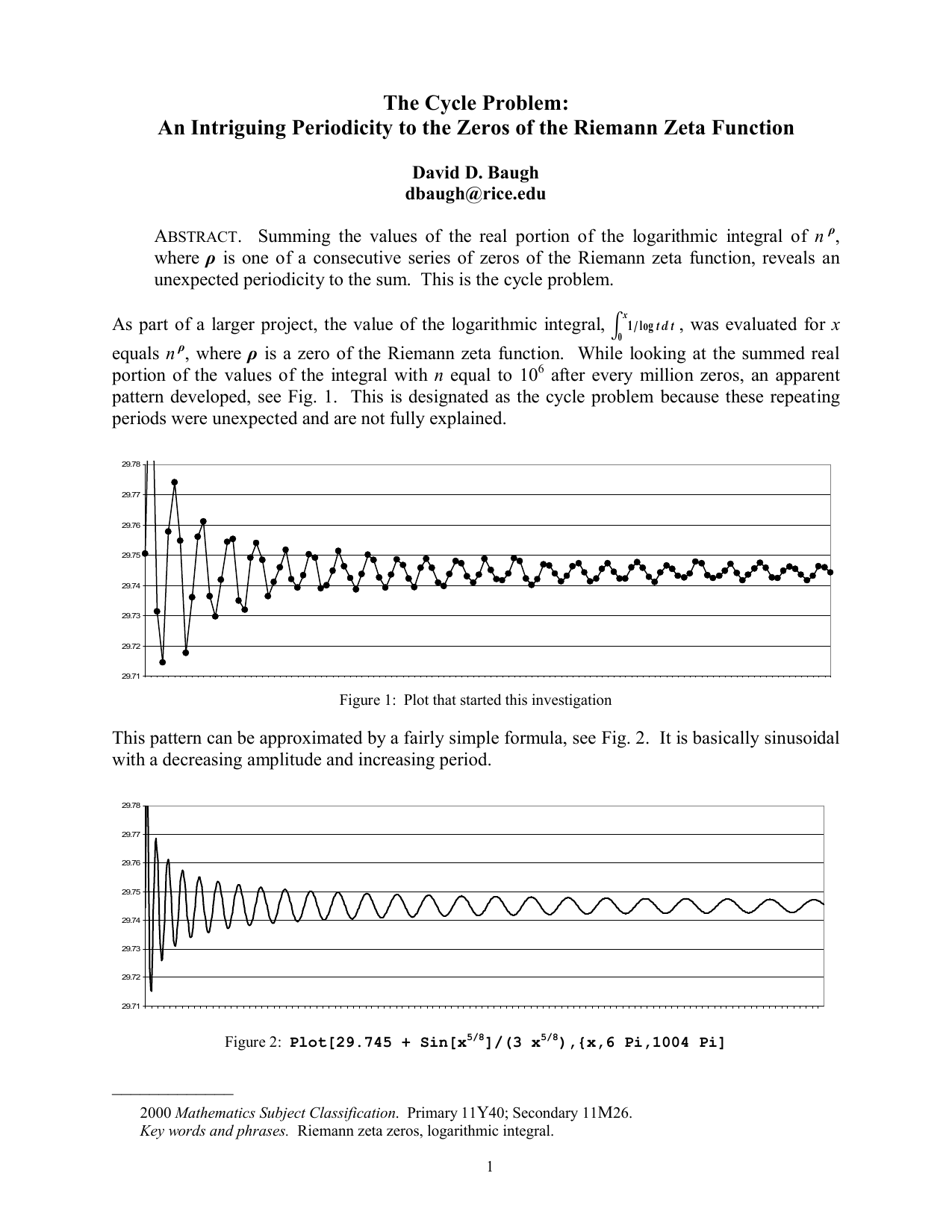
1 log t t , was evaluated for x equals n ρ , where ρ is a zero of the Riemann zeta function. While looking at the summed real portion of the values of the integral with n equal to 10 6 after every million zeros, an apparent pattern developed, see Fig. 1. This is designated as the cycle problem because these repeating periods were unexpected and are not fully explained. In exploring this phenomenon in detail for smaller values of n, it was discovered that the pattern can be much more complex than a simple sine wave. This example uses an n of 1295 and the first 30,000 Riemann zeta zeros, see Fig. 3. It should be noted that summing the imaginary portion does produce an obvious pattern for this value, see Fig. 5.
Figure 5: Accumulated imaginary portion using 30,000 zeros and n = 1302
In every case the values are bounded by a narrowing envelope. This is due to a feature of the logarithmic integral for n raised to a complex power. When plotted for some value of n, here the number 12, it produces a spiral approaching π i. The values produced using the first 20 Riemann zeta zeros are represented as large dots along this zoom of the spiral, see Fig. 6. Plotting these points as a cumulative sum generates an even more unexpected pattern, see Fig. 8. For a pattern such as the one in Fig. 3 to occur requires a remarkable coincidental distribution of these dots given that their position on the spiral is determined by the zeros of the Riemann zeta function, see Fig. 9. Riemann referred to the function being investigated as the “periodic terms” (1) of the Riemann prime counting function. His use of the term periodic meant only that the individual values oscillated between positive and negative. He was not implying the periodicity observed here.
The cycle problem suggests that there is a readily discernable periodicity to the zeros of the Riemann zeta function. This information is presented for discussion in the hope that better minds will discover the underlying explanation for the patterns observed even if it is something that should have been obvious to the researcher.
📸 Image Gallery
Reference
This content is AI-processed based on ArXiv data.