A Common View on Strong, Uniform, and Other Notions of Equivalence in Answer-Set Programming
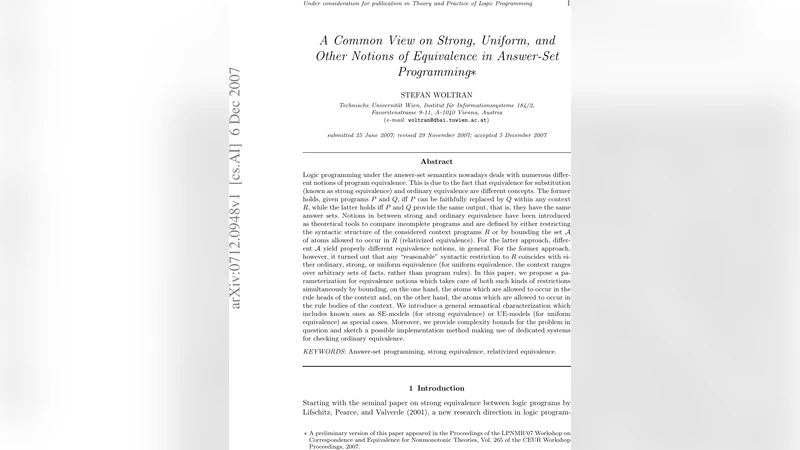
Logic programming under the answer-set semantics nowadays deals with numerous different notions of program equivalence. This is due to the fact that equivalence for substitution (known as strong equivalence) and ordinary equivalence are different concepts. The former holds, given programs P and Q, iff P can be faithfully replaced by Q within any context R, while the latter holds iff P and Q provide the same output, that is, they have the same answer sets. Notions in between strong and ordinary equivalence have been introduced as theoretical tools to compare incomplete programs and are defined by either restricting the syntactic structure of the considered context programs R or by bounding the set A of atoms allowed to occur in R (relativized equivalence).For the latter approach, different A yield properly different equivalence notions, in general. For the former approach, however, it turned out that any ``reasonable’’ syntactic restriction to R coincides with either ordinary, strong, or uniform equivalence. In this paper, we propose a parameterization for equivalence notions which takes care of both such kinds of restrictions simultaneously by bounding, on the one hand, the atoms which are allowed to occur in the rule heads of the context and, on the other hand, the atoms which are allowed to occur in the rule bodies of the context. We introduce a general semantical characterization which includes known ones as SE-models (for strong equivalence) or UE-models (for uniform equivalence) as special cases. Moreover,we provide complexity bounds for the problem in question and sketch a possible implementation method. To appear in Theory and Practice of Logic Programming (TPLP).
💡 Research Summary
The paper addresses the proliferation of equivalence notions in answer‑set programming (ASP) that have emerged because strong equivalence (equivalence under any context) and ordinary equivalence (identical answer sets) are fundamentally different. Between these extremes lie several intermediate concepts, most notably uniform equivalence (equivalence under contexts consisting only of facts) and relativized equivalence, where the set of atoms that may appear in the context is restricted. Existing research shows that any “reasonable” syntactic restriction on the context program R collapses to either ordinary, strong, or uniform equivalence, while different choices of the atom set A in relativized equivalence genuinely yield distinct notions.
The authors propose a unified parameterisation that simultaneously controls two orthogonal aspects of the context: the atoms allowed to appear in rule heads and the atoms allowed to appear in rule bodies. Formally, a pair of sets (H, B) is fixed; a context R is admissible iff every rule in R has its head atoms drawn from H and its body atoms drawn from B. This (H, B)‑parameterisation subsumes earlier approaches: setting H = All and B = All recovers strong equivalence; H = ∅ and B = All yields uniform equivalence; fixing only one component reproduces the various relativised notions studied before. By allowing both components to be chosen independently, the framework can express a continuum of equivalence relations that were previously inaccessible.
To give a semantic characterisation, the paper introduces (H, B)-SE‑models. A pair (X, Y) of interpretations is an (H, B)-SE‑model of a program P if (i) X ⊆ Y, (ii) Y satisfies P, and (iii) for every rule r whose head atoms belong to H and whose body atoms belong to B, if the body of r is satisfied by X then the head is satisfied by Y. Two programs are (H, B)-equivalent exactly when they have the same set of (H, B)-SE‑models. When (H, B) is instantiated to the special cases mentioned above, the definition collapses to the familiar SE‑models for strong equivalence and UE‑models for uniform equivalence, thereby proving that the new characterisation truly generalises the known ones.
The complexity analysis shows that the decision problem “are P and Q (H, B)-equivalent?” is coNP‑complete in the general case, matching the known complexity of strong and uniform equivalence. However, when H or B is restricted to a proper subset of the atom universe, the problem can climb to Σ₂^P‑completeness, reflecting the additional quantifier alternation introduced by the asymmetric restrictions on heads and bodies. The authors provide detailed reductions both from known hard problems and to standard ASP reasoning tasks, establishing tight bounds for all relevant parameter configurations.
On the implementation side, the authors sketch a translation of (H, B)-equivalence checking into propositional SAT (or SMT) by encoding the (H, B)-SE‑model conditions as constraints. Existing ASP solvers can be leveraged to generate the base program’s models, while the head/body restrictions are enforced by auxiliary variables that guard the inclusion of atoms in H or B. This modular approach means that a prototype tool can be built on top of current ASP systems with relatively modest engineering effort. The paper also outlines experimental scenarios where such a tool would be valuable, for instance in modular program development, program optimisation, and verification of program updates under specific deployment constraints.
In summary, the contribution of the paper is threefold: (1) a novel, highly expressive parameterisation of context restrictions that unifies strong, uniform, and relativised equivalence notions; (2) a clean semantic characterisation via (H, B)-SE‑models that subsumes earlier model‑theoretic frameworks; and (3) a thorough complexity analysis together with a practical roadmap for implementation. By bridging the gap between syntactic restrictions on contexts and atom‑based relativisation, the work provides a powerful theoretical tool for ASP researchers and a promising foundation for future tooling that supports fine‑grained program equivalence checking in real‑world applications.
Comments & Academic Discussion
Loading comments...
Leave a Comment